





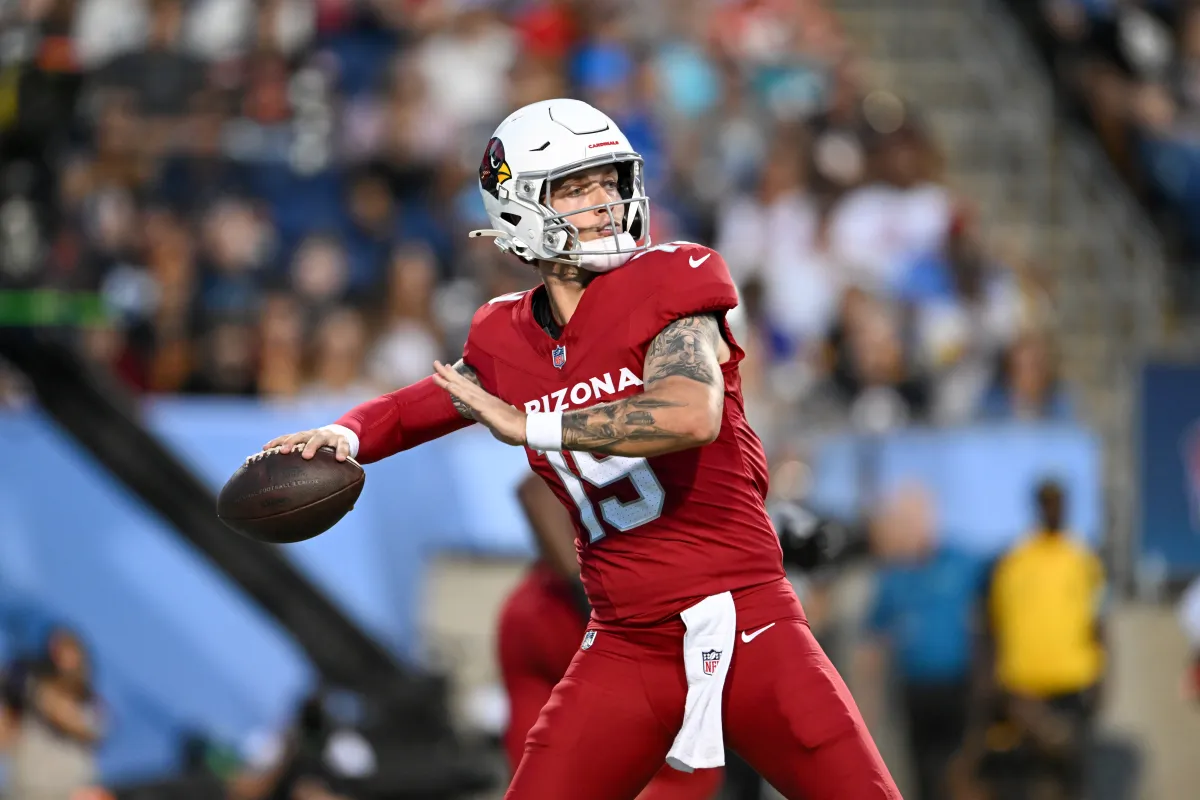
It was a moment that felt like a glimpse into tomorrow, a perfect August night when the Hall of Fame Game gave football fans something genuinely exciting to talk about. The two rookies under center, Haynes King of the Carolina Panthers and Carson Beck of the Arizona Cardinals, made their preseason debuts feel less like a warm-up act and more like a coming-out party. Beck, in particular, was electric. He completed 15 of 19 passes for 188 yards and a touchdown, numbers that looked even better when you consider the poise and precision he showed against live competition. His passer rating of 125.4 was excellent, but what really stood out was the way he moved the offense, made quick reads, and looked entirely unbothered by the speed of the pro game. For a third-round pick, this was exactly the kind of performance that makes fans dream and makes coaching staffs take notice. It wasn’t just a stat line; it was a statement. And for a franchise that has spent the past several seasons trying to figure out its long-term answer at quarterback, Beck’s debut offered a tantalizing possibility: maybe, just maybe, the future had already arrived.
But the football gods, as they often do, had other plans. On Thursday, just days after that impressive showing, Beck was suddenly sidelined, ruled out of Arizona’s preseason matchup against the Las Vegas Raiders. The culprit was a rib injury, sustained during the very game in which he had looked so sharp. Ian Rapoport of NFL Network broke the news, and while the injury was described as not serious, the team decided to exercise caution. Beck had practiced through soreness all week, showing the kind of toughness that coaches love, but the medical staff and front office ultimately made the call to keep him out. It wasn’t a panic move, and there was no long-term alarm, but it was a reminder that the preseason is a delicate balancing act between development and protection. For a young quarterback, every snap matters, and losing one opportunity to play—even a meaningless exhibition game—can feel like a small setback. Still, the decision to hold him out speaks to a larger strategy. The Cardinals are thinking big picture, protecting their investment, and ensuring that Beck’s promising momentum doesn’t get derailed by an avoidable aggravation of an already sore rib. It’s the kind of prudent move that doesn’t make headlines but often quietly shapes a season.
What made Beck’s absence even more intriguing was the quarterback situation he was walking into. The Cardinals had already announced days earlier that veteran Jacoby Brissett would get the start on Thursday, a decision that seemed to promise Beck some action later in the game. With Brissett likely to play the first quarter or so, the expectation was that Beck would take over from there and continue building on his strong debut. That plan evaporated the moment the injury report came out. But the underlying reality remains: Beck is in a fascinating position, one that is both comfortable and competitive. Unlike many rookie quarterbacks who are thrust into the spotlight by default, Beck gets the luxury of time. He was selected in the early third round, a pick that signals potential but not necessarily immediate succession. The franchise has been in the post-Kyler Murray era, and while that transition has been rocky at times, there is no desperate mandate to play the kid right away. Brissett is on a one-year deal, a short-term bridge at best. That arrangement gives the Cardinals flexibility and gives Beck a rare opportunity to develop without the weight of an entire franchise resting on his shoulders.
Then there’s the Brissett question, and it’s a fascinating one. On paper, he’s a perfectly capable quarterback. When he stepped in for an injured Murray last season, he put up solid numbers—3,336 passing yards, 23 touchdowns, and just eight interceptions. His 94.1 passer rating was respectable, even commendable, especially considering the circumstances he was thrown into. But here’s the thing about football: numbers don’t always tell the whole story, and wins are the ultimate currency. During Brissett’s tenure as the starter, the Cardinals went 1-11. That’s not a typo. Eleven losses in twelve games. Some of that had to do with the roster around him, the coaching instability, and the sheer bad luck that plagued the team. But at the end of the day, quarterbacks are judged by their record, fair or not. Brissett might be steady, experienced, and reliable in the huddle, but 1-11 is the kind of record that makes a front office twitchy and makes head coaches start looking over their shoulders. It’s also the kind of record that creates opportunity for a young player waiting in the wings. If the Cardinals stumble out of the gate this season, if Brissett struggles to generate wins early on, the public pressure to see what Beck can do will grow louder and louder.
New head coach Mike LaFleur has not been shy about his quarterback acumen, and he understands that the future of the franchise might already be in his building. LaFleur came to Arizona with a reputation for offensive creativity and a willingness to mold his system around the strengths of his quarterback. That kind of coach is uniquely positioned to develop a rookie like Beck, especially one who has already shown flashes of elite anticipation and arm talent. Beck’s college career was marked by steady improvement, and his NFL debut suggested that the transition to the pros might not be as steep as some feared. But LaFleur also knows the importance of patience. Throwing a young quarterback into a losing environment too early can do more harm than good. The key is reading the situation, weighing development against desperation, and deciding when the time is right. If Brissett starts losing games and the season starts to slip away, the calculus changes. At that point, the team is no longer just trying to win games; it’s trying to evaluate its next franchise cornerstone. Beck’s continued health, his progress in practice, and his ability to absorb LaFleur’s offense will all factor into that decision. The rib injury, while a temporary hiccup, is also a test—one that Beck can pass by returning quickly and continuing to impress.
In the end, the bigger picture here is one of possibility, timing, and the strange alchemy of NFL quarterback development. Beck’s absence on Thursday is not a disaster; it’s a precaution. His showing in the Hall of Fame Game remains a tantalizing preview, and the Cardinals’ coaching staff will be eager to get him back on the field as soon as he’s medically cleared. Meanwhile, Brissett carries the ledger of a veteran who has seen it all—a guy who can keep the ship afloat but perhaps not steer it into uncharted waters. And LaFleur, the steady hand at the helm, must navigate the tricky currents of a rebuild while keeping his young quarterback ready. For fans, the storyline is irresistible. A rookie with promise, a veteran with a losing record, and a coach with a vision. It’s the kind of narrative that defines NFL seasons, the quiet storylines that simmer beneath the surface before boiling over in dramatic fashion. Beck may not be the starter today, but the door is wide open for tomorrow. All he has to do is heal, stay patient, and keep showing why his debut felt like the start of something real. The preseason game against the Raiders would have been another chapter, but the book is still being written, and the best parts are likely still ahead.