




Paragraph 1: The Weight of Expectation and the First Shadow of Doubt
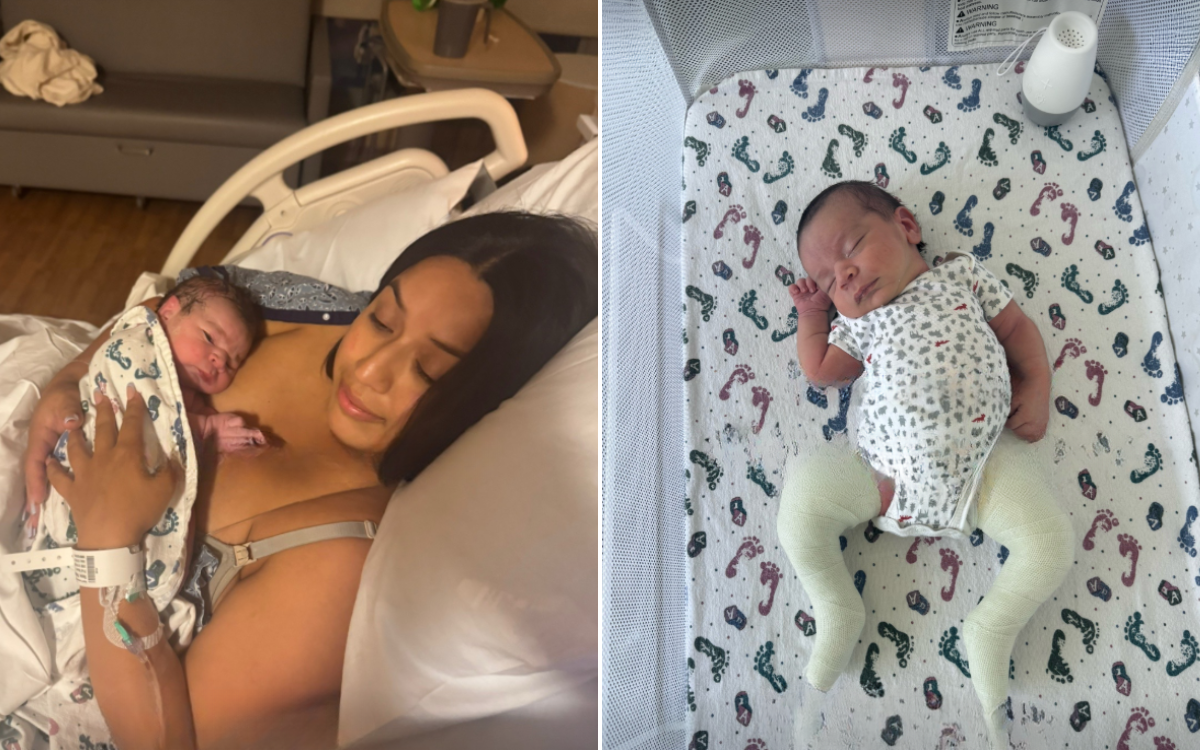
Motherhood is a landscape painted in extremes—the blinding brightness of a newborn’s cry, the bone-deep exhaustion of sleepless nights, and an undercurrent of fear that no manual can truly prepare you for. For Michelle Reyes, a mother of three from the sun-soaked city of Buena Park, California, that undercurrent became a roaring tide long before her third child ever took his first breath. Her pregnancy with Tommy was markedly different from the first two; it wasn’t a matter of mild discomfort, but a profound physical struggle. Simple, occupational tasks like standing for a shift at work became logistical feats, requiring her to request a chair just to maintain her composure against the gravitational pull of fatigue that seemed to sap every ounce of her strength. The doctors ran their batteries of tests, peered at the black-and-white sonograms, and offered only clean reports, reinforcing the placid narrative of a typical, healthy pregnancy. There was no red flag, no urgent phone call, no hint of the anomaly forming in the silent, watery world of the womb. As far as Reyes knew, she was walking toward a standard delivery room scenario, arms open to receive a perfect, uncomplicated boy. But the moment he emerged into the harsh glare of the delivery room lights, that illusion shattered. She saw it instantly, with the clarity of a lightning strike: his feet, both of them, turned inward with a severe, almost unnatural twist. The nurses, with their practiced and placid smiles, dismissed it as a byproduct of cramped womb-living, assuring her that babies often contorted themselves into strange positions. Yet, a mother’s intuition is a stubborn compass, and Reyes felt a knot of uncertainty tighten in her chest, knowing that this sight was far too pronounced to be a mere quirk of fetal positioning. Her body had already braved the war of childbirth, but the real battle for her son’s future, it seemed, was only just beginning.
Paragraph 2: The Verdict That Reshaped the World
The reassurance offered in the delivery room was a fragile shield, one that a visiting specialist dispelled just days later while Reyes was still finding her footing in the hospital’s sterile recovery suite. With the clinical gravity of a diagnosis being delivered over glowing X-rays, the doctor spoke two words that would forever etch themselves into her memory: bilateral clubfoot. It was a term that felt archaic, almost Victorian in its connotations, yet it described a very modern and tangible reality. Her son, her tiny, fierce fighter, had been born with a condition where both feet twisted downward and inward, a structural defect that, according to the Centers for Disease Control and Prevention, affects roughly one in every 1,000 newborns in the United States, with both feet involved in roughly half of those cases. The shock was not just in the word itself, but in the sudden collision of a normal pregnancy with an extraordinary outcome. Reyes felt the world wobble beneath her, the solid ground of her expectations giving way. The very strangeness of the situation was compounded by a bizarre premonition: just weeks before, she had mindlessly scrolled past a social media video featuring a baby with clubfoot, dismissing it as an obscure rarity. Now, that rarity had taken up residence in her hospital bassinet. In the quiet aftermath of the pronouncement, the most devastating question rose to the surface of her consciousness—a question that has haunted mothers since the dawn of time: What did I do wrong? She began a mental autopsy of her pregnancy, dissecting every misstep, every moment of fatigue, every dietary choice, wondering if she had somehow caused this. Her doctor, however, was a bastion of clear-sighted rationality, gently dismantling her guilt. The truth, he explained, was that clubfoot is rarely a consequence of maternal action; it is a twist of developmental fate, a mystery of genetics and formation that occurs in the womb for reasons largely unknown. It was a hard pill to swallow, this lack of a target for her blame, but it was the first step toward acceptance, and the first step toward the grueling road of correction that lay ahead.
Paragraph 3: The Forging in Plaster and Steel
The road to correction began with remarkable speed, as if the medical world was in a hurry to right a wrong that had occurred in the dark. At just six days old, a time when most babies are still learning the rhythm of breathing and feeding outside the womb, Tommy was introduced to the world of pediatric orthopedics. The treatment protocol, known as the Ponseti method, is a dance of manipulation and casting, and it started with heavy, unforgiving fiberglass encasing his tiny limbs from the tops of his thighs all the way down to the very tips of his toes. Reyes watched, her heart a warring mix of hope and sorrow, as her newborn was swaddled in plaster, making him look less like a baby and more like a tiny, stationary statue. The routine became a bi-weekly pilgrimage; they would pack up the car, navigate the traffic, and present themselves at the clinic where the old casts would be sawed off, the twisted feet gently manipulated into slightly straighter angles, and fresh casts applied to hold that new position. It was a relentless, mechanical process that rewrote the definition of normalcy for their household. After five rounds of this casting gauntlet, the next milestone arrived in the form of an Achilles tenotomy—a minor but deeply symbolic surgical procedure where the tight tendon at the back of Tommy’s ankle was snipped to grant the foot a greater range of motion. He was fitted with one final, triumphant cast before the plaster came off entirely. What awaited him then was not freedom, but a new kind of harness: a special pair of tiny boots connected by a rigid metal bar that looked like a prop from a science fiction film. For the first six months of his life, this apparatus was his constant companion, required to stay attached to his body for 23 hours of every single day, leaving only a single, solitary hour of respite. Reyes and her husband became captives to the clock, counting the minutes until they could remove the bar, only to dread its imminent return, all while trying to soothe a baby whose legs were bound by necessity.
Paragraph 4: The Rhythm of the Bar and the Light of Progress
The transition from a life of 23-hour wear to a slightly more lenient 14-hour schedule felt like winning a marathon. The bar, which had once felt like an anchor dragging down Tommy’s movement, became a part of their nightly rhythm, clicked into place before bedtime and naps while he slept. Reyes learned the intricate choreography of managing a baby in boots—the careful way to hold him to avoid the clatter of the bar, the strategic placement of pillows to keep him comfortable, the hushed whispers of comfort as he protested the rigid confines during the night. It was a test of endurance not just for Tommy, but for the entire family unit, who had to plan their days around the relentless schedule of the brace. Yet, even amidst the exhaustion and the logistical nightmares, there was a profound beauty in the process. Reyes began to see the bar not as a punishment, but as a sculptor’s tool, slowly chiseling away at the deformity. Medical literature, such as the clinical study published in the Journal of Pediatric Orthopaedics, supports this brutal methodology, citing initial correction rates of 90 to 100 percent, with long-term success rates hovering around 93 percent when the full protocol is followed diligently. For Reyes, these statistics were not just numbers; they were the lifeline she clung to on the hard nights. She watched the daily progress with the awe of a scientist witnessing a miracle, marvelling at how his feet, once so severely twisted, were aligning, becoming recognizable, becoming functional. The pediatric orthopedist’s measurements became a source of quiet celebration, each degree of correction a victory in a war she never wanted to fight, but was now determined to win. Tommy was proving to be a warrior, and his resilience in the face of this metallic and plaster burden became a beacon that lit up the darkest corridors of his mother’s anxiety.
Paragraph 5: The Unfurling of a Normal Childhood
Despite the medical circus imposed upon his infant body, Tommy refused to be defined by his hardware. As the months wore on and the time in the bar gradually decreased, the true miracle of the treatment began to manifest. Reyes watched, her breath held in her throat, as her son began to move. He crawled, not with a limp or a drag, but with the normal, relentless forward propulsion of a baby exploring his world. He pulled himself up on furniture, his freshly corrected feet gripping the ground with a confidence that belied his turbulent start. He swims, splashing in the water with the unbridled joy of a child who has no concept of his own scars. The medical miseducation that had initially predicted a future of limited mobility was being rewritten in real-time by a toddler who just wanted to run after his siblings. For Reyes, this was the ultimate vindication. The fear that had gripped her when she first saw his turned feet—the terror that he would be left behind, that he would be unable to participate in the simple pleasures of childhood—melted away like frost under a morning sun. He is doing everything a baby his age should do, she notes, a statement so simple yet so monumental. The entire process, she reflects, has been amazing to watch; it is a testament to the brilliance of modern medicine and the extraordinary resilience of the human body. She sees such a huge improvement in his feet since he was born, but even more than that, she sees the spirit of her son, unbroken and undaunted. The pink scars on his heels and the faint memories of discomfort are invisible battle wounds, badges of honor worn by a boy who faced his first major challenge with a bravery that far surpasses his tender age.
Paragraph 6: A Legacy of Hope for the Road Ahead
Now, standing on the precipice of Tommy’s toddlerhood, Michelle Reyes has traded her anxiety for a mission. She wants her son to know his own story—not as a tale of suffering, but as a narrative of triumph. She wants him to remember, through her retelling, how brave he was through the relentless cycles of casting, through the sting of the tenotomy, and through the long, nightmarish nights strapped to a metal bar. She understands that his journey with clubfoot is not merely a medical footnote; it is a foundational stone in the building of his character. Most importantly, Reyes feels an overwhelming pull to turn her private ordeal into a public beacon for others. She wants to reach across the vast, isolating chasm that separates parents receiving a terrifying diagnosis, and offer them a hand. Her message is one of radical acceptance and profound hope: “It’s OK to be overwhelmed at first,” she says, acknowledging the torrent of fear and guilt that inevitably floods the heart. “But there is so much hope, and their baby can still grow up doing all the things they imagined for them.” In a world where birth defects are often whispered about, Reyes is choosing to shout, to normalize this experience, and to dismantle the stigma of imperfection. Her family’s journey is a living testament that a diagnosis is not a destiny, that a pair of boots and a bar can pave the way for a pair of sneakers running across a soccer field. As Tommy grows, he will carry his story with him—a story of a mother who refused to drown in blame, a team of doctors who corrected a twist of fate, and a boy who, from his very first days, taught everyone around him that the greatest growth often comes from the tightest casts. His feet, once a source of dread, are now a testament to his strength, and his future, once clouded by uncertainty, is as wide and open as the California sky above his home.