






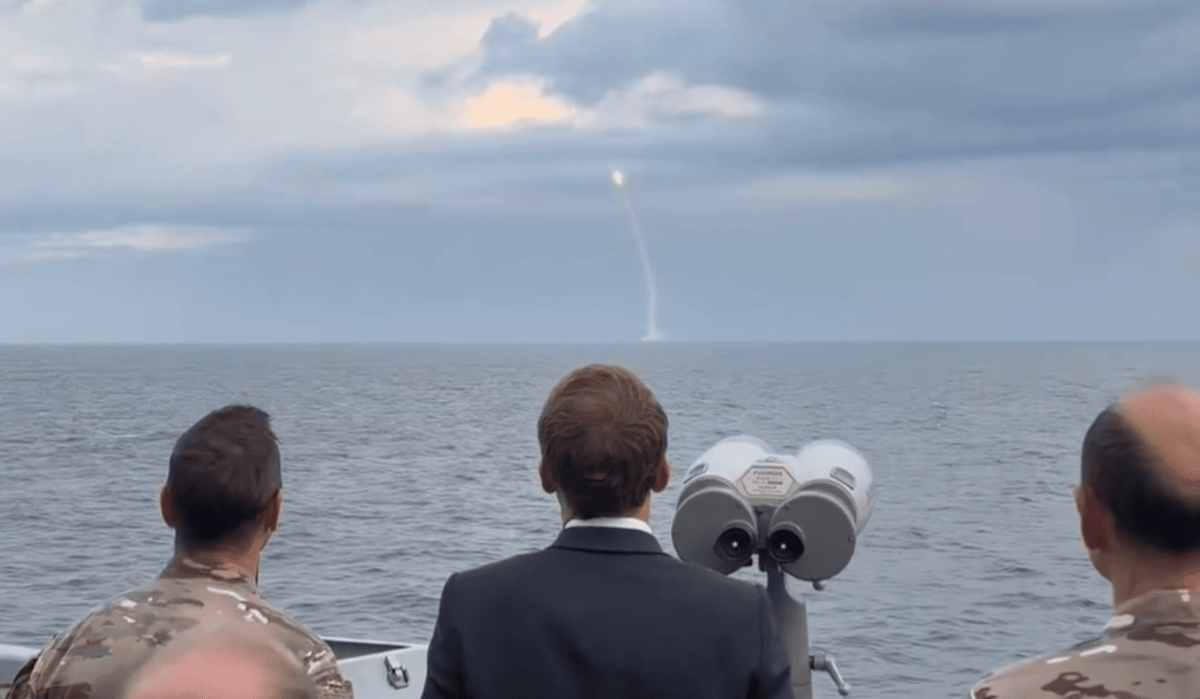
The Atlantic off the coast of Brittany, western France, was a steely grey in the cold winter light, its surface broken only by the wind and the restless movements of the sea. Beneath that deceptively calm expanse, hidden from satellite eyes and listening sensors, a vessel moved in silence. It was the Le Vigilant, one of France’s nuclear-powered ballistic missile submarines, a ship designed to be invisible, to wait, and to be ready. On Tuesday, aboard that submarine, a command was given, and the sea itself seemed to erupt as the M51.3 missile, an upgraded, nuclear-capable ballistic missile, broke through the surface in a roar of steam and fire. It climbed into the sky, carrying no nuclear warhead, but carrying something perhaps just as heavy: the weight of France’s promise to protect itself. For the crew, it was a moment of intense concentration, years of training, sleepless watches, and quiet sacrifice compressed into a few seconds of flame. For the French government, it was a message to the world. President Emmanuel Macron later called it a demonstration of credibility. But for ordinary people on shore, it was a reminder that beneath the ordinary rhythm of life, there are machines built to do terrible things, and men and women ready to operate them.
The M51.3 is not just another missile. It is the latest evolution of France’s M51 family, a long-range weapon designed to be launched from the depths of the ocean, far from home, and to strike targets thousands of miles away. This upgraded version incorporates improved guidance systems, greater range, and more advanced capabilities to penetrate enemy defenses, ensuring that France’s retaliatory forces cannot be neutralized by a surprise attack. The missile is the sharp tip of an enormous underwater spear: the French nuclear submarine fleet. The Le Vigilant, whose name means “the watchful one,” is one of these extraordinary vessels. It is powered by a nuclear reactor, which allows it to stay submerged for months at a time, surfacing only rarely. It carries a crew of more than one hundred sailors, many of them young, all of them bound by secrecy. They live in a world of steel and recycled air, far from sunlight and family. They do not know when or if they will ever fire their weapons. Their duty is simply to be there, invisible and ready, so that no enemy can ever think they can destroy France with impunity. Behind every announcement about nuclear deterrence, every geopolitical statement, there are these human beings: engineers checking valves, sonar operators listening to the sea, officers rehearsing launch procedures at three in the morning.
France holds a unique place in the world’s nuclear order. It is the only nuclear-armed state in the European Union, and it possesses an estimated 290 nuclear warheads, making it the fourth-largest nuclear arsenal on Earth. Unlike the United States and Britain, which also possess nuclear weapons, France has insisted for decades on maintaining an independent deterrent. This is not a technical choice but a deeply political and philosophical one. It dates back to President Charles de Gaulle, who argued that no nation, not even a close ally, would risk its own destruction to defend another. He believed that France must be able to stand alone, to hold its fate in its own hands, and that meant possessing its own ultimate weapon. This concept, known as the “force de frappe,” has shaped French defense policy ever since. For many French citizens, the nuclear arsenal is a source of national pride, a guarantor of sovereignty in a turbulent world. For others, it is a dangerous and expensive relic of a darker age. But there is no serious debate in Paris about giving it up. The submarines are always at sea, the missiles are always ready, and the republic maintains a permanent, silent presence beneath the waves.
The timing of this test is significant, and it is impossible to understand it without looking at the shadow that has fallen over Europe. Relations between France and Russia have deteriorated sharply, especially since the full-scale invasion of Ukraine and the accompanying threats from Moscow about the possible use of nuclear weapons. The world has returned to a language of deterrence that many had hoped was fading. In March, President Macron made an extraordinary announcement: France would increase its number of nuclear weapons for the first time in decades. For years, the trend had been toward reductions, arms control, and the slow shrinking of arsenals. Macron’s pledge reversed that logic. He argued that in a more dangerous world, France could no longer take its security for granted. The test of the M51.3 is a concrete step in that direction, a physical demonstration that France is not merely talking about expanding its arsenal but is actually modernizing and validating it. In a way, this missile launch was an act of reassurance for the French people and for Europe as a whole. But it was also a warning. France, the message reads, is watching, and it will not be intimidated.
France is not alone in this nuclear world. Across the globe, nine states are believed to possess nuclear weapons: the United States, Russia, China, France, the United Kingdom, India, Pakistan, North Korea, and Israel. France is one of three NATO members with nuclear weapons, but it is the only one whose arsenal is not part of NATO’s integrated command structure. This independence gives France both freedom and responsibility. When Macron says, as he did after the test, “This technical success is a new demonstration of the credibility of our deterrence,” he is using the precise language of nuclear strategy. Credibility is everything. A missile that fails in testing is not credible. A submarine that cannot be found is credible. A nation that is unwilling to use its weapons is not credible. The entire theory of deterrence rests on the idea that the threat of overwhelming retaliation is so certain and so awful that no rational leader would ever attack. That is why France tests its missiles, why submarines patrol the ocean, and why leaders speak in calm, measured tones about the possibility of nuclear annihilation. It is a strange paradox: to prevent a war, you must be ready to fight one. To avoid using nuclear weapons, you must convince the world that you are ready to use them.
In the end, this story is not only about a missile. It is about the human imagination, the fear of what may come, and the lengths we go to protect ourselves from it. The sailors aboard the Le Vigilant will return to port eventually, their mission complete, their secrets intact. They will see their families, hold their children, and go back to ordinary life. But they will know that somewhere, in the deep ocean, another submarine has already taken their place. The French government says this is a breaking story, and more details may emerge in the coming days. But the core reality is clear: France is arming itself for a more dangerous century. President Macron, who once seemed to dream of a more open and cooperative world, has become the steward of a new arms buildup. The M51.3 is a masterpiece of engineering, a symbol of human ingenuity and also of human dread. We can only hope that this weapon, and all the others like it around the world, will remain forever silent, locked in their launch tubes, waiting for a command that never comes. But if that command ever does come, France wants to be sure that the answer will be heard, and that the price of attacking the French republic will be too terrible for any enemy to pay. That is the true meaning of this test, and the quiet, unspoken hope of the men and women who made it possible.