




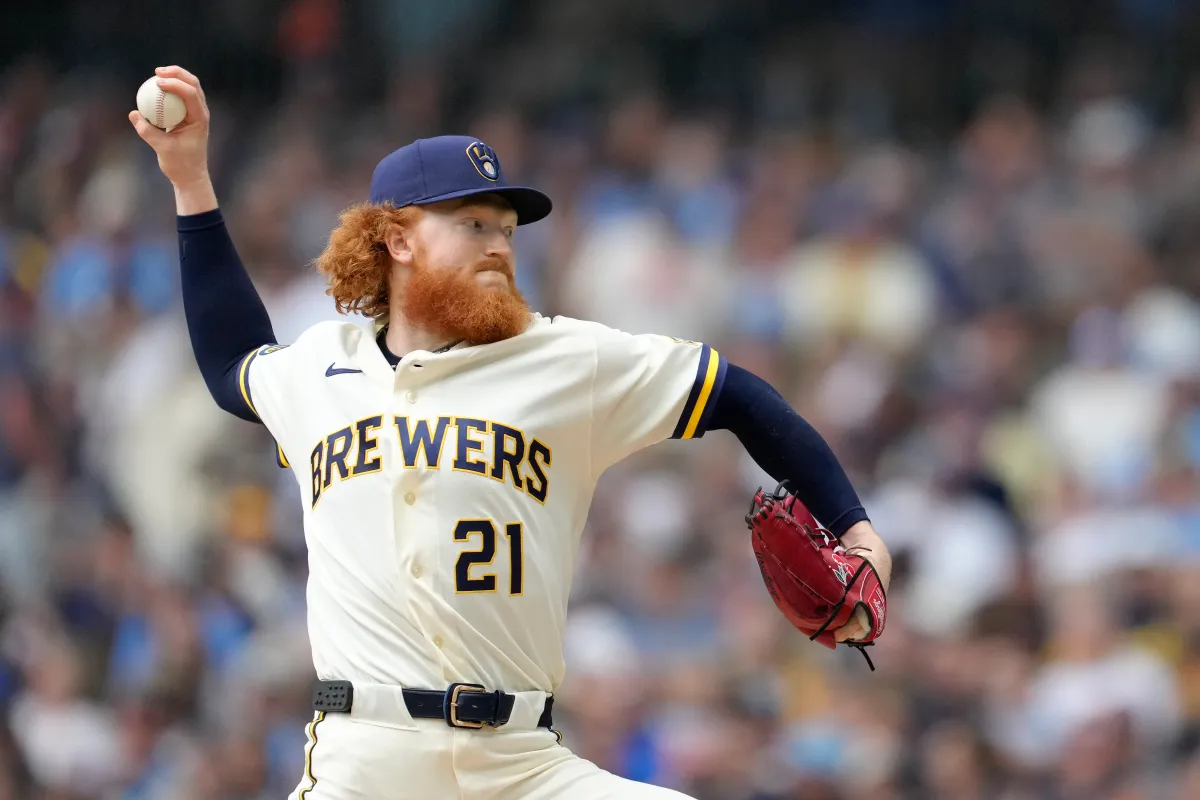
The late-August air was thick with humidity, carrying the familiar scents of freshly cut grass and roasted peanuts as the Milwaukee Brewers prepared to host the New York Mets under the bright stadium lights. The home crowd was buzzing with genuine excitement, not just for another regular-season game, but because their team was sitting atop the baseball world with the best record in the majors at 81-51. Every pitch felt meaningful as the calendar turned toward September and the promise of October baseball loomed large. On the mound, Dustin May was the picture of concentration. He had fought through a turbulent season to get to this point, battling back from prior setbacks and determined to be the reliable anchor the Brewers needed in their playoff rotation. As he toed the rubber, he felt the familiar pulse of adrenaline. His routine was meticulous—a deep breath, a look to the catcher, a glance at the base runners. But tonight, his very first pitch of the game would define his entire evening. He kicked his leg, drove his hips, and unleashed a signature 95.8 mph sinker, aiming for the low outside corner. The stadium’s noise died away as the ball left his hand, a split second that felt like an eternity. He had no idea that this singular throw would soon become the most terrifying, gut-wrenching moment of his professional career, one that would test his resilience and remind everyone in the ballpark how fragile a baseball player’s livelihood truly is.
The crack of the bat that followed was not the clean, satisfying sound of a solid base hit; it was a sharp, violent crack that sent a shudder through the crowd. A.J. Ewing, the Mets’ center fielder, had jumped all over the sinker, his timing perfect and his swing explosive. The baseball rocketed off his bat at a staggering 106 mph, a white-hot projectile that screamed directly back toward the mound. For May, there was no time to think, only the primal instinct to survive. He reacted with lightning reflexes, twisting his body slightly to the side, but the ball was simply too fast. It struck him squarely in the back, thudding against his shoulder blade with a sickening, meaty sound that seemed to echo through the now-silent stadium. The collective gasp from forty thousand fans was raw and immediate. Meanwhile, the baseball ricocheted off May’s body and trickled onto the infield grass. Third baseman David Hamilton, exhibiting remarkable composure under the tense circumstances, sprinted over, scooped up the ball with his bare hand, and fired a strike to first base, recording the out on Ewing. But the usual celebration of a defensive gem was entirely absent. Every player on the field froze, their eyes locked on their fallen teammate, who was now writhing in pain on the dirt, clutching his shoulder, his face a mask of agony. The game had halted, and time itself seemed to stand still as the gravity of the situation settled over everyone.
The trainer’s sprint onto the field was a blur of white jerseys and medical bags. May had collapsed to one knee, his face contorted into a grimace of pure, undeniable pain. He was struggling to breathe, each shallow inhalation seeming to require a monumental effort. The “Foul Territory” podcast later detailed on social media that the ball had caught his right shoulder, a fact confirmed by the way he instinctively clutched his upper back with his glove hand. There was a desperate, hopeful moment when May waved off the trainer, determined to prove his toughness. He got to his feet, took a few tentative steps, and attempted to throw a warm-up pitch. He raised his arm, but it dropped weakly; he shook his right hand as if trying to rid it of a stinging numbness between each toss. The pain was clearly radiating through his entire throwing side. Even breathing was painful, a deep, sharp ache that made him wince with every intake of air. He threw five pitches, then ten, each one a visible struggle filled with grimaces and deep sighs. Ultimately, he had to admit defeat. He shook his head slowly, a gesture of pure frustration, knowing his night was over before it had truly begun. As he walked off the mound, he pulled his hat down over his eyes, but the emotion was raw and visible. The crowd, having witnessed his brave and painful effort, rose to their feet in a thunderous ovation, a spontaneous tribute to his courage and his determination. Relief pitcher Robert Gasser jogged in from the bullpen, inheriting a mound that suddenly felt very lonely and heavy with worry.
Gasser took a deep breath and managed to work through the remainder of the inning, allowing the Mets to score a couple of runs but preventing a total collapse. The game continued, but the mood in the ballpark was decidedly subdued; the earlier joy of the night had been replaced by a palpable, anxious concern. The Associated Press’s Jerry Beach provided a sobering historical note: this marked the first time a starting pitcher had exited a game after just a single pitch since Pablo Lopez left a contest back on July 2, 2021. It was a stark reminder of the fragility of a baseball player’s body and the thin line between glory and disaster. In the press box, sportswriters were frantically working the phones, trying to piece together the early reports. Zach Braziller of the New York Post was among them, diligently gathering information. The initial fear was catastrophic—a broken clavicle, a separated shoulder, or worse, a nerve injury. The waiting was the worst part, as fans and players alike held their breath for the results of the X-rays. The Brewers’ medical staff rushed May to the clubhouse, where they conducted a series of imaging tests to assess the damage. The silence in the dugout was telling; veterans stood quietly, staring into the distance, remembering the sickening thud of the ball against bone and the sight of their teammate’s pain.
When the news finally arrived, it was greeted with a collective sigh of relief throughout the organization and the fanbase. Zach Braziller reported that May was not believed to have suffered a significant structural injury. The Brewers’ team doctors revealed the official diagnosis: a right scapula contusion—a deep, painful bruise of the shoulder blade. The X-rays came back negative, meaning there was no fracture and no broken bones. It was the absolute best-case scenario given the terrifying nature of the incident, yet it still didn’t diminish the reality of the physical pain he was enduring. A 106 mph line drive leaves a mark, and May would be dealing with significant discomfort for the foreseeable future. The scapula is a crucial component of the throwing motion, stabilizing the shoulder and generating power. Even without a break, the bruise would likely form a large, angry knot, and the inflammation would severely restrict his mobility and range of motion. He would need extensive treatment—ice baths, anti-inflammatory medication, and gradual rehabilitation to rebuild his strength and flexibility. The question on everyone’s mind was no longer if he would recover, but when. Could he be back in time for the postseason? The answer was uncertain, but the resilience of the human body and the sheer determination of a professional athlete should never be underestimated. For now, he would rest, letting the deep tissue heal, hoping that this scare would not derail his season.
As the night wore on and the game faded into the background, the bigger picture came into sharp focus. The Brewers, even with this scare, remain a dominant force in baseball, sitting pretty at 81-51 as of Wednesday evening, the best record in the majors. They have a comfortable cushion in their division, which grants them the luxury of time and the ability to be cautious with their prized pitcher. May would be wise to use the remainder of August and the beginning of September to fully recover, to let that scapula heal completely before attempting to ramp his throwing back up to game speed. The ultimate goal is not a meaningless start in mid-September, but a fully operational, healthy pitcher for the grueling stretch run and the relentless intensity of the World Series chase. The team’s eyes are set squarely on October, on hoisting the championship trophy. This incident serves as a stark reminder of the danger that lurks on every pitch, a split-second where a ball traveling at over 100 mph can change everything. For Dustin May, it was a brush with real danger, a sudden, violent interruption of a promising season. Yet, it also revealed the strong support system around him—the fans who cheered his courage, the teammates who rallied together, and the medical staff who acted with precision. Baseball is a brutal, beautiful game, where a single pitch can bring both triumph and terror. But it is also a game of comebacks and redemption. As May heads toward a period of rest and recovery, one thing is clear: he will be back, stronger and more determined than ever, ready to help the Brewers finish what they started this October.