


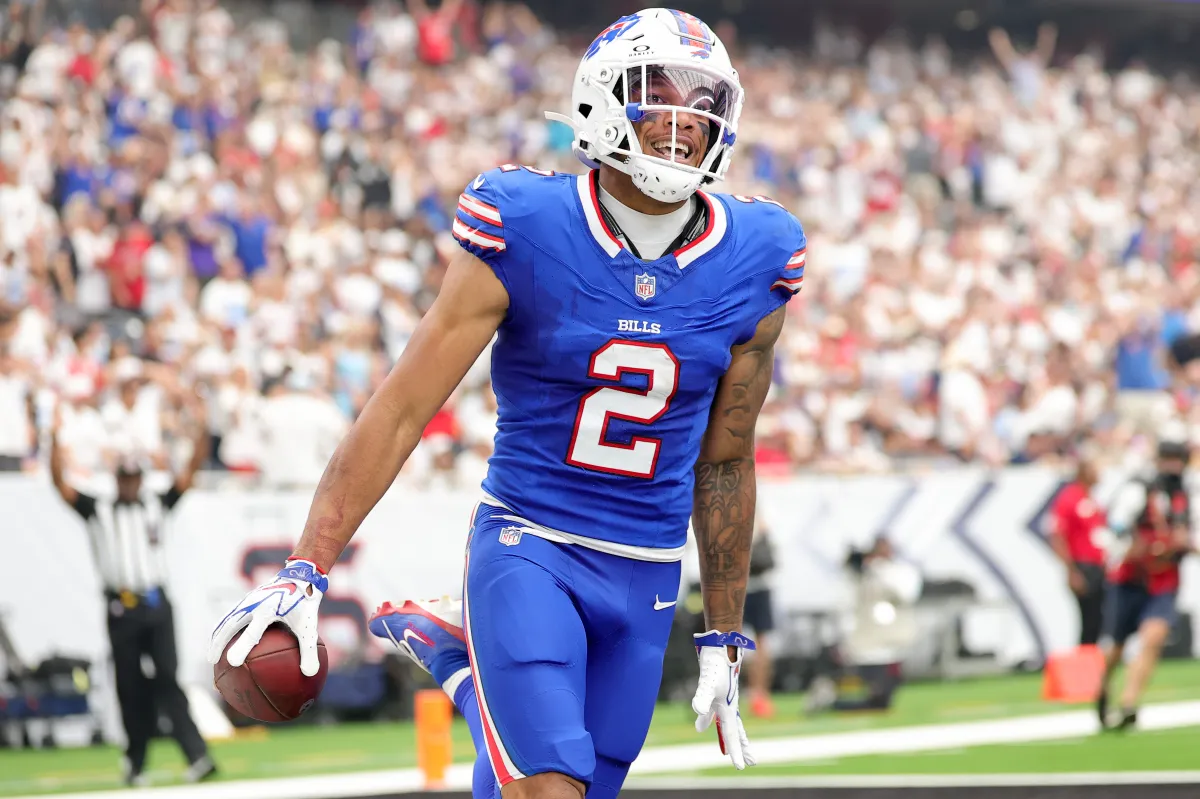
The lights were bright, the stakes were high, and Thursday night in Buffalo turned into something close to a fireworks factory. The Bills and the Lions traded explosive drives like two fighters who refused to let the other breathe, and by the time the clock hit zero, Buffalo had rolled up six touchdowns in a 41-31 victory that felt more like a statement than a regular season win. There were deep shots downfield, short-yardage battles in the trenches, and enough offensive firepower to make an entire television audience sit up a little straighter. But even in the middle of all that celebration, there was a moment that cut through the noise. DJ Moore, one of the wide receivers who came to Buffalo with a big story and an even bigger chip on his shoulder, dove for a touchdown catch in the second quarter and came down on his shoulder wrong. For a fraction of a second, the game seemed to pause. Moore stayed on the turf a little longer than anyone wanted, and when he finally got up, it was clear that something wasn’t right. By halftime, the news had made its way through the stadium and into living rooms around the country: he was ruled out for the rest of the night. The Bills would go on to win, the offense would keep humming, and the highlight reels would be full of brilliant catches and bruising runs. But for the people who care about the players behind the jerseys, the image of Moore walking to the sideline with his shoulder hanging loosely was the one that lingered.
The official word came from Ian Rapoport of the NFL Network, who confirmed that Moore was ruled out due to a shoulder injury. It was the kind of report that sounds dry and clinical, but the reality behind it was anything but. Moore had no receptions in that contest. Not one. He was credited with a single rushing attempt, and it went for minus one yard. For a receiver, there is no stat line more empty than that. It looks like a typo, or a bad dream, or the kind of night that makes a player wonder if the whole world noticed him disappear. But the people who watched Week 1 knew exactly what Buffalo was missing. In the season opener, in a 36-21 win over the Houston Texans, Moore looked like the exact kind of playmaker the front office hoped he would be. He caught five passes for exactly 100 yards and added a touchdown to his account, proving that he could stretch the field, win contested catches, and create the kind of chemistry with Josh Allen that takes most receiving corps years to build. That performance was why the trade made sense. Buffalo had sent a second-round pick to the Chicago Bears in exchange for Moore and a fifth-round pick, and moves like that are always scrutinized until the player proves they were worth it. Moore proved it. And then Thursday night happened, and one awkward landing in the second quarter turned a breakthrough story into an injury watch. It is a brutal reminder of how thin the margin is between a season-defining moment and a shoulder that changes your entire month.
After the game, Bills head coach Joe Brady made it clear that Moore’s presence mattered even when the stat sheet couldn’t measure it. “Yeah, I mean, you see there’s a reason we brought him here and the ability that he can make plays down the field,” Brady said. He continued, “And look, we had a PI that’s not even going to show up in the stat book, right? But that’s another added bonus, right?” It was a fascinating quote because it pointed to something most casual fans miss: a receiver’s impact isn’t only measured in catches. A pass interference penalty means the defense had to cheat to stop him, and that’s a win that never appears in the box score. Brady also mentioned the variety of weapons Buffalo has, bringing up Dalton Kincaid’s big night and talking about the trust Josh Allen has in the entire group. “A lot of trust that Josh has in those guys,” Brady said. “It’s just going to continue to open up for everybody else.” That idea is at the heart of football, the invisible thread that connects a quarterback and his receivers. It takes time to build, but once it exists, it changes everything. A quarterback doesn’t throw with perfect anticipation unless he believes his receiver will be exactly where the route demands. A receiver doesn’t run through a middle zone with full speed unless he knows the pass won’t be late. Brady’s words suggested that Moore had already earned that trust, and that losing him even for a few drives on Thursday night was a bigger loss than the stat sheet would ever show. And then Brady said something even more personal. “I was proud for him to get in the end zone. I know he’s been working on it… He has a little chip on it, you can tell, so happy for him.” That chip is important. It’s the fuel that makes a player push when nobody is watching, the quiet stubbornness that turns a trade into a mission, and the reason so many people in Buffalo are already rooting for his return.
With Moore out of the game, the Bills had to lean on the depth of their receiving room, and the response was exactly what you hope to see from a team with championship ambitions. Dalton Kincaid led the way with seven receptions for 95 yards and a touchdown, playing with the kind of steady hands and sharp route running that makes a quarterback’s job easier. Every time Allen needed a reliable target, Kincaid seemed to be open. Keon Coleman also stepped up, catching six passes for 63 yards and adding the kind of physical, run-after-catch mentality that makes defenders hesitate. Then there was Joshua Palmer, who hauled in a 43-yard scoring strike that looked like the kind of play a team draws up in practice and hopes to see once a season. It was a collective effort, the best possible answer to an ugly injury. And there is something truly human about the way a football team responds in those moments. When one player goes down, the others don’t just run more routes. They carry a little extra weight. They want to make plays not only for themselves, but for the teammate who is standing on the sideline in a hoodie with ice wrapped around his shoulder. That kind of energy can’t be taught. It comes from shared sacrifice, from the summer workouts, from the long nights in the meeting room, and from the unspoken understanding that in the NFL, the spotlight is always one play away from moving to someone else. Kincaid, Coleman, and Palmer all proved they were ready for the spotlight, and their performances were a big reason Buffalo was able to keep scoring touchdowns even after losing one of its most important playmakers. It was a reminder that an offense is more than its star players, and a locker room is more than a collection of contracts.
Looking at the bigger picture, the Bills’ offense looked almost unstoppable on Thursday night. Six touchdowns in one game is not a number you see every week in the NFL. It means the red zone was not a problem, the intermediate routes were working, and Allen was playing with the kind of confidence that makes defenders age in dog years. The final score, 41-31, suggests a game that was closer than it felt, but for Buffalo, the takeaway was clear: this offense has too many weapons for any opponent to take away all of them at once. The offensive line gave Allen time. The running game kept Detroit honest. And the passing attack opened up like a fully blossomed flower at the exact moment the team needed it most. Still, the injury to Moore is the kind of subplot that hangs in the background of an otherwise brilliant performance. The Bills were building something, and losing Moore for any length of time could force them to recalibrate their red-zone schemes and their deep-shot packages. It’s not that they can’t win without him, because Thursday already proved they can. It’s that a player of his caliber gives the offensive coordinator a different kind of flexibility, the kind that keeps defenses off-balance because they have to account for speed on the outside, physicality in the middle, and reliable hands in the tightest windows. The next few weeks will determine how much the offense has to change. If Moore’s shoulder heals quickly, Buffalo could be even more dangerous. If it takes longer, the team will need more nights like Thursday, where Kincaid, Coleman, and Palmer made sure the machine kept rolling.
Now the hardest part begins for everyone involved: the wait. Shoulder injuries are tricky for receivers because catching a football is not just about having good hands. It’s about extending your arms at the exact moment a defender is about to hit you. It’s about absorbing contact while you’re off balance, landing on artificial turf with your full body weight twisted into a joint, and then getting up and doing it again on the next play. Moore will spend the next several days getting examined, resting, testing his range of motion, and trying to convince both the medical staff and himself that he is ready. The mental side might be even more difficult than the physical side. After an injury like that, there is always a flicker of hesitation, a tiny voice in the back of your mind that wonders whether that same shoulder will hold up the next time you reach for a ball in traffic. That hesitation can be a receiver’s worst enemy, because the NFL waits for no one. The Bills have to plan for Week 3, and they have to make decisions that balance Moore’s long-term health with their short-term need to keep the offense firing. It would be easy for the story to become all about numbers, about targets, about wins and losses. But the real story is about a player who came to Buffalo with something to prove, who showed the football world exactly what he could do in Week 1, who got hurt in Week 2, and who will now have to find his way back. If there is one thing the Bills have shown so far, it’s that they believe in him. The trade, the coach’s words, and the way the offense rallied around his absence all point to a team that treats its players like family. And families don’t give up on each other. They wait, they heal, and they come back stronger. That’s the hope for DJ Moore, and that’s the hope for Buffalo as the season moves forward.