


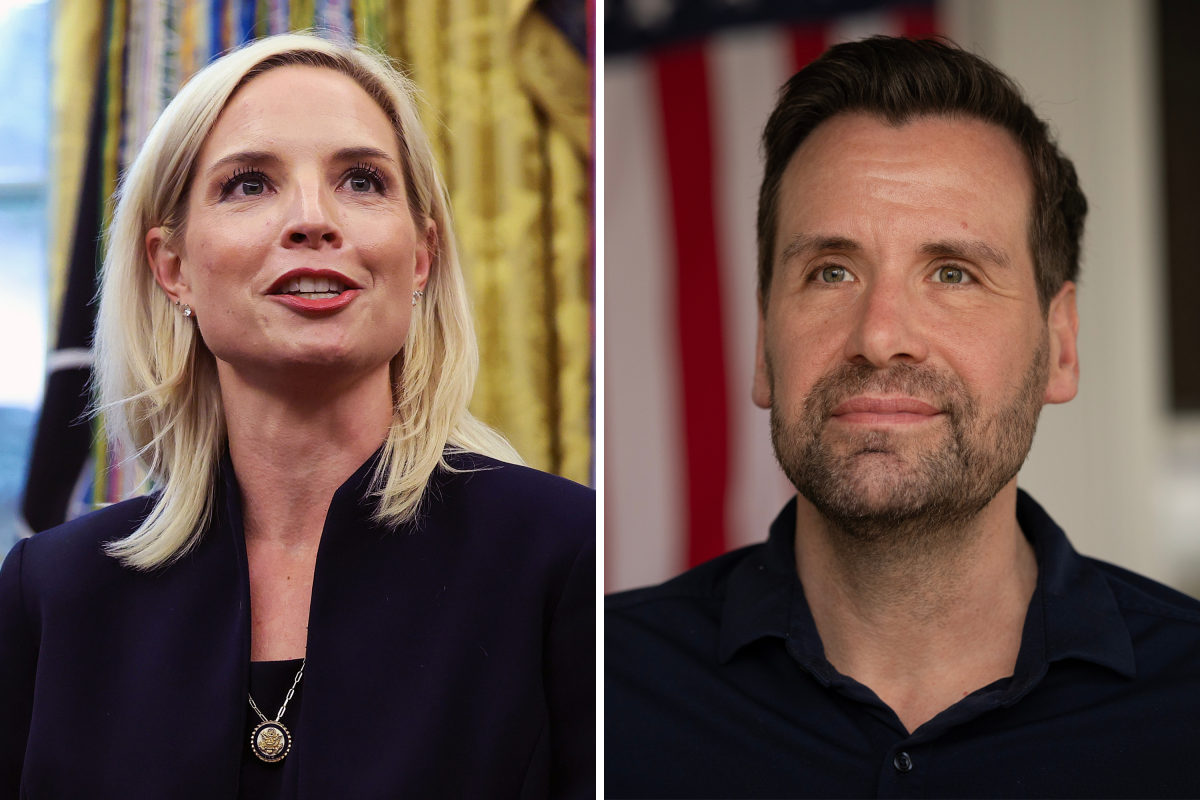
Politics is a game of showing up—or at least it is in Iowa this fall. With longtime Republican Senator Joni Ernst retiring, the Hawkeye State has become one of the most intensely watched Senate battlegrounds of the 2026 midterm cycle. Standing in the spotlight are two very different candidates: Ashley Hinson, a Republican U.S. representative who has built her political identity as a conservative workhorse, and Josh Turek, a Democrat and Iowa state representative who is trying to prove that a Democrat can still win in a state that has voted for Donald Trump three times and drifted red in recent presidential elections. With roughly a month to go before Election Day, the race is effectively tied in the polls, and every small move seems to matter. But in recent weeks, the loudest debate hasn’t been over taxes, immigration, or even the economy—it’s been over attendance. Both candidates have accused the other of skipping votes, turning the simple act of being physically present into a central campaign issue. They have traded accusations on social media, in press releases, and in dueling statements to reporters, each trying to paint the other as lazy, disconnected, or entitled. In a normal election year, voting records might be a footnote. In a race this close, however, they become a mirror for trustworthiness. Voters want to know who will actually show up in Washington, who will do the hard work, and whose promises are more than just campaign slogans. The controversy has even sparked fact-checkers to dig into the numbers, and the result is a messy, complicated picture that both campaigns have weaponized in their own favor.
The first major volley came in early September, when Hinson took to social media to hammer Turek over his statehouse attendance. She posted on X that Turek had skipped 58 percent of votes at the Iowa Statehouse that year and had the audacity to say his absentee voting record didn’t matter to Iowans. Hinson then tied his attendance to his actual votes, listing several issues she said defined his record: giving taxpayer-funded welfare benefits to illegal immigrants, allowing kids to secretly change their gender at school, making it easier for politicians to raise taxes on working families, and restricting Iowa law enforcement from working with federal immigration agents to keep dangerous criminals off the streets. Her post was blunt, angry, and clearly designed to make Turek seem both irresponsible and out of step with Iowa values. She returned to the theme again on a Friday, this time connecting his absence to a concrete economic opportunity. Hinson wrote that Turek had skipped the initial vote to create the MEGA program, a legislative initiative the state was later amending to help bring the largest steel plant in the United States to Iowa. She said he couldn’t be bothered to show up, and then used his absence to question his commitment to job creation. “Hopefully he isn’t too busy to vote today with thousands of good-paying jobs on the line!” she wrote. The message was clear: Turek might talk about helping Iowans, but when it came time to actually show up and vote for something that could transform the state’s economy, he wasn’t there. For Hinson, this was not just a matter of parliamentary procedure—it was proof of character.
Turek’s campaign, unsurprisingly, saw things very differently. When reached by reporters, his team pushed back hard, painting Turek as one of the most effective and bipartisan legislators in the statehouse. A spokesperson said Turek had voted with Republicans more than 700 times to lower costs, cut taxes, and keep Iowans safe, and that he had a record of actually getting things done across party lines. Then the campaign turned the same attack back on Hinson. They pointed out that Hinson, who has represented Iowa in Congress since 2021, has missed nearly 200 votes since being elected, including votes to protect children from AI-generated child pornography and to hold Jeffrey Epstein accountable. The statement went on to call Hinson the least bipartisan member of the Iowa congressional delegation and accused her of being a Washington insider who was out of touch with the people she represented. The campaign framed the race as a choice between a pragmatic, bipartisan state legislator and a party-line politician who, in their telling, repeatedly hurt Iowans to enrich herself and her billionaire donors. They also appealed to the timeline of the election, saying that in 32 days, Iowans would reject Hinson because they were tired of corrupt D.C. politicians. Hinson’s campaign did not immediately respond to a request for comment, leaving the Turek team’s accusations to hang in the air. The back-and-forth reveals a classic political pattern: each side accuses the other of hypocrisy, each side presents its own record as flawless, and each side tries to make the other’s perceived weakness into the central narrative of the race.
The actual numbers behind these accusations are more complicated than either campaign lets on. According to a fact check by PolitiFact, Turek was indeed absent for 261 out of 445 votes during the Iowa state legislative session, which ran from January 12 to April 2. That works out to 58 percent of the votes, exactly the figure Hinson cited. The Turek campaign did not provide a reason for his absence, and the fact check noted that he simply missed a majority of the floor votes during that period. But Turek’s allies insist that his attendance in Des Moines is far less important than his effectiveness when he is present, pointing to the hundreds of bipartisan votes he has cast. Meanwhile, Hinson’s record is also under scrutiny. A report by American Journal News found that since being elected to Congress in 2021, Hinson has missed 163 committee votes and 33 floor votes. Some of those misses, the report noted, were due to her being sick with COVID-19. In congressional rules, floor votes are typically the most consequential, because they determine whether legislation actually passes the House. Missing a floor vote usually draws far more attention than missing a committee vote, because a floor vote is the final public decision on a bill. Committee votes, on the other hand, happen earlier in the process, often with less public scrutiny, though they are still important because that is where bills are debated, amended, and approved before they reach the floor. By lumping both types of votes together, the Turek campaign was able to produce a large, dramatic number. But the truth is that in Washington, everyone misses votes at some point, and the reasons can range from illness to family emergencies to scheduling conflicts. What matters to voters, perhaps, is not just the number of misses but the pattern behind them. Still, in an election this tight, both campaigns clearly believe that any ammunition is worth using.
The stakes of this argument extend beyond social media sniping because the race itself remains razor-thin. Polls released in the same week told a story of a contest too close to call. A Rasmussen Reports poll put Turek ahead by four points, with 47 percent of likely Iowa voters saying they would vote for him and 43 percent backing Hinson, while 7 percent were undecided. That was slightly closer than September’s five-point lead for Turek in the same poll, which surveyed 1,048 likely voters from September 28 to September 30 and had a margin of error of plus or minus three points. A Fox News poll released on Thursday also showed Turek leading narrowly among likely voters, 49 percent to 47 percent, and by a slightly larger margin among registered voters, 50 percent to 46 percent. That survey, conducted by Beacon Research and Shaw & Company Research, polled 1,204 likely voters from September 24 to September 28 and also had a margin of error of three points. But not every poll pointed in the same direction. A Quantus Insights survey showed Hinson with a slight edge, 47.1 percent to 45.8 percent, based on interviews with 738 Iowans conducted on September 28 and September 29, with a margin of error of plus or minus 3.8 points. An InsiderAdvantage poll, meanwhile, gave Turek a 47.4 percent to 45.7 percent advantage among 1,200 likely voters surveyed on September 22 and September 23, with a margin of error of 2.83 points. The bottom line is that no one can reliably say who is ahead right now. The race is genuinely within the margin of error, which means tiny shifts in public opinion or turnout could decide the outcome. In such an environment, the attendance debate becomes more than a distraction—it is a way for both candidates to define their opponent in the final weeks, when many voters are only starting to pay close attention.
In the past 24 hours, the attacks have continued at full throttle, with both candidates firing shots on social media over everything from taxes to personal wealth. Hinson, looking to position herself as a defender of middle-class workers, posted that on day one in the Senate she would be ready to file legislation to make no tax on tips, no tax on overtime, and no tax on Social Security permanent. Then she pivoted to her opponent, claiming that Turek would repeal that middle-class tax relief on day one and instead raise taxes to give benefits to illegal immigrants. Turek responded in kind, taking aim at Hinson’s personal finances. He posted that Hinson did not want to show the rest of a fact check because she was trying to hide the fact that she was a multi-millionaire who owned up to five million dollars in insurance stock and had spent her time in Washington selling out Iowans to make herself richer. It was a sharp, personal attack, designed to contrast her wealth with the struggles of ordinary families. But beyond the daily drama, the deeper question is why this race matters so much. Iowa is one of the most competitive Senate races this cycle, and the outcome could help determine which party controls the Senate. If Turek wins, it would not only potentially flip the chamber but would also send a powerful signal that Iowa voters are open to electing Democrats again, even in a state that has supported Trump in three straight presidential elections. A Democratic victory would also give strategists in both parties a preview of shifting voter attitudes heading into the 2028 presidential election. For now, the two candidates are locked in a grinding, personal, and fiercely close battle, with every vote—and every absence—being used as evidence in a case to the voters. In Iowa, the race to Ernst’s open seat has become a referendum on whose story Iowans believe, and whether showing up is the standard that should ultimately decide who gets to go to Washington.