





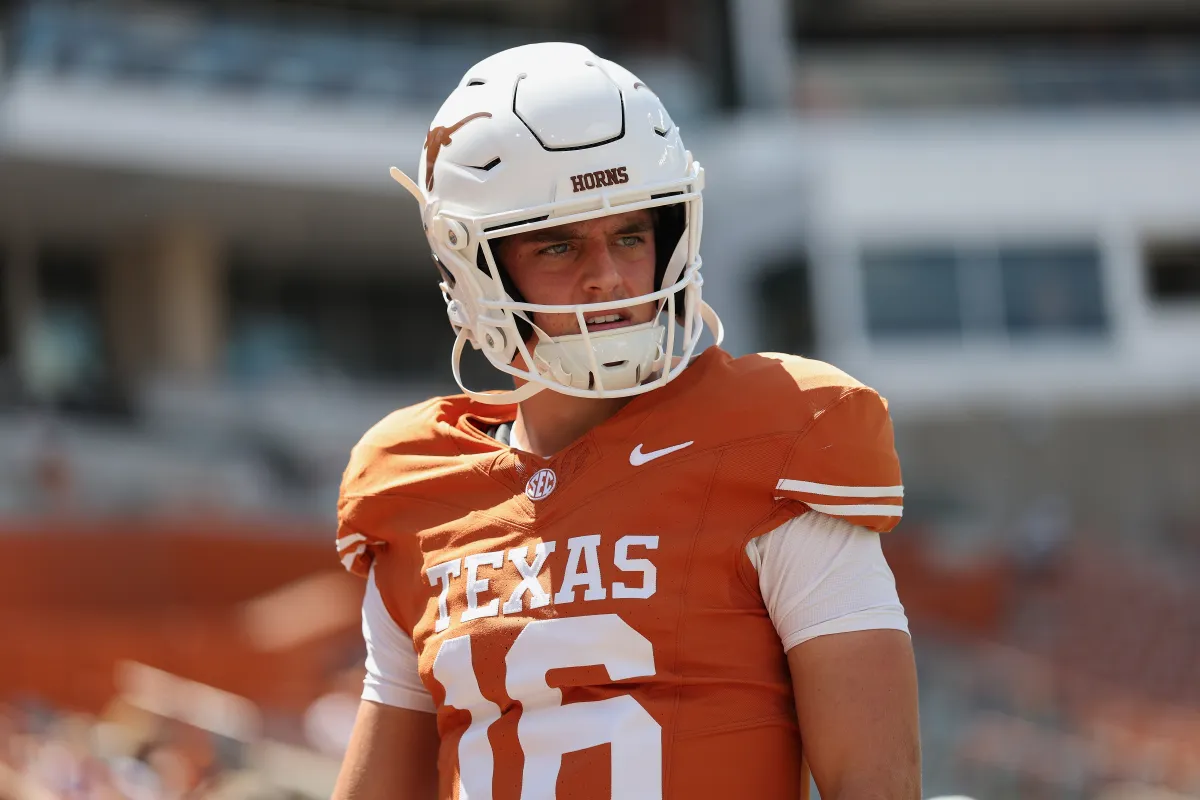
In Austin, the atmosphere was electric and heavy with expectation as No. 4 Texas hosted No. 1 Ohio State, a showdown that felt less like an ordinary regular-season game and more like an early playoff preview. For the Longhorns, it was a chance to prove they belonged on the same field as the nation’s top team, and for quarterback Arch Manning, it was a personal mission to rewrite a painful chapter from his past. But the game did not begin the way anyone in burnt orange had hoped. Texas came out flat, tight, and uncharacteristically careless. The first two offensive drives ended in turnovers, and the second was particularly cruel. On a pass that Manning delivered with confidence and timing, wide receiver Cam Coleman let the ball slip through his hands, deflecting it into the waiting arms of Ohio State safety Jaylen McClain. It was the kind of play that leaves everyone searching for someone to blame, but the truth was that Manning had done his part. None of that mattered on the scoreboard, though. The Buckeyes turned those early mistakes into points, jumping out to a 10-0 lead in the first quarter. The crowd, which had arrived roaring with optimism, grew quieter with every possession. The Texas sideline looked tense. The game was not slipping away, not yet, but the margin for error had vanished. What should have been a statement performance had become a test of character, and the Longhorns needed their quarterback to steady not only the offense but the entire emotional energy of the stadium. Manning had been here before, in a sense, but every game brings its own kind of pressure. This one, against the No. 1 team, with a national audience watching, felt especially consequential. He had to keep throwing, keep trusting, and keep believing that one bad bounce would not define him or his team.
Manning’s resilience was tested almost immediately, not just by the early mistake but by something far more alarming. In the first half, he appeared to suffer a wrist injury. The moment was terrifying for Texas fans. A quarterback is the lifeblood of a team, and Manning is not just any quarterback—he is a name that carries decades of football royalty, and he is widely projected as a future first-round NFL pick. When he headed to the sideline and the training staff began working on his right wrist, the entire stadium seemed to hold its breath. Cameras showed the medical staff examining him, and social media began buzzing with worry. ESPN reported that Texas training staff was focused on Manning’s right wrist, and for a while, it was unclear whether he would return. But he did. And when he came back onto the field, something shifted. There was a collective exhale from the Longhorns faithful, a surge of belief that maybe this game was not lost after all. Manning picked up the ball, tested his wrist by throwing, and stepped back into the huddle. It was the kind of moment that reveals the difference between talent and toughness. He did not sulk about the dropped pass or the early deficit. He did not seem distracted by the pain. Instead, he went to work. With just under six minutes remaining in the second quarter, Manning led the Longhorns methodically down the field, completing key passes and managing the offense with the poise of a veteran. When Texas finally put points on the board with a field goal, it was more than just a score. It was a message—to his teammates, to Ohio State, and to the country—that he was not going to fold. The silence that had fallen over the stadium was replaced by a roar. The first half had been ugly, painful, and full of adversity, but Manning had found a way to keep Texas alive. His wrist would be monitored, his grit could not be questioned, and the game was far from decided.
The physical toll Manning took in the first half was impossible to ignore. Ohio State’s defense was aggressive, relentless, and clearly intent on making him uncomfortable. They sacked him twice before Texas even got on the board, and those hits were part of a larger pattern of pressure that followed him on nearly every dropback. Each time Manning hit the turf, the crowd winced. Each time he got up slowly, the concern deepened. The wrist injury, whatever it was, only added to the worry. By the time Texas scored its first points, the conversation around the game had shifted from X’s and O’s to something more basic: How much punishment can a quarterback take and still lead his team? The answer, at least in the short term, was that Manning could take quite a bit. He kept playing, kept throwing, and kept competing. But the situation was worth monitoring, not just because of this game but because of everything that lies ahead. For a player with Manning’s future, every snap carries weight. An injury could change the trajectory of a season, an entire program’s hopes, and even an NFL career before it begins. The Longhorns know this. Their entire season may depend on how his wrist responds, how his body holds up, and how he manages the accumulated punishment that comes with playing quarterback in a high-stakes college football game. There is a reason coaches obsess over protection schemes and training staffs stay on edge. One bad hit can erase months of preparation. Manning’s willingness to return to the game despite the injury said something about his determination, but it also raised the stakes. Every throw he made from that point forward was a test, not only of his arm but of his ability to block out fear and keep his focus on the moment. The physical battle was real, and it was far from over.
Beyond the immediate drama of the game, Saturday’s matchup carried deep emotional meaning for Manning, rooted in a painful memory from the previous season. When Ohio State defeated Texas 14-7 last year, the loss stayed with him. He admitted earlier in the week that he does not like revisiting that film, that it is hard to watch the way that game unfolded. There is something universally human about that feeling—the desire to avoid the replay of your own failures, the sting of a moment you wish you could have back. But Manning did not hide from it. He spoke openly about being excited for a second chance, about the rare opportunity to face the same team after a rough loss and prove that he has grown. “It’s a rough film to watch,” he said, via ESPN. “I don’t like watching it that much.… It’s not all the time you get a second chance to play another team after a rough loss. So we’re all excited for the opportunity. I think we’ve all grown mentally and physically.” Those words reveal something important about his character. He was not looking for excuses or revenge in a bitter sense. He was looking for redemption, and he understood that redemption is earned through action, not words. The early turnovers and the injury could have unraveled him. Instead, they became part of his story of resilience. This game was never just about rankings or playoff positioning. It was about facing the ghost of the past and refusing to be defined by it. Every throw Manning made was a declaration that he is not the same player he was last season, that he has learned from his mistakes, and that he will not let the weight of one bad night keep him from chasing something greater. The scoreboard mattered, but so did the journey.
The implications of Manning’s performance extended far beyond Saturday’s final score. As he stood in the pocket, absorbing hits and delivering passes through the pain, the entire trajectory of Texas’s season seemed to hang in the balance. Football is a sport where confidence is fragile and momentum is everything. If Manning can shake off the early turnovers, the injury scare, and the relentless pressure, the Longhorns have a chance to be the team everyone hoped they could be. If not, the doubts will creep in, the season could spiral, and all of the preseason hype will feel like a distant memory. This is the reality of being a star quarterback at a program like Texas. The burden is not fair, but it is real. Manning has handled the spotlight with remarkable maturity so far, but games like this are where legacies are forged. The fact that he was able to return from the wrist injury and lead his team to points was a positive sign, but it was only a beginning. He still had to prove he could sustain that performance, protect the football, and make the right decisions under pressure. The offensive line would need to give him more time. The receivers would need to hold on to passes that were placed in perfect position. And Manning would need to keep getting up, no matter how many times he was hit. The phrase that kept echoing through the minds of coaches, analysts, and fans was simple: How Manning holds up on Saturday could determine Texas’s season. Those are not dramatic words; they are a statement of fact. A team can survive an early loss, but it cannot survive the breakdown of its quarterback. Everything else—the defense, the running game, the special teams—becomes secondary if the most important player on the field is compromised. Manning’s ability to endure, to adapt, and to lead through adversity is the single greatest variable in a season full of uncertainties.
As the game continued, one thing became clear: Saturday was about more than football. It was about watching a young man confront his limits and decide whether to push past them. Manning entered the season with enormous expectations, carrying a famous name and a future that seems bright beyond imagination. But in the first half against Ohio State, none of that mattered. He was simply a competitor fighting through dropped catches, an injury, and a defense that wanted to knock him out of the game. He responded the way great players do—not with words, but with actions. He returned to the field, steadied his offense, and gave Texas a chance to climb back into a game that could have easily slipped away. Whether the Longhorns ultimately won or lost, the lesson of the afternoon was already being written. Resilience is not about avoiding adversity; it is about how you respond when adversity finds you. Manning’s response, at least in those early moments, was a testament to his growth both as a player and as a person. He had said during the week that he had grown mentally and physically, and now he was proving it in front of a national audience. The road ahead remains long, with many challenges and no guarantees. But the way Manning held up on Saturday will shape not only his own confidence but the confidence of every player in the Texas locker room. If their quarterback can absorb the worst punches and keep moving forward, they can too. The season is far from over, and the story is still being written. But in the heat of a rivalry that had become deeply personal, Arch Manning showed that he is not just a name. He is a fighter. And that, more than any stat line or final score, is what will be remembered.