






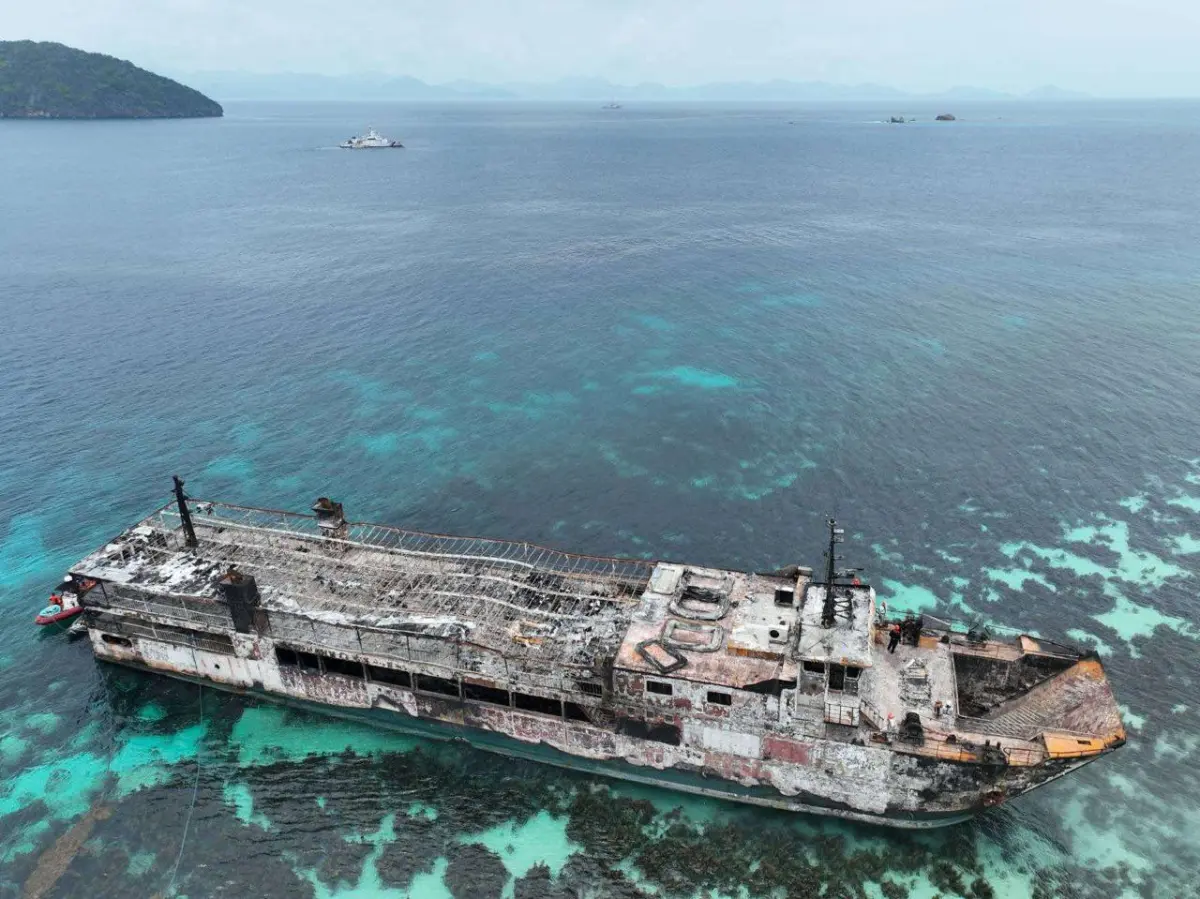
The darkness of the Sulu Sea was shattered by a sudden, terrifying burst of orange flame. On the night of Wednesday, the MV June Aster, a passenger ferry nearing the end of its long voyage from the sprawling metropolis of Manila to the idyllic tourist haven of Coron in Palawan, became a floating inferno. Carrying 132 souls—families, migrant workers returning home, and travelers chasing paradise—the ship was merely 24 miles from its destination when a catastrophic explosion ripped through its hull, shattering the peaceful hum of the engine room. Within moments, thick, acrid smoke began to flood the corridors, and panicked screams replaced the casual chatter of passengers. Survivors recount a hellish scramble through narrow passageways, the desperate search for loved ones, and the agonizing choice between the suffocating smoke below and the black, churning waters above. By Saturday, Philippine authorities confirmed the grim tally: at least 76 people had perished, making it one of the deadliest maritime disasters globally this year. The charred and mangled wreck bobbing in the waters off Palawan now serves as a haunting monument to a journey that ended in catastrophe, leaving 43 recorded survivors to grapple with immeasurable grief and a nation to demand answers.
As the smoke began to clear over the wreckage, the grim work of recovery and identification commenced. Philippine Coast Guard official Geronimo Tuvilla addressed the press on Saturday, stating that the immediate priority was twofold: identifying the victims through forensic examination and determining the precise cause of the blaze that consumed the vessel so swiftly. The captain, reportedly alive, will undoubtedly face intense scrutiny as maritime safety and criminal investigations unfold. This tragedy is a painful reminder of the perilous nature of ferry travel in the Philippines, an archipelago of over 7,600 islands where the sea is not a luxury but a lifeline. For millions, ferries are the only affordable and practical route to jobs, healthcare, and family reunions. Yet, the nation carries a long and tragic history of maritime accidents, marked by aging fleets, chronic overloading, and lax enforcement of safety regulations. The investigation will likely probe whether the vessel had adequate firefighting equipment, whether the crew were properly trained for such emergencies, and why—despite the proximity to land—so many could not escape the vessel’s belly. Each recovered body, each tearful identification in a cramped morgue, underscores a systemic failure that has yet to be adequately addressed, transforming a routine commute into a fatal lottery where the cost of a ticket can just as easily be a life.
The tragedy in the Philippines, however, is not an isolated incident but the latest and most visceral example of a global maritime crisis that has claimed hundreds of lives in recent months. Across the African continent, the waters have also turned deadly. In August, Zimbabwe was plunged into mourning when a government-owned ferry capsized on Lake Kariba, the world’s largest man-made reservoir. Carrying roughly 180 passengers—far exceeding its official capacity of 90—the vessel was caught in strong waves while ferrying people to a remote lakeside community. The overcrowding turned the vessel into a death trap; as the boat keeled over, a chaotic scramble for the few available life jackets began. Survivor Chance Siyamavhu, 45, described the heartbreaking scene to AFP, noting that “most of the people scrambled to get the life jackets but most of them did not even know how to use them.” The water, vast and unforgiving, swallowed at least 94 people in what the state media called the deadliest transportation disaster in the country’s history. Similarly, off the coast of Guyana in July, the capsizing of the MV Barima, an 87-year-old state-run ferry, raised disturbing questions about official manifests. Carrying 179 people, though the manifest listed only 116 passengers, the vessel overturned and sank in minutes, taking an estimated 100 lives. Survivor Helena Moonsammy, who lost four grandchildren, articulated the sheer speed of the horror to the Associated Press: “I was fighting for my life. The boat sunk in minutes, seconds… I told my grandbabies to cling on to anything as I hollered for them. I prayed all night and was in the water for nine hours.” Her agonizing prayer, echoing across the waterways, is a scar not just on a nation’s conscience but on humanity’s collective sense of security.
The deadly pattern of maritime catastrophe extends even to the waters of Southeast Asia and the Eastern Mediterranean. In August, Indonesia—a nation of more than 17,000 islands where ferries are as essential as roads in other countries—suffered its own terrifying ordeal. The Mutiara Sentosa 2 ferry, carrying 271 people, caught fire off the coast while en route from Surabaya to Makassar just before dawn. The blaze broke out with such ferocity that a massive rescue operation was launched, ultimately saving about 230 passengers, but at least five people perished and dozens more were reported missing, their fates locked within the burning hull. Meanwhile, in the Mediterranean, a passenger ferry carrying 267 people capsized shortly after departing Kyrenia on a route to Turkey. The ship rapidly overturned in waters deeper than 1,640 feet, and survivors recounted harrowing tales of mass panic. Ayten Bicer, whose young daughter and six-year-old son were among the missing, delivered a devastating testimony to Turkey’s DHA news agency: “My daughter slipped from my grasp. She was holding my hand. The suitcase fell, she slipped from my hand.” Another survivor, Serkan Kunduraci, painted a grim picture of the ship’s final moments, telling the outlet, “I saw some who didn’t know how to swim die in the sea. There were those who, in a panic, didn’t grab life jackets. Some jumped (into the sea) immediately out of fear. There was an old man, we couldn’t get him… We saw and witnessed a family’s children, boys and girls, very young children, drowning.” The sheer helplessness encapsulated in these words strips away the statistics and exposes the raw, primal horror of sinking into the deep.
Looking at these incidents side-by-side—the Philippines, Zimbabwe, Guyana, Indonesia, and Cyprus—a disturbing and inescapable pattern emerges. These are not merely freak accidents of nature; they are the cumulative consequences of systemic negligence and a fundamental disregard for human life. The root causes are strikingly similar: vessels that are routinely overcrowded, carrying two to three times the legal limit of passengers or operating with outdated equipment and structural deficiencies. The MV Barima was 87 years old, a relic of a bygone era that had no business carrying a full load of passengers across open waters. The Zimbabwe ferry doubled its capacity. In the Philippines and Indonesia, passenger manifests are often loosely tracked, and regulatory bodies—often underfunded and overwhelmed—fail to conduct rigorous safety inspections. Beyond the physical infrastructure, there is an alarming lack of basic maritime safety training. The chilling testimonies from survivors repeatedly highlight the same tragedy: life jackets present but useless because people didn’t know how to don them; extinguishers inaccessible; crew ill-prepared to guide panicked crowds. In the chaos of an emergency, seconds matter. But when passengers are packed like sardines in poorly lit corridors, when life-saving equipment is a mystery, and when the nearest lifeboat is a rusted hulk, those seconds evaporate. The economically marginalized, the rural poor who cannot afford flights, and those who depend on these ferries for their basic survival bear the brunt of this negligence. They board these ships not out of choice but out of necessity, trusting that the government and operators have prioritized their safety—a trust that has been betrayed time and time again across borders and oceans.
As the world turns its gaze to the growing list of casualties, we must remember that behind each number is a human story abruptly severed. A father returning from a construction job in Manila, a grandmother traveling to see her grandchildren in Palawan, a young student taking the ferry to university—each of the tens of thousands of people who boarded these ill-fated ships carried with them hopes, fears, and loved ones waiting on the shore. While the investigation into the Philippine ferry will continue, and while the search for missing children in the Mediterranean goes on, the true lesson of this cyclical series of tragedies is a profound call for accountability. Governments of archipelagic and island nations must recognize that maritime transport is not merely a commercial venture but a public utility that demands the highest standards of safety. Overloading must be criminalized and strictly enforced. Crews require comprehensive, regular drills that go beyond simple paperwork, teaching actual emergency responses. Passengers must be educated on safety procedures as a fundamental part of boarding. The sea is ancient, powerful, and indifferent to human error. It does not negotiate with grief. For the families of the 76 killed in the Philippines, the 100 off Guyana, the 94 on Lake Kariba, and the countless others claimed by the waves this year, the pain is eternal. Their loss should not be a footnote in a news cycle but a resounding alarm that demands immediate, structural change to prevent the next mother from losing her child to the silent, crushing depths. The ocean will always be a part of their identity, but it should never again become a mass grave for those who simply wanted to go home.