









Paragraph One: A Diplomatic Breeze at the American Embassy
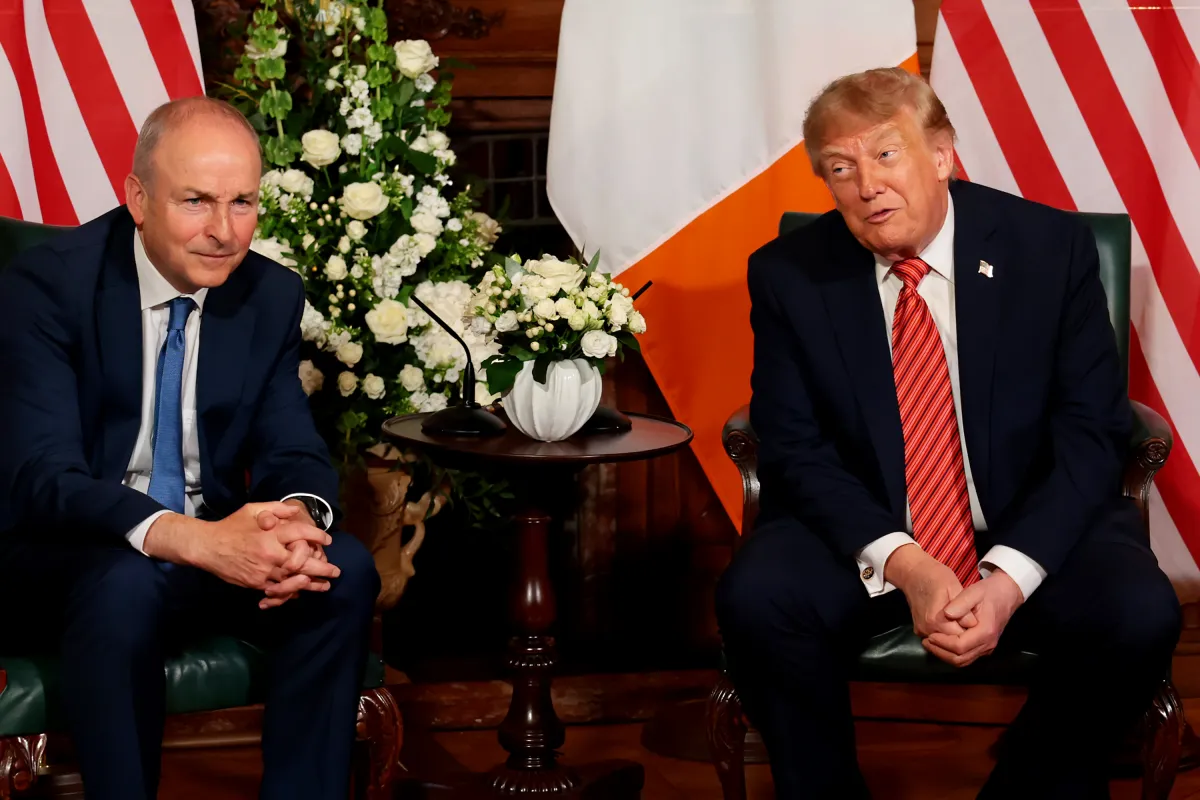
The scene was set in the hushed, vaulted grandeur of the United States embassy in Dublin, a building that stands as a testament to the enduring, if occasionally tangled, relationship between two nations separated by an ocean but bound by a history of emigration, sentiment, and strategic alliance. President Donald Trump, seated beside the Taoiseach, Micheál Martin, exuded a particular brand of brash amiability. He was in his element, the global stage humming with his restless energy, when a reporter lobbed the question—a question that has haunted British-Irish relations for over a century: what did he make of the prospect of a united Ireland? The room likely held its collective breath, diplomats tensing as they do when a loose cannon is primed to fire. Trump, however, appeared utterly unencumbered by the weight of history. Leaning back, he delivered his verdict with a casual shrug that belied the geopolitical earthquake contained within his words. “I don’t want to cause any problems, but I will tell you, I’d love to see it unified,” he said, the phrasing almost endearing in its disarming simplicity. He paused, then polished the thought with a characteristically transactional metaphor: “I think it would be a great feather in everybody’s hat if that happened.” The irony was thick enough to cut with a shillelagh. Here was the American president, the man famous for building walls and portraying borders as existential security threats, casually advocating for the erasure of one of Europe’s most historically contentious frontiers. And he did so not with the careful, measured diplomacy of a seasoned statesman, but with the breezy optimism of a dealmaker looking at a map and seeing a cleaner, more profitable outline. Beside him, Martin’s smile was a carefully calibrated mask—the practiced equilibrium of a politician who knows that a single involuntary twitch of his lips could be parsed for meaning across the United Kingdom, in Brussels, and in Washington. He was, after all, the steward of a fragile peace, and a foreign leader’s unscripted enthusiasm was both a gift and a grenade.
Paragraph Two: Echoes of the Troubles and the Blood-Letting of Memory
To truly grasp why Trump’s lighthearted remark carried such profound weight, one must conjure the ghost of Ireland’s bloody history that hangs over that very conversation. This was not a discussion of a merger of two friendly corporations; it was a suggestion about healing a wound that has festered since the partition of 1921, when the British Isles drew a border through a province that had never consented to its own division. The physical map of the island is a scar that runs through rolling green hills, dividing villages, splitting farmlands, and separating family compounds that predate the creation of the United Kingdom itself. For thirty years, from the late 1960s to the signing of the Good Friday Agreement in 1998, that border became a locus of terror. It was a landscape punctuated by British Army checkpoints, snarling barbed wire, and armored vehicles that patrolled the “bandit country” of South Armagh. The Troubles were not a distant memory of political squabbling; they were a visceral nightmare of bombings in shopping districts, of snipers picking off soldiers, of mothers losing sons to sectarian violence, and of victims whose bodies were never recovered from the Irish Sea. Peace walls—massive concrete barriers adorned with murals of masked gunmen and faded political slogans—still separate nationalist and unionist neighborhoods in Belfast. To suggest the end of partition is to whisper the word “unity” in a place where that word once meant cultural annihilation to Protestants who pledged allegiance to the Crown. Trump’s American riff, delivered from a posh Dublin podium, echoed into the memory of the Omagh bombing, where a car bomb in 1998 killed 29 people, including a woman pregnant with twins—a brutal reminder that unity was not a whimsical aspiration but a matter of life and death. The “feather” Trump envisioned was, for many, still stained with the crimson of a communal bloodletting that two generations ago tore the island apart. The president’s ignorance of this history does not make his statement less potent; it makes it more jarring, a jarring that humanizes the deep anxiety still live in the quiet, rain-soaked lanes of the border counties, where the pavement is painted with scratch of loyalist red, white, and blue or a hungered tricolor of green, white, and orange.
Paragraph Three: The Good Friday Agreement and the Principle of Consent
The critical context that Trump sidestepped is the intricate legal architecture of the Good Friday Agreement, the historic accord signed in 1998 that brought an uneasy peace to the land. This agreement did not presuppose a permanent partition, nor did it mandate immediate unification. Instead, it enshrined a delicate principle known as “consent”—the idea that Northern Ireland’s constitutional future can only be altered by a majority vote of its own people. In essence, a united Ireland is not a deterministic inevitability; it is a democratic potential that could be triggered if a border poll were ever held and said majority voted for it. This is a long, meticulous, painstaking process designed to prevent the kind of unilateral declarations that had caused a century of strife. Trump’s casual assertion that “it’s going to happen eventually” disrupts this fragile compromise. It suggests a foregone conclusion, a neat denouement that the agreement explicitly resists. Standing next to him, Micheál Martin is a man of nuance, rooted in the traditional Fianna Fáil party, which has always harbored an aspiration for a united Ireland yet understands that to push too hard too soon would be to fracture the unionist community and risk sinking the peace process he protects. To hear the American president—the arbiter of Western diplomacy—so blithely endorse the nationalist dream must have sent a jolt of mixed exasperation and cautious delight through the Taoiseach. He cannot wholeheartedly reject the sentiment, for it aligns with the deep-seated nationalist desire he shares; yet he must temper it, reminding the press that the path to unity is paved with the “practicalities” of shared services, healthcare, economies, and trust-building. The human truth here is that Martin is not merely a bureaucrat; he is a man walking a tightrope over a chasm of historical grievances, carrying the heavy briefcase of a fragile post-conflict society. He smiles, nods, and deflects with gentle phrases about cooperation and Northern Ireland’s prosperity, but his inner world is one of ruthless calculation—how to honor the American ally without alienating the British prime minister, or how to quietly use Trump’s words to nudge public opinion without igniting unionist fury. In that moment, the political becomes profoundly human: the leader as parent, trying to soothe a child who just loudly promised to buy a house the family hasn’t yet saved for.
Paragraph Four: Brexit and the Unsustainability of a Hard Border
The conversation in Dublin did not occur in a vacuum; it took root in the soil thoroughly churned by the catastrophic political event known as Brexit. When the United Kingdom voted narrowly in 2016 to leave the European Union, it threw Northern Ireland into a constitutional nightmare. The region, like Scotland, had voted overwhelmingly to remain, but it was dragged out against its will. The subsequent negotiations produced the infamous Northern Ireland Protocol, a complex arrangement that effectively kept Northern Ireland inside the EU’s single market for goods to avoid a hard border with the Republic. This meant a customs border down the Irish Sea—a physical and psychological frontier between Great Britain and her own province. This protocol infuriated Loyalists, who felt their Britishness diluted and their trading links severed, while it simultaneously highlighted the economic absurdity of partition. For the people who live along the border, the impact has been intensely human. Farmers who graze cattle on both sides of the line now need reams of paperwork. Small businesses that previously enjoyed frictionless trade across communities now face inspections and tariffs for moving a few dozen crates. Truck drivers express their bewilderment about which regulatory regime applies to their particular load of dairy or aluminum. The average resident in the border town of Newry or Derry now navigates a twilight world where the Amazon delivery from London takes longer than one from Dublin. This bureaucratic chaos has fundamentally reshaped the political psyche of Northern Ireland. The rise of Sinn Féin, the former political wing of the IRA, into the position of largest nationalist party at Stormont has shown a demographic shift. Young voters, raised mostly in a post-ceasefire era, overwhelmingly identify as Irish rather than British. The economic nonsense of the border, magnified by the post-Brexit hybrid arrangement, has made the abstract notion of a united Ireland feel less like a nostalgic ambition and more like a pragmatic solution. Trump, with his simplistic lens of trade and deals, tapped into this palpable frustration. He saw a border that served no commercial logic, a source of bickering, and a clean map where the island was one green block. That he might unwittingly be endorsing a project that would dissolve the very union he nominally supports with the United Kingdom speaks to his transactional view of identity, a view inherently detached from the loyalist fear of being subsumed into a Catholic-majority republic. Yet, for a border farmer mired in paperwork, Trump’s offhand endorsement of “one island” might have sounded like the most common-sense sentence they’ve heard in a decade.
Paragraph Five: A Geopolitical Shipwreck and the Chessboard of Alliance
On the international chessboard, Trump’s words were a rogue missile that detonated in the heart of establishment diplomacy. In London, Downing Street reacted with a train-wreck of stiff-upper-lip fury, issuing a terse statement reaffirming that Northern Ireland is “part of the United Kingdom” and that there would be no change without the consent of its people. The rupture was ugly: here was the U.S. President, the chief ally of the UK, openly advocating for its disintegration, sitting next to a foreign head of state who—though polite—was clearly not rebuking him. The traditionalists in the White House would have been clutching their pearls, but nuance is a stranger to Trump’s brand of populism. Meanwhile, in Brussels, EU officials watched with a predatory glint, aware that American pressure on the UK could accelerate the Irish unity scenario, which would ultimately bring the entire island into the EU fold, strengthening the bloc’s economic footprint. Dublin was left in an exquisite dance of embarrassment and gratitude, simultaneously disavowing Trump’s interference while privately relishing the maximalist pressure it placed on its old rival. The human drama extended to the streets of Belfast. For unionists, Trump had long been seen as a friend of the larger British project—a “man of the people” who opposed the EU’s bureaucracy. To hear him throw them under the bus was a profound betrayal. A loyalist community organizer in East Belfast, waving a Union Jack, might have felt a deep, personal insult—the US President, his country’s supposed guarantee of security, had casually dismissed the legitimacy of the very flag he flew. Conversely, a nationalist resident in the Falls Road felt a surge of vindication, a validation that the world—even the chaotic, impulsive world of American politics—was waking up to their dream. This polarized reaction is the essence of the human condition on that island: a fragile equilibrium where hope for one side is experienced as existential dread by the other. Trump, in his oblivious grandeur, failed to grasp that he wasn’t selling a product; he was stirring a pot of acid that had already burned the hands of three decades of peacemakers.
Paragraph Six: The Imminent Vote and the Imperative of Human Dignity
The greatest human truth emerging from Trump’s Dublin soundbite is that he has accelerated a clock that was already ticking, but with his characteristic lack of gentle handling. Political analysts note that a border poll can legally be called by the Secretary of State for Northern Ireland if “it appears likely” that a majority would support a united Ireland. Demographic projections suggest that within the next two decades—perhaps by the 2040s—nationalists will outnumber unionists in the north, making a referendum mathematically plausible. The question, then, is not if but when, and at what social cost? Trump’s “eventually” is another way of saying “inevitably,” and in that word lies the profound human anxiety of transition. A united Ireland would mean a reimagining of identity, national health services, policing, property rights, and even the language spoken in government buildings. It would force a Protestant grandfather, who remembers his father being held at gunpoint by republicans, to cede sovereignty to a parliament in Dublin. It would compel a Catholic mother, who grew up in a segregated school, to wonder if her children’s heritage will survive a merger. The human stakes are not just political; they are psychological, emotional, and spiritual. Trump’s contribution—the idea that it would be a “feather in everybody’s hat”—trivializes the agonizing measured conversations that must happen between neighbors, across kitchen tables, and in parochial halls. It reduces a soul-wrenching negotiation about communal destiny to a sporting victory. Yet, despite his unwitting harshness, his words have democratic resonance. They give permission to a generation of nationalists to believe that the old order is shifting, that a future once only whispered in republican kitchens is now being toasted in the White House. The true test of humanity lies in the days ahead, as the people of Northern Ireland—let alone the entire island—are forced to reckon with the possibility that an American President’s casual approval may push them faster than they are ready to walk. Ultimately, the eventual unity of Ireland must not be a feather in the cap of a foreign politician, but a quiet, collective decision born of mutual respect and shared destiny—a decision where the choice of one is not the annihilation of the other. As the sound of Trump’s voice fades from the Dublin air, the Irish people are left to navigate the human, messy, and unglamorous work of building a future that could, for the first time in a century, belong wholly to them. Whether that future is seamless unification or a continued, complicated coexistence, it will require patience, empathy, and a deep recognition that a nation’s soul is not carved by grand proclamations, but by the tender, intimate conversations had on stoops and in pubs, where the ghosts of the past are asked to finally, gently, release their grip.


