





It began as a scene of raw, ugly spectacle outside a Manhattan courthouse, and it ended up sparking a fight over the meaning of press credentials in New York City. On a day when Luigi Mangione was due in court for the murder of UnitedHealthcare CEO Brian Thompson, three young women flashed city-issued press passes to reporters outside the building. They were not there to document history. They were there to celebrate a killer. One of them, identified as Ashley Rojas, looked into a New York Post camera and delivered a message that was as chilling as it was crude: “F— Brian Thompson. That’s all I want to say. F— Brian Thompson. F— his mom.” Another woman, Lena Weissbrot, went even further, attempting to justify the assassination by comparing Thompson to Osama bin Laden and claiming that the health insurance executive was “responsible for more deaths” than the architect of the September 11 attacks. The images and sound bites went viral almost instantly. For many New Yorkers, the sight of these women proudly holding official press credentials while cheering for a cold-blooded murder was not just offensive — it was an indictment of a system that had allowed them to obtain those credentials in the first place. Now, the New York City Council is moving to change that system, introducing a bill designed to make it easier to strip press passes from people who abuse them or use them for purposes that have nothing to do with journalism.
To understand why this matters, it helps to understand what a press pass actually is. In New York City, a press credential issued by the Mayor’s Office of Media and Entertainment is more than just a laminated card. It is a key that opens doors: courthouse steps, crime scenes, press conferences, and other restricted areas where the public cannot go. It is a symbol of legitimacy, a signal that the person holding it is there to do the vital work of informing the public. For real journalists, it is an essential tool of the trade. But for someone like the so-called “Luigi Mangione fangirls,” it is something else entirely: a way to get close to the action, to stand in the spotlight, and to use the credibility of the press to amplify a message of violence. The trial of Luigi Mangione has become a magnet for attention, and not just from legitimate media outlets. The case has attracted true-crime obsessives, online extremists, and people who seem to view Mangione as a folk hero. Some have gone so far as to romanticize the killing of Brian Thompson, a 50-year-old father of two, as an act of rebellion against the health insurance industry. That grotesque narrative has spilled over into the real world, where it has created security concerns and forced the judge to keep jurors anonymous due to threats and harassment. In this atmosphere, the presence of young women with official press passes, using them to celebrate the murder, felt like a direct violation of the trust that the credential is supposed to represent.
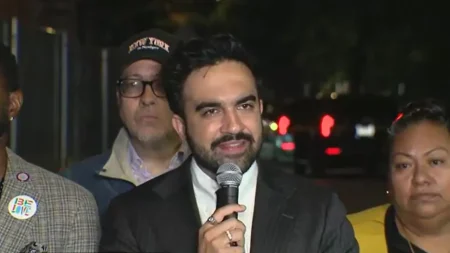
The bill introduced Thursday seeks to address that violation head-on. Sponsored by Councilmember Chris Banks and co-sponsored by Carmen De La Rosa and Inna Vernikov, the legislation would give the Mayor’s Office of Media and Entertainment new authority to suspend or revoke a press pass when the “preponderance of the evidence” shows that it is justified. That may sound like legal jargon, but the shift is significant. Under current rules, the city must meet a higher bar — “clear and convincing evidence” — before it can take someone’s press credentials away. That standard is meant to protect against arbitrary or politically motivated decisions, but critics argue that it also makes it too difficult to act quickly when someone abuses the privilege. The new bill would lower the threshold, making it easier for the city to pull a press pass from someone who is clearly not acting as a journalist. For City Council Speaker Julie Menin, who once served as MOME commissioner, the reform is personal. She described the measure on Fox 5 New York’s “Good Day New York” as a direct response to the “Luigi Mangione fangirl” problem. “These fangirls, who are not journalists, are showing up at the trial with press credentials that the City of New York is giving to them,” she said. The point, she emphasized, is to ensure that it is “really journalists, legitimate journalists, who should be getting the press credentials.” It is a simple message, but the implications are complex.
The reaction from city officials has been swift and pointed. Mayor Zohran Mamdani, who had previously acknowledged that the three women should not have received press passes, has signaled support for the broader effort to reform the system. That acknowledgment, while welcome, also raises an obvious question: how did they get the passes in the first place? Press credentials are supposed to be issued after a review process, but the women’s behavior outside the courthouse suggested that little vetting had been done. They were not covering the trial; they were turning it into a spectacle. One of them was seen grinning and posing with her press badge, as if it were a prop in a sick performance. For the family of Brian Thompson, the images must have been devastating. Imagine watching someone stand outside a courthouse, holding an official credential from your city, and use it as a platform to curse the name of your murdered loved one and question whether he deserved to die. It is an insult not only to the victim and his family, but to the journalists who work hard every day to cover the justice system with fairness and integrity. The proposed bill is, in many ways, a response to that insult. It is a way of saying that the press pass is not a toy, not a costume, and not a free pass to join a fan club for a man accused of assassination.
Behind the political maneuvering is the grim reality of the case itself. Luigi Mangione is accused of murdering Brian Thompson on a Manhattan sidewalk on December 5, 2024. Surveillance video shows him approaching Thompson from behind, pulling out a silenced handgun, and opening fire in broad daylight before fleeing on a bicycle. Thompson, a Minnesota native and father of two, was gunned down just steps from a hotel where he was scheduled to attend an investors conference. The killing sent shockwaves through the corporate world and ignited a national conversation about anger at the health insurance industry. Mangione was eventually arrested at a McDonald’s in Altoona, Pennsylvania, after customers and employees recognized him from a wanted poster. He has since pleaded guilty to federal charges, but his legal team is fighting to have state-level charges dismissed on double jeopardy grounds. The trial has been adjourned until December as the courts wrestle with that issue. In the meantime, Mangione has become an unlikely icon for a certain segment of the internet, with supporters showing up to hearings and even raising money for his defense. The “fangirls” with the press passes are just one visible symptom of that broader cultural phenomenon. They are not interested in the facts of the case or the rule of law. They are interested in the myth, the image, the rebellious romance of a handsome young man who allegedly killed a wealthy executive. That fantasy, however, collided with reality outside the courthouse, where their words were broadcast to millions and forced city leaders to confront a loophole in their press credential system.
The proposed bill raises important questions about the balance between press freedom and public accountability. On one hand, the press pass system is built on trust. Reporters need access to do their jobs, and the public relies on them to provide independent, accurate information. When a person abuses that trust, they undermine the credibility of the entire institution. Being able to revoke credentials quickly is essential to maintaining that credibility. On the other hand, there is always a danger that laws designed to punish bad actors can be used too broadly. Who decides what constitutes a “non-journalistic purpose”? What if a legitimate journalist is accused of bias or advocacy? The standard of “preponderance of the evidence” is lower, which means the city would have more power to strip someone’s credentials based on a subjective judgment. That is a concern that civil liberties advocates are likely to raise as the bill moves through the council. Still, the sponsors insist that the goal is not to suppress speech but to protect the integrity of the credential. “We want them to reform their practices,” Menin said, “so it’s really journalists, legitimate journalists, who should be getting the press credentials.” In a city as vast and complicated as New York, where the internet can turn anyone into a self-proclaimed reporter overnight, that is no small task. The fangirls outside the courthouse may have been dismissed as a joke, but they exposed a real weakness in how the city vet the people it grants access to the news. For now, the bill is just a proposal, and it will need to go through hearings and debates before becoming law. But the message is already clear: the city is no longer willing to let press credentials be used as a costume for people who want to cheer for murderers. It is a small reform, but in a time when trust in the media is already fragile, it is a necessary one. The next time someone flashes a press pass outside a courtroom, they may actually have to be a journalist.