




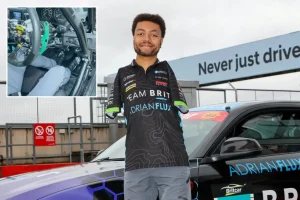





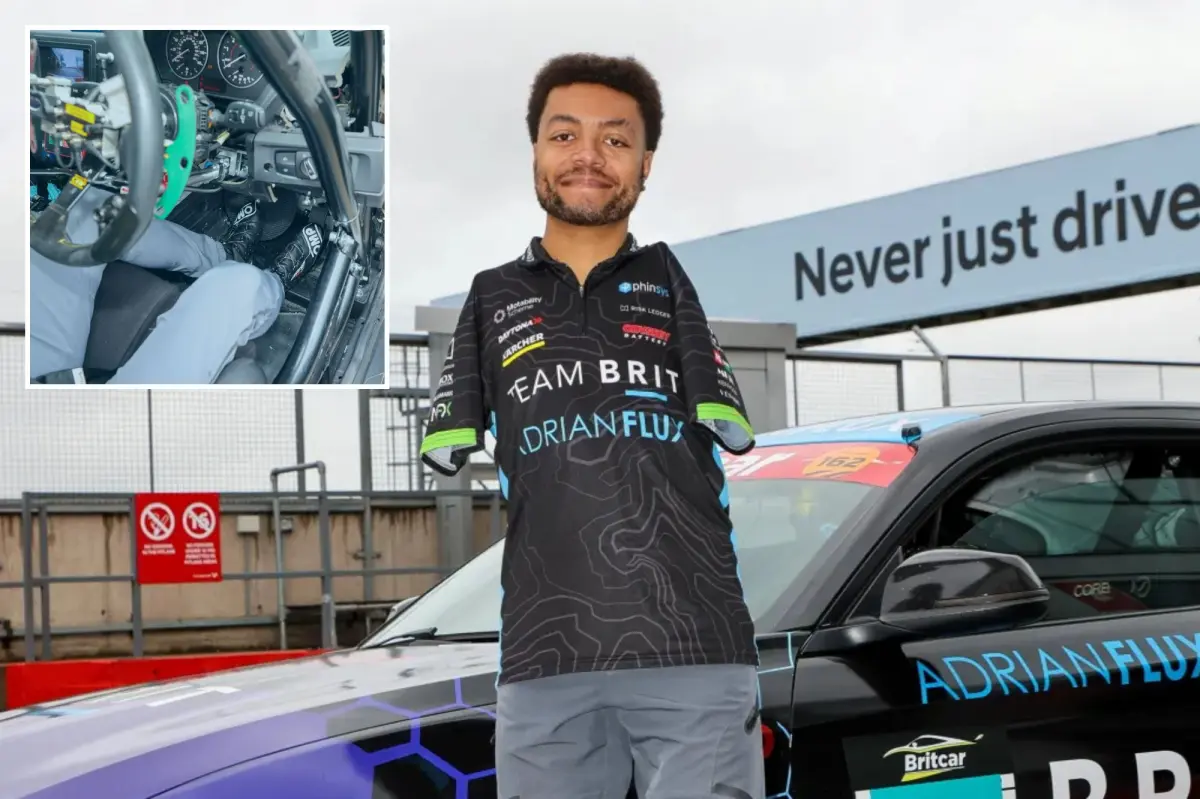
On a windswept morning at Donington Park, the roar of a modified BMW 1 Series cuts through the crisp air as it tears down the iconic 2.5-mile circuit. Inside the cockpit, strapped into the racing seat with fierce concentration, is 23-year-old Callum Smith, a finance assistant from Nuneaton, England, who is currently defying every physical convention of motorsport. Callum was born without arms due to an unexplained bilateral upper-limb disability, yet he has already pushed a race-prepped car to over 110 miles per hour, and he has no intention of slowing down. This is not just a hobby for the young man who fell in love with racing at the age of two, watching bike races on television with his grandfather, Michael Smith. It is a meticulously planned assault on the history books. Having just signed his first professional driver contract with Team BRIT—the world’s only competitive racing team composed entirely of disabled drivers—Callum is chasing a destiny that no one in the sport has ever achieved: to become the first armless driver to compete at the legendary 24 Hours of Le Mans. With his grandad’s memory fueling his ambition and a fiery self-belief that he describes as limitless, Callum is forcing the racing world to rethink what it means to be a driver, proving that the steering wheel is merely a suggestion of how control should be wielded.
The mechanics of Callum’s driving are a technological marvel born of necessity and engineering ingenuity. Inside the cabin, there is no conventional steering wheel in front of his chest; instead, a custom-built steering plate, designed by Jim Doran Hand Controls, rests in the footwell. Callum’s left foot acts as his primary steering appendage, dancing across this plate to turn the vehicle, while his right foot operates the accelerator and brake pedals with an intuitive grace that most drivers take for granted. The coordination required is staggering—a split-second ballet where his left foot must counter-steer on the heavy, stiff racing setup while his right foot modulates braking thresholds to avoid locking up. To manage the auxiliary functions of the car, Callum relies on a Lodgesons Bleeper System, a set of buttons placed atop the accelerator that control the horn, main beam, windshield wipers, and indicators. “It’s hard,” Callum admits, describing the physical sensation of driving the beastly BMW. “There’s a lot of eye-to-foot coordination. The biggest surprise to me is how heavy the steering feels in a race car—everything is stiffer.” Yet despite this immense physical strain, which would fatigue even the most seasoned able-bodied racers, Callum thrives on the challenge, describing the initial tests at Silverstone’s 3.66-mile Grand Prix circuit—where he clocked 100 mph in his own Audi A3—as the catalyst that proved his concept works. He is currently putting the Team BRIT BMW through its paces, working tirelessly toward his full racing license, knowing that the transition from a road car to a stripped-out racing machine requires not only raw speed but a deep, symbiotic trust between man and machine.
To fully grasp Callum’s journey, one must understand that his disability has never been a handicap—it is the foundation of his identity. Since birth, his feet have served as his hands, and he regards them with the same dexterity and precision that most people reserve for their fingers. He writes legibly with his right foot, plays competitive video games like FIFA and Call of Duty with the same appendage navigating the controller, and even plays the guitar with remarkable proficiency. He eats with a normal knife and fork, entirely unaided, flipping food with the casual ease of someone who has never known any other way. This remarkable independence was nurtured in a childhood filled with motorsport obsession, where his grandfather’s enthusiasm for biking ignited a flame that never extinguished. “I grew up in the motorsport world, my grandad was a massive biking fan and I loved it from such a young age,” Callum recalls. It was this background that instilled a profound, unwavering self-belief. When the time came to chase his dream, he didn’t wait for an invitation; he sent a bold, heartfelt email to Team BRIT, expressing his interest in racing and offering his eternal gratitude if they would give him a chance. His audacity paid off. The team responded, inviting him to undergo a series of rigorous tests with their instructors, including a demanding skid test to assess his car control under adverse conditions. He passed with flying colors, and the dream transformed from a fantasy into a concrete, roaring reality. Callum’s daily life is a testament to human adaptability, but his time on the track is where he transforms that adaptability into a fierce, competitive weapon.
However, the path to full racing legitimacy is paved with intense hurdles. To secure his full racing license, Callum must prove to the governing bodies that he can meet safety standards that were never designed with him in mind. The most daunting challenge involves the harness—in the event of an accident, or simply to exit the vehicle, he must physically prove he can undo the six-point safety harness and open the car door entirely unaided. This is a formidable task for someone without arms, requiring herculean core strength, flexibility, and the incredible use of his teeth, his torso, and his feet to manipulate the mechanism. Yet Callum remains undeterred, approaching this obstacle with the same grit he displays on the track. He speaks of his confidence with an almost humbling directness: “Confidence I’m not short of, but it’s going to be a lot of hard work.” He understands that the license is merely a bureaucratic formality—the true battle is on the asphalt. Each lap at Donington Park where he pushes the BMW to its handling limits is a statement of intent. He is not merely driving; he is negotiating a complex dialogue with his own body, forcing his left foot to respond to the car’s slide with millisecond precision while his right foot manages the shuddering brake pedal. His instructors are reportedly astounded by his natural rhythm and pace. Callum’s motivation is deeply personal, fueled by the naysayers who might have doubted him, but more powerfully, by the sheer joy of piloting a machine at speed. He knows he is making history, and he carries the weight of that responsibility with pride, eager to showcase his skills not as a novelty, but as a legitimate professional driver.
Callum is not alone in this vanguard of motor racing; alongside him is Harvey Phillips, a 21-year-old quadruple amputee from Louth, Lincolnshire, who is equally rewriting the rules of what a driver can be. Harvey lost parts of both legs, his right arm up to the elbow, and the fingers and thumbs of his left hand after contracting meningitis as a nine-month-old infant. His approach to driving is uniquely his own. Inside the Team BRIT car, Harvey uses a central lever for acceleration and braking—twisting it down to speed up and pushing it toward the dashboard to slow down—while steering with his the assistance of a brilliantly inventive 3D-printed cup attached to his residual right arm, which he slots into a ring mounted on the steering wheel to rotate it. “Driving this car was fun,” Harvey says with an infectious grin, describing the intricate coordination as “a bit of a puzzle” that he relishes solving. The arrival of these two young drivers marks a powerful shift for the team, highlighting the vast spectrum of human adaptation. Their journey is physical, yes, but it is equally psychological; they must overcome the fear of crashing, the frustration of mechanical complexity, and the immense pressure of representing a cause larger than themselves. Harvey echoes Callum’s focus, stating clearly that getting comfortable with the car and finding a consistent race pace are his primary goals. Together, they embody the core philosophy of Team BRIT, showing the world that disability does not preclude excellence, but rather demands a different kind of innovation and nerve.
Their story is fundamentally about a mission that transcends ribbons and trophies. Team BRIT’s ultimate goal is nothing short of historic: to be the first team to compete in the grueling 24 Hours of Le Mans—the world’s oldest and most prestigious endurance race—with a fully disabled driver lineup. This ambition is the North Star guiding Callum and Harvey through their year-long training program, as they seek sponsors to fund their equipment, track time, and the extensive modifications required for their cars. For Callum, the dream of Le Mans began with his grandfather’s couch, but it will end, if his will prevails, in the hallowed French countryside, where he will navigate the Mulsanne Straight at night, the roar of the crowd a distant soundtrack to his relentless pursuit. He dreams of crossing that finish line, not merely as a participant, but as a pioneer. His story—alongside Harvey’s—is a beacon for the millions of disabled people around the world who have been told, implicitly or explicitly, that they cannot. It challenges the automotive industry to design more inclusive interfaces, it challenges race organizers to re-evaluate their safety regulations, and it challenges society to abandon its narrow definitions of strength and ability. As Callum straps his helmet on, using his teeth to cinch the strap, he is not just a man driving a car; he is a testament to the boundless capacity of the human spirit. He is carving a new lane in a sport that has historically been exclusive, and in doing so, he is proving that the only true limitation is the one we accept in our minds. With the engine revving and the checkered flag on the horizon, Callum Smith is ready to outrun the odds.


