






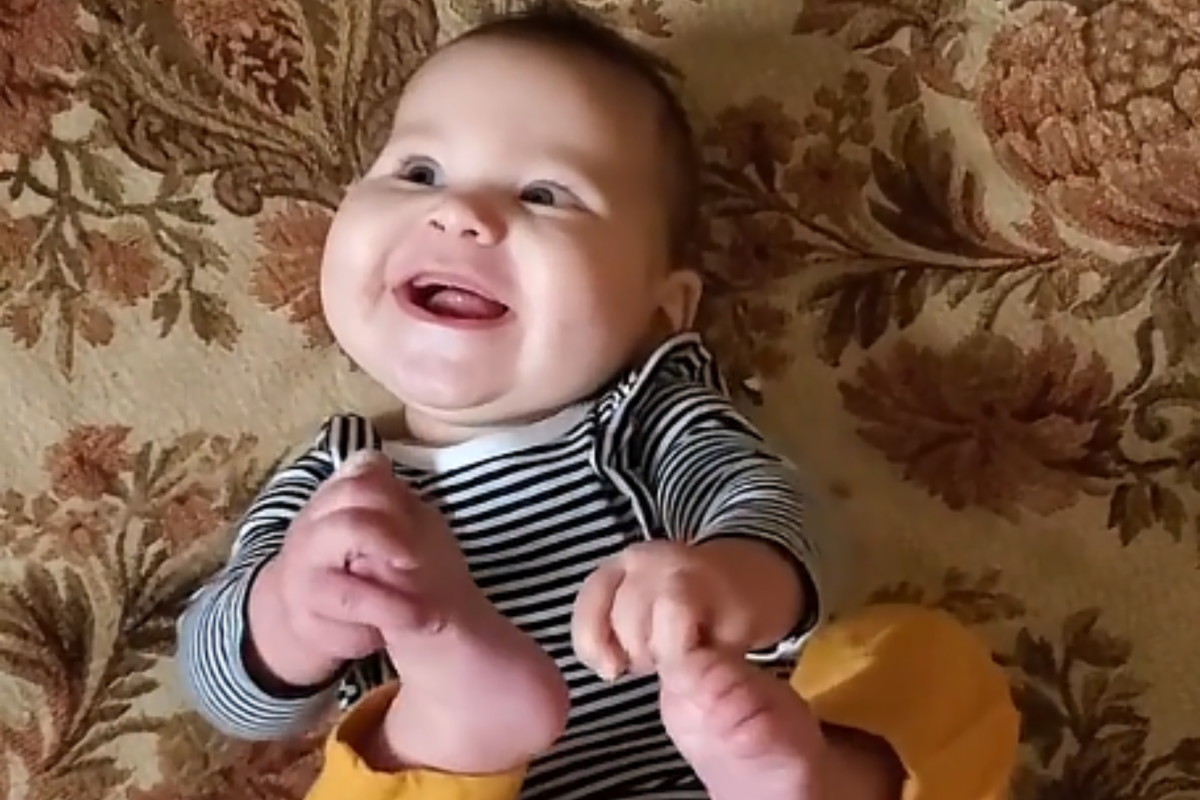
A mother’s love is not a formula. It does not calculate probabilities, weigh outcomes, or ask for a second opinion before it decides to hope. For Bambi, a 28-year-old mother in the United States who chooses to keep her real name private, that truth arrived in the most brutal way possible: in a hospital room, surrounded by fluorescent lights and beeping monitors, watching her newborn daughter fight for survival. What was supposed to be a time of joy became something else entirely. Her daughter was born with a severe form of hypoxic ischemic encephalopathy, a brain injury triggered by inadequate oxygen around the time of birth. Doctors in the neonatal intensive care unit showed the family MRI scans that told a story no new parent can bear to hear. On top of that, her daughter experienced seizures in the first days of life. The NICU team did not sugarcoat their belief. They gently but clearly said that, based on all the information they had, this little girl was unlikely to ever walk or talk. They were not trying to be cruel; they were trying to prepare Bambi for what they considered a realistic future. But Bambi, though devastated, never confused probability with certainty. She heard their warning. She also heard her own heart.
That heart was tested again when doctors delivered another piece of news, one so overwhelming it nearly broke her. Her daughter was also diagnosed with pyruvate dehydrogenase complex deficiency, a rare genetic metabolic disorder that affects the body’s ability to convert carbohydrates into energy. It was a second medical weight piled onto an already unbearable load. Bambi described the chaos of those early days with devastating honesty, telling Newsweek that receiving terrible news was only the beginning. “I guess that’s just being thrown off the deep end of parenting,” she said. “You get horrible news, and then five minutes later someone needs your insurance card, and you realize you haven’t eaten since yesterday, and you have to make calls and let everyone else know what’s going on.” There was no time to fall apart in the way grief demands. There were phone calls to make, forms to fill, insurance battles to fight, and the constant hum of practical survival drowning out the emotional wreckage. The moment a parent is told their child’s future may be unrecognizable, they must somehow continue to function as if the world has not just tilted. Bambi did exactly that, stumbling through the administrative nightmare of modern healthcare while trying to understand what was happening to her child. It was not heroic in the television sense. It was raw, messy, exhausting, and utterly human.
The timing made everything harder. Her daughter spent two weeks in the NICU during the height of the COVID-19 pandemic, and Bambi was often there without the comfort of family or friends by her side. Hospitals were locked down, visiting hours were brutal, and the world outside felt unstable and frightening. In the quiet, lonely hours beside her daughter’s incubator, she had to confront the terrifying possibility that her baby might never smile at her, never call her name, never take her first unsteady steps toward her arms. And yet, even in that darkness, Bambi chose a different path. She refused to let a prognosis dictate her efforts. She made a deliberate decision that is so easy for someone who has never been in that position to misread. She was not hoping for a miracle that would erase disability. She was not in denial. She simply understood that even a small possibility was still a possibility worth pursuing. “If somebody tells me my child has a 5 percent chance of doing something, I understand that means there is a 95 percent chance she won’t,” Bambi explained. “But I’m also not going to make decisions based on the most pessimistic view of her future. I didn’t need to believe she was definitely going to achieve a particular milestone to want to find out.” That distinction is at the heart of her story. She did not need guarantees to keep loving, to keep pushing, to keep showing up.
What followed was a grueling, unglamorous marathon. In the beginning, the family lived in an underserved area where early intervention services were difficult to access. Bambi did not wait for help to arrive. She went looking for it. She scoured online resources, leaned on friends who worked in education, and eventually connected with state intervention programs. When insurance coverage ran out, she and her husband drained their savings to pay for therapy out of pocket. There were no parades, no social media applause in those early months. Just endless repetition. Just the quiet, grinding work of trying to help a tiny child build a foundation of movement and connection. Bambi was honest about how far the reality was from the polished milestone videos that later appeared on her TikTok account. “Before you get the big milestones in the video, there are months of working on weight shifting, trunk control, reaching across midline, tolerating a position, moving one foot correctly over and over again until something sticks,” she said. It was the kind of work that does not trend online. It was sitting on the floor, hour after hour, adjusting a foot, praising a glance, holding a toy just one inch beyond reach. It was not giving up when progress was invisible to everyone except a therapist with a trained eye. Bambi learned to celebrate tiny victories: a head held steady for ten seconds longer, a hand reaching across the middle of the body, a new understanding in a pair of bright eyes. Those small steps became the building blocks of the later miracle moments. But they were slow. They were exhausting. And they were, every single day, a refusal to accept that a future of possibility had already been written by a doctor’s assessment.
Today, Bambi’s daughter is five years old. The prognosis of “unlikely to walk or talk” now lives in the rearview mirror, but Bambi is careful not to pretend that it has been completely defeated. Her daughter is still a disabled child with significant medical needs. She receives multiple therapies and is involved in a clinical trial for dichloroacetate, a medication designed to help regulate mitochondrial energy production, alongside a ketogenic diet. That combination, Bambi says, has coincided with remarkable developmental gains. She does not want to tell a tidy, misleading story of cure or conquest. “I don’t want the ending of this story to be, ‘Surprise, disability defeated!’ That’s not what happened,” she insisted. “She is still a disabled child with medical needs. However, she’s very happy, very opinionated, and relatively healthy. Still surprising us every day with new skills.” Those new skills may not look like the skills other parents brag about on social media. They might be a single sign, a shared laugh, a stubborn expression, a tiny word spoken after months of silence. But for Bambi, each one is more precious than any first-place trophy. Her daughter has not just survived those early terrifying predictions; she has expanded the boundaries of what everyone, including the doctors who counseled them, thought was possible. She has done so on her own timeline, in her own way, with her own fierce spirit. Bambi’s pride in her daughter is not about proving doctors wrong. It is about watching a child grow into the person she was always meant to become, even if that person looks different from what anyone expected.
For other parents who receive similarly devastating prognoses, Bambi has a simple but profound message: unlikely does not mean impossible. A prognosis is not a sentence. It is a snapshot of information based on what is known at a certain moment in time, and children have a remarkable way of rewriting the story. Bambi advises parents to read the research, ask questions, seek second opinions when warranted, and use every piece of equipment and every therapy available. She also acknowledges that goals may need to change along the way, and that is not a failure. It is wisdom. “A prognosis is information, not an instruction to stop trying,” she said. “Read the research. Ask questions. Get second opinions when they’re warranted. Use the equipment. Change the goal when the goal needs changing, but don’t mourn your child and the future you expected for them so thoroughly that you forget they’re still right there.” That last line is the heart of her message. It is too easy, when faced with a diagnosis, to get lost in the future that will never be. But the child is not gone. She is there, waiting for her mother to see her, to love her, to fight for her. Bambi’s story is not a fairy tale with a perfect ending. It is something far more real and far more powerful: a story about a mother who reached into a dark, uncertain future with two bare hands and demanded a place for her child in it. She did not erase disability or hardship. She met it with courage, patience, and a stubborn love that refused to let a pessimistic prediction become the only chapter. Five years later, her daughter is not a statistic, not a cautionary tale, not a miracle cure. She is simply a happy, opinionated, relatively healthy little girl who still surprises everyone, one new skill at a time. And she is alive, present, and loved far beyond any number a machine or a doctor could assign to her worth. That is the truest victory of all.