




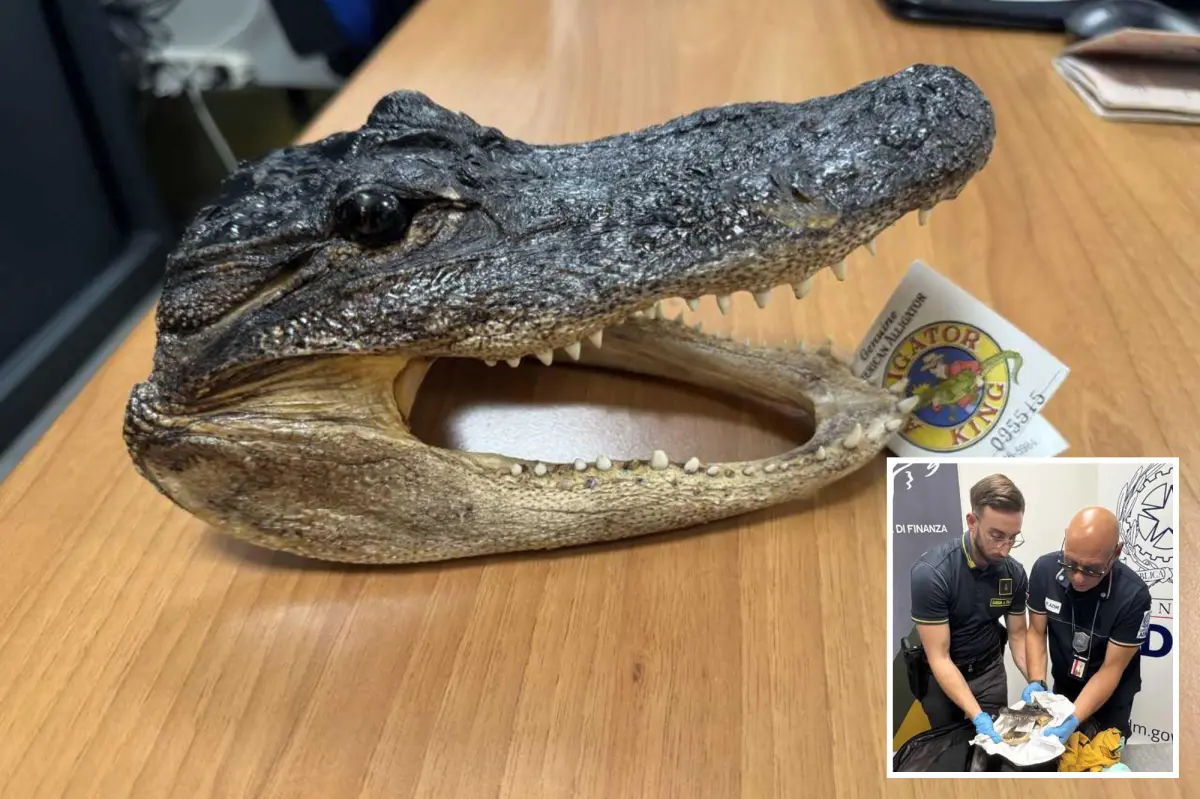
To most people, the beginning of a quiet morning at an airport looks like any other: travelers shuffling through glass doors, tickets clutched in tired hands, suitcases moving along conveyor belts like obedient animals. At Sandro Pertini Airport in Caselle Torinese, near Turin, Italy, that ordinary rhythm was violently interrupted by a suitcase containing something no one expects to find wrapped in paper. A passenger, who had flown from Miami and connected through Istanbul, made his way through baggage check only to find himself facing customs officers with questions he could not easily answer. Inside his luggage, hidden among the ordinary items of a traveler’s life, was the severed head of a crocodile. The head was dry, preserved, and carefully wrapped, as if the person carrying it imagined it might pass as nothing more than an unusual souvenir. It did not. The discovery triggered immediate alarm, and authorities moved quickly to confiscate the biological remains, report the man to the Guardia di Finanza, and set in motion a legal process that could end with a six-figure fine or time behind bars. The man had not been accused of violence on the plane, nor of carrying explosives or contraband chemicals; his alleged crime was carrying the remains of a creature that belonged to a protected species, a trophy that many would consider grim, illegal, and profoundly unnecessary. Later, someone on the internet would describe the scene as a portrait of human greed ignoring wildlife, and the image is hard to shake. A crocodile that once ruled a river, basked in muddy sunlight, and breathed the heavy air of a living ecosystem was reduced to a dried artifact in a bag, heading toward someone’s private collection. The officers who unpeeled the paper likely felt a shock that was personal as well as professional: an encounter with death that had traveled thousands of miles only to be exposed in an Italian customs room.
The legal language is clinical, but the stakes are deeply human. The unidentified man was reported for importing a specimen belonging to a protected species without the required certificate or license, according to a statement from Turin’s Guardia di Finanza. If convicted, he could face a fine ranging from roughly $23,200 to $232,000, or a sentence of six months to one year in prison. That wide range reflects the seriousness of wildlife trafficking, a global criminal enterprise estimated to be worth billions of dollars each year, and the determination of authorities to send a message that the trade in protected animals is not a minor oversight. The law exists because the destruction of species does not happen naturally; it happens suitcase by suitcase, order by order, greed by greed. International treaties such as the Convention on International Trade in Endangered Species, commonly known as CITES, are supposed to act as a barrier between the wild and the market, but every day, travelers and smugglers attempt to slip through the gaps. This man, if he had possessed the correct paperwork, might have been legally transporting a specimen for scientific, educational, or cultural reasons. Without it, his dried crocodile head became evidence of an illegal act, a violation not just of national law but of a broader agreement among nations to protect vulnerable creatures. What makes the story particularly unsettling is how easy it is to imagine the man’s own perspective. Perhaps he bought the head at a market, thinking it looked bold, exotic, or impressive. Perhaps he was unaware of the legal requirements, or perhaps he simply did not care. In any case, he was caught, and in being caught he joined the uncomfortable parade of people who discover that the world’s laws are not suggestions and that wildlife cannot be carried across borders like a bottle of perfume.
Italy’s customs agency, working alongside airport officials, has been increasing baggage checks in the summer months, and this incident appears to be a direct result of that vigilance. The tourism season brings a wave of passengers returning from increasingly exotic locations, and with them come objects that should never have been removed from their places of origin. Some travelers bring shells, corals, ivory trinkets, snake skins, or carved bones, unaware that their souvenirs may have been taken from animals facing extinction. Others are not unaware at all, and they arrive at customs with carefully hidden packages, hoping that airport scanners will not notice what lies beneath clothing and toiletries. The Guardia di Finanza has been training its officers to spot these hidden treasures, learning the visual signature of illegal animal products, the way a crocodile head wrapped in paper appears on an X-ray screen, the density of bone and dried muscle that signals something unnatural and unlawful. The effort is noble, but the scale is overwhelming. Wildlife trafficking is a low-risk, high-reward crime in many parts of the world, and for every head caught in an Italian airport, countless other animals may still be dying in remote rivers, forests, and savannas. The crocodile head in Turin is therefore not just a strange incident but a tiny window into a massive and brutal industry. By drawing attention to this passenger, the authorities hope to deter others and to remind travelers that their choices have consequences. But the deeper truth is that laws alone cannot protect the world’s creatures. As long as there is a desire for exotic trophies, there will be someone willing to kill and carry them, and as long as the demand persists, the airport scanners will keep catching fragments of a tragedy occurring far away from the bright lights of customs halls.
Amid the legal procedures and the policy debates, it is important to pause and look at the crocodile itself, the silent victim in this strange affair. A crocodile is not a symbol. It is a living being, an animal with a long evolutionary history, a creature that has survived on Earth for millions of years by being powerful, adaptive, and intelligent in its own ancient way. This particular crocodile swam through water, felt the sun on its scales, perhaps raised a family, and died not because of natural causes or a predator’s hunger but because a human being decided that its head would make a striking trophy. The head was dried, preserved, wrapped in paper, and placed in luggage, transformed from a part of a sentient animal into an object of display. The dehumanization of animals happens so quietly that most people do not notice it. We call them specimens, samples, and seized goods, and in doing so we erase the fact that each one had a life, a wildness, and a right to exist. This crocodile belonged, in all likelihood, to a species protected because of declining populations and the pressures of poaching. Every illegal removal from the wild makes the species a little more fragile, a little closer to the edge of disappearance. The person carrying that head may have seen it as a piece of decoration, a conversation starter, or a connection to a dangerous world. But what he was really carrying was the evidence of an ecological wound, a death that would never be mourned by the marketplace. Humanizing the story means seeing the crocodile not as a villain or a trophy but as a victim, one that had no choice in the matter and no way to defend itself against the human desire to own and display. In the end, the creature that arrived at the airport was already gone, but the act that killed it was still being counted, still being measured, still being judged.
When the incident was shared online, the reactions were as revealing as the event itself. On an Instagram post from the Brazilian outlet Metrópoles, one outraged man wrote: “An unacceptable absurdity! What we’re seeing here is a portrait of human greed ignoring wildlife. A living being, part of an endangered species, treated like an object in a suitcase.” His words captured a genuine and important anger, a refusal to accept that such cruelty should be normalized or dismissed. But on a post from the Italian newspaper Il Messaggero, another commenter responded with a cynical twist: “Meanwhile, while our customs is busy with this super seizure, suitcases full of methamphetamine are crossing the border as if it were nothing.” The contrast between these two voices says a great deal about how people react to crime and suffering. One person looks at the crocodile head and sees the horror of species extinction; another looks at the same incident and sees a missed opportunity to investigate more dangerous criminals. Neither response is entirely wrong, but both are incomplete. The outrage is understandable because the killing of a protected animal is a violent and selfish act. Yet the cynicism also carries a point, not because wildlife crime should be ignored, but because human beings are often selective in what they care about. We mourn a crocodile head in an airport while ignoring the drug epidemic destroying families, or we worry about drugs while overlooking the silent extinction crisis happening around us. The truth is that society is capable of caring about both, and that the presence of one tragedy does not erase the importance of another. What the comments reveal is not a contradiction in the law but a struggle in human psychology: the difficulty of holding multiple truths in our minds at once, of feeling compassion for animals while also confronting the many ways people harm each other. The crocodile head is an easy target because it is visually grotesque and legally unambiguous. It does not confront us with the complexity of addiction, poverty, or systemic violence. It is a simple, ugly object, and that simplicity makes it satisfying to condemn.
In the end, this strange little story from a Turin airport is more about us than about the crocodile. It is about the choices we make when we travel, the souvenirs we buy, and the values we carry in our own bags. It is about the enormous distance between a living animal in its natural habitat and a dried head wrapped in paper, and the many small steps in that journey that require people to look away, to ignore, to rationalize, and to participate. The man who was stopped at Sandro Pertini airport might face a fine that changes his life or a prison sentence that takes away his freedom, and that is the legal consequence of his decision. But the deeper consequence is incalculable, because no punishment can bring back the crocodile, and no fine can repair the damage done to a species that cannot testify in court. What the authorities can do is continue to inspect the bags, scan the cargo, and enforce the rules that protect the fragile web of life that humans depend on. What every traveler can do is ask one simple question before buying an exotic souvenir: did something die so that I could own this? If the answer is even slightly uncertain, the only responsible choice is to walk away. The crocodile head in Turin has become a brief news item, a curiosity that will fade from the headlines within a day. But if we are willing to look deeper, it becomes a mirror reflecting our own complicated relationship with the natural world, a relationship too often based on domination rather than respect. The man was caught, and the head was seized, but the fight against wildlife trafficking is far from over. The next suitcase is already being packed somewhere in the world, and the next animal may already be dead. Whether that suitcase will be stopped depends not only on customs officers and international laws but on the slow, difficult work of changing human hearts and minds, one person at a time.