





For decades, the city of Tuscaloosa, Alabama, has existed as the undisputed epicenter of the college football universe, a place where championship banners are treated as annual expectations rather than hopeful dreams. Under the sweltering Southern sun, generations of fans have grown accustomed to seeing the Crimson Tide dominate not only the gridiron but also the preseason accolades, routinely hoarding first-team All-American selections like precious crown jewels. Yet, the winds of change are blowing through Bryant-Denny Stadium, and the latest preseason All-America team released by the Sporting News serves as a stark, sobering reminder of how quickly the national perception can shift. In what can only be described as a historic lull in expectations for the proud program, Alabama found itself represented by a solitary player on the entire roster—and to the dismay of the Crimson Tide faithful, that lone representative did not even secure a spot on the coveted first team. This unprecedented omission has sent shockwaves through a fan base that measures success solely in gold and glory, sparking intense debate about whether the national media is finally writing off the powerhouse, or if they have simply overlooked the quiet storm brewing in the heart of Dixie. For a program built on the foundation of relentless excellence, this perceived disrespect is more than just a statistical anomaly; it is a direct challenge to the culture of Alabama football, serving as a reminder that respect in this modern era of the sport must be violently reclaimed rather than passively inherited. In this environment, where football is not merely a game but a secular religion, these preseason lists are parsed with the intensity of ancient prophecies, and the sudden absence of Alabama’s signature dominance on the national stage feels like an existential tremor shaking the very foundations of the community.
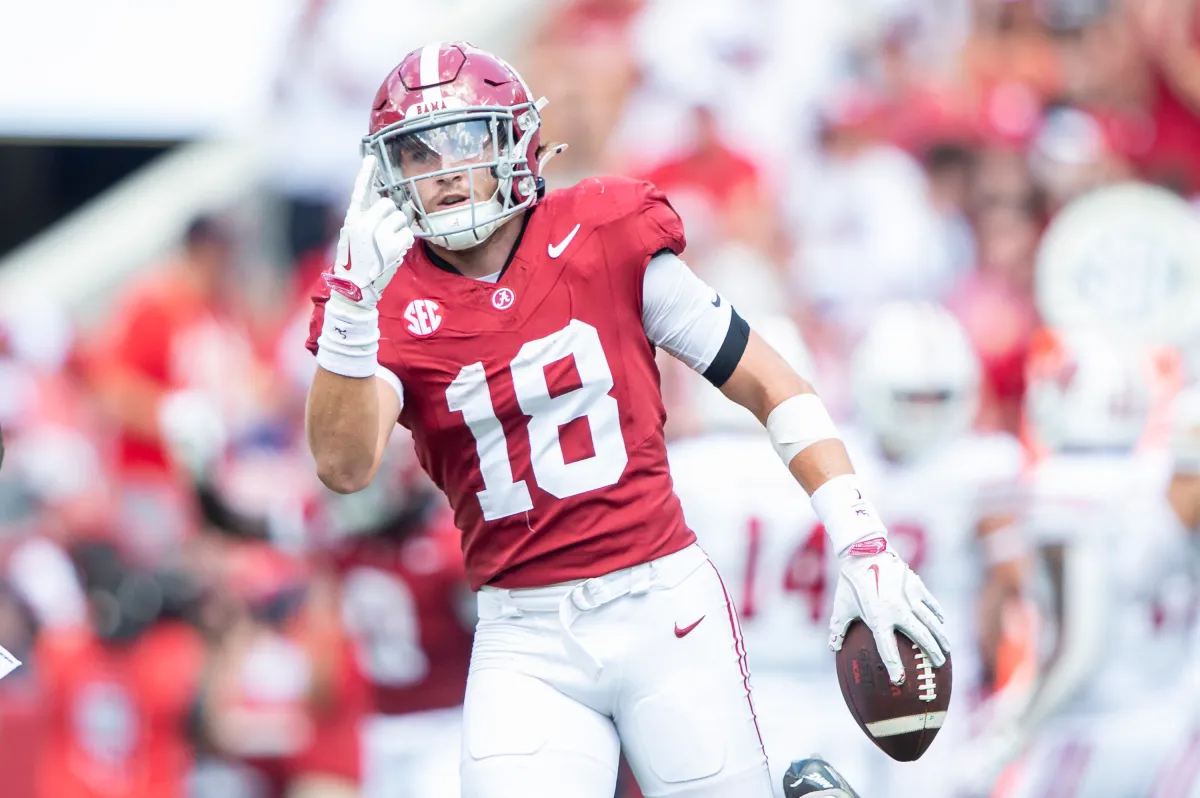
The sole bearer of the Alabama flag on this year’s Sporting News preseason list is safety Bray Hubbard, who earned a well-deserved, albeit solitary, spot on the All-America second team. While some might view a second-team nod as a slight, those who closely watched Hubbard’s meteoric rise during the 2025 season understand that his inclusion is a testament to blue-collar work ethic and an extraordinary, almost instinctual nose for the football. Hubbard spent the previous season terrorizing opposing quarterbacks, cementing his status as one of the nation’s premier ball-hawks by tying for the Southeastern Conference lead with four crucial interceptions. His finest hour came in a relentless defensive showcase against the Wisconsin Badgers, where he picked off two passes in a single afternoon, single-handedly shifting the momentum of the game and breaking the spirits of the opposing offense. But Hubbard’s impact extends far beyond his coverage skills; he is a violent, physical defender who forced three fumbles and racked up an impressive 79 total tackles, including 50 solo stops, 4.5 tackles for loss, and a pair of sacks. He is the quintessential modern safety—capable of playing in the deep third of the field one play and crashing down into the box to blow up a running play the next. Yet, despite these eye-popping statistics and his undeniable influence on the field, Hubbard has never been one to seek the spotlight, preferring to let his hard-hitting style of play do the talking for him, even as he now carries the weight of being Alabama’s only recognized preseason All-American. His journey from an overlooked recruit to a vital cog in the defensive machine is the kind of story that defines the human element of college sports, showing that sheer determination and a relentless pursuit of the ball can triumph over recruiting stars and media hype.
The true shock of the preseason list, however, lies not in who was included, but in who was left behind in the shadows, most notably wide receiver Ryan Coleman-Williams. Just a year ago, Coleman-Williams was the undisputed poster child of college football’s next generation, sharing the highly anticipated cover of the “EA Sports College Football 26” video game alongside Ohio State’s sensational wideout, Jeremiah Smith. It was a marketing marriage made in heaven, showcasing the two brightest young stars in the sport and setting the stage for an epic, bi-coastal rivalry of productivity. Fast forward to the release of the Sporting News preseason All-America team, and the contrast between the two cover stars could not be more jarring: while Smith secured his rightful place on the first-team roster, Coleman-Williams was completely, inexplicably absent from the list. For a player of Coleman-Williams’ immense talent and high-profile status, such a glaring omission is a psychological curveball, a public demotion that challenges his standing among the elite elite. It forces us to look past the glitz of video game covers and NIL deals to examine the human element of a young athlete dealing with the fickle nature of national praise, where one day you are the face of a multi-million-dollar franchise and the next you are fighting to prove you belong in the conversation of the top players in your own conference. The omission is not just a statistical debate; it is a narrative of redemption for Coleman-Williams, who must now channel the disappointment of being overlooked into a dominant on-field campaign, showing the world that digital covers mean nothing compared to real-world dominance. This setback will either crush a player’s spirit or ignite a competitive fire that burns through opposing secondaries all season long, and those close to the Alabama program believe it will greenlight a version of Coleman-Williams that is hungrier, sharper, and more dangerous than ever before. He now enters the season not as the celebrated golden boy, but as an elite competitor with a massive point to prove to every voter who left his name off their ballots.
Equally baffling to coaches, analysts, and fans alike was the omission of cornerback Zabien Brown, a defensive maestro who spent the previous season delivering some of the most spectacular, high-stakes plays in recent college football history. Brown proved himself to be the ultimate big-game hunter, leading the entire country last season with a pair of defensive touchdowns that occurred at the absolute peaks of competitive tension. His first iconic moment came against the bitter rival Tennessee Volunteers, when, with the Vols threatening to score at the end of the first half, Brown intercepted a pass in his own end zone and sprinted a breathtaking 99 yards down the sideline for a touchdown, turning a potential deficit into a commanding halftime lead. He proved this was no fluke in the high-stakes arena of the College Football Playoff, stepping in front of a pass from Oklahoma Sooners quarterback John Mateer and returning it 50 yards to tie the game in the first round, sending the stadium into absolute pandemonium. Brown’s ability to rise to the occasion when the lights are brightest has led many scouts to believe he is actually the true crown jewel of the Alabama secondary, a unit that is widely projected to be a top-five defensive backfield in the nation. To see a player who literally alters the course of championship games left off a preseason All-America list is a tough pill to swallow, highlighting the often-arbitrary nature of preseason projections that favor offseason hype over on-field, cold-blooded execution. The human story here is one of a clutch performer who does not receive the credit his historic plays deserve, yet continues to prepare with the quiet confidence of a player who knows his worth cannot be measured by a panel of journalists. His pick-sixes are not merely highlight-reel moments; they are memories etched into the hearts of Crimson Tide fans who will forever remember where they were when Brown turned defeat into victory. For Brown, the goal remains unchanged: to lock down his side of the field and make opposing quarterbacks pay dearly for every mistake, regardless of whether the national media recognizes his defensive brilliance ahead of time.
Despite the perceived slights from the Sporting News, the football establishment has not entirely ignored the immense talent residing in the Alabama defensive backfield, as both Bray Hubbard and Zabien Brown were recently named to the prestigious preseason watch list for the Bronko Nagurski Trophy, awarded annually to the best defensive player in college football. This dual recognition speaks volumes about the true potential of this Crimson Tide defense, suggesting that while individual national media outlets may overlook them, opposing offensive coordinators are staring at the game tape with a sense of genuine dread. There is a unique synergy that exists between a safety like Hubbard and a cornerback like Brown; Hubbard’s physical presence over the top allows Brown to play with aggressive, predatory instincts on the perimeter, while Brown’s lockdown coverage forces quarterbacks to hold onto the ball just long enough for Hubbard to fly down and make a play. This symbiotic relationship is the engine that drives Alabama’s defensive identity, a brotherhood forged in the grueling heat of practice field repetitions and film room study. Being left off the All-America lists while simultaneously being nominated for the sport’s highest defensive honor creates a fascinating paradox, feeding a collective chip on the shoulders of these young men who are eager to prove that the whole of this Alabama defense is far greater than the sum of its preseason ratings. This shared snub binds the secondary together, transforming them from individual stars into a cohesive, dangerous unit determined to restore Alabama’s reputation as a defensive steel curtain that suffocates opponents. They understand that individual glory is fleeting, but a championship defense that dominates the SEC is immortalized in the history books of college football forever. Their daily practices have become intense laboratories of defensive excellence, where they challenge each other to reach new heights, knowing that the ultimate validation will come from hoisting trophies at the end of the year rather than reading preseason press releases in August.
Ultimately, these preseason lists are written in pencil, destined to be erased and rewritten by the chaotic, unforgiving reality of the college football season. For the Alabama Crimson Tide, starting the season with a lack of national fanfare might actually be the greatest gift they could receive, stripping away the complacency that often plagues highly touted teams and replacing it with a hungry, underdog mentality that Tuscaloosa hasn’t seen in a very long time. History has shown that there is nothing more dangerous in the sporting world than a roster overflowing with elite, blue-chip talent that believes it has been disrespected and undervalued by the outside world. When the pads click, the stadium lights turn on, and the real games begin, the opinions of writers and analysts fade into the background, leaving only the truth of what happens between the white lines. Do not be surprised if, when the dust settles in January and the official postseason All-America teams are announced, Bray Hubbard is joined by Ryan Coleman-Williams, Zabien Brown, and a host of other Crimson Tide stars who used this summer’s snubs as the fuel to launch a relentless campaign of redemption, proving once again that the standard of Alabama football is defined by how you finish, not where you start. The young men wearing the crimson and white are not playing for preseason accolades; they are playing for their teammates, their families, and the legacy of a program that refuses to yield its crown without a fierce fight. As they prepare to march onto the field, they do so not with the burden of maintaining someone else’s expectations, but with the liberating power of having everything to prove and absolutely nothing to lose. In the end, the Sporting News snubs may be remembered not as a sign of Alabama’s decline, but as the spark that reignited a dynasty, turning a group of doubted athletes into a legendary team that conquered the college football world on its own terms.