






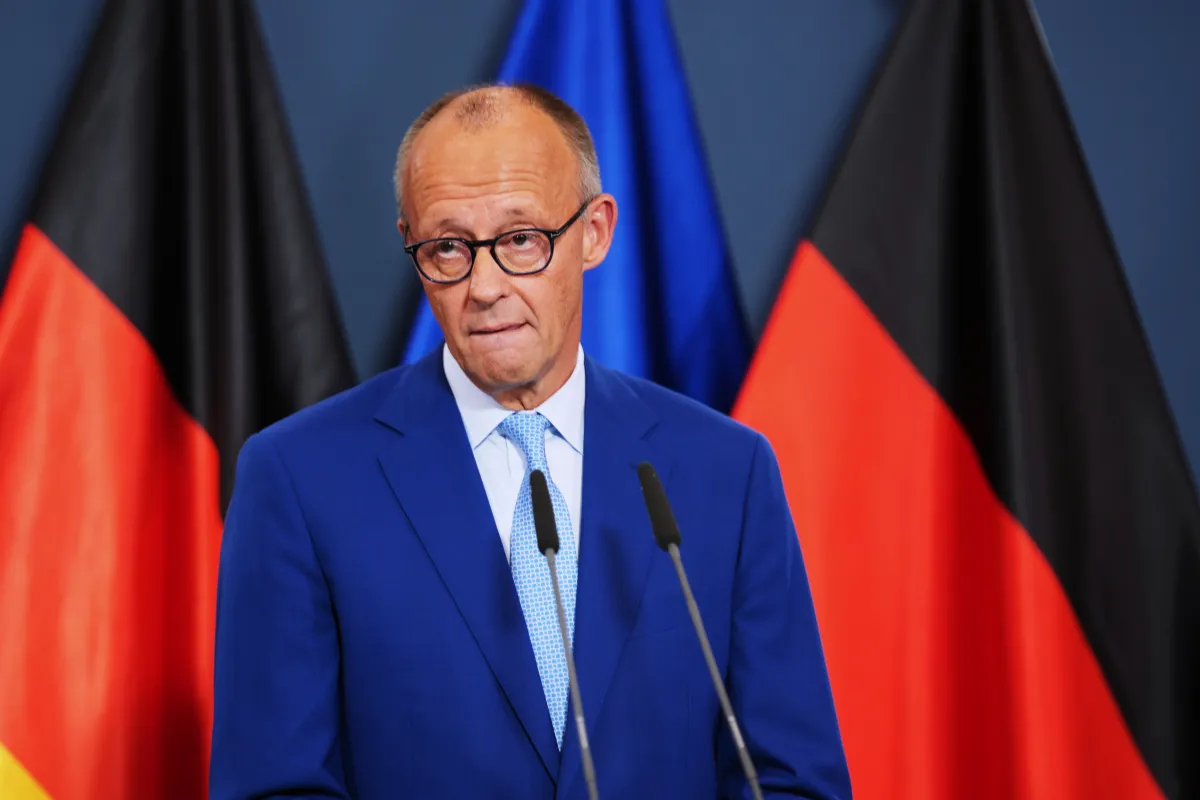
There is a particular kind of exhaustion that settles over a political leader when the results keep coming in the wrong direction. On Sunday evening in Germany, Chancellor Friedrich Merz was standing in that glare again, watching the numbers roll across the screen and trying to find words that did not sound hollow. It had been another difficult night for the conservative bloc he leads. In the northeastern state of Mecklenburg-Western Pomerania, the far-right Alternative for Germany, or AfD, swept to a commanding victory with 37 percent of the vote. In Berlin, the city at the heart of the country’s power, the story was different but no less painful for Merz: his Christian Democratic Union finished second, at around 20 percent, while the socialist Left Party won the capital with 24.5 percent. And in the same Berlin race, the AfD still managed to pull in 15.7 percent, enough to keep proving it is a presence that cannot be ignored. There is no way around it: these were bad numbers for the chancellor. They were not just bad in a technical sense, in the way that pollsters and political strategists might analyze them. They were bad in a human sense, because they carried the weight of disappointment, frustration, and a growing sense among voters that the people in charge of Germany are not delivering what the country needs.
When the exit polls were announced, Merz did not try to put a brave face on the results. He called them a “disaster,” and it is hard to imagine he felt any differently. But then came the tricky part. A politician in his position has two basic choices: accept the judgment and step back, or stay and fight. Merz chose the second option. He rejected calls to resign, insisting that he would continue leading the government and his party despite the mounting criticism from opponents and the unease becoming audible among some members of his own coalition. According to the Associated Press, he made it clear that the path forward was not one of panic or retreat, but of persistence. “What needs to be done now requires backbone, steadfastness, and patience,” he said in a statement after the exit polls were published. “I will demonstrate these qualities as chairman of the CDU and, above all, as Chancellor of our country.” There is something almost defiant in those words, a sense of a man digging his heels in as the political ground shifts beneath him. But defiance alone may not be enough. Behind the brave statement lies a deeper question that no amount of resolve can easily answer: if the voters keep rejecting you, how long can you insist that you are the one to lead them?
The elections on Sunday were never just about regional politics. They were a temperature check on the national mood, and the temperature in Germany is running dangerously hot. The AfD has been riding a wave of anger, and its latest victories have made it clear that this is not a fleeting protest movement. The party entered the weekend with momentum from a striking win in the eastern state of Saxony-Anhalt on September 6, where it took 43.8 percent of the vote, more than doubling the support received by Merz’s CDU, which finished at 17.2 percent. That result was itself a historic milestone, the strongest showing by a far-right party in a German state election since the end of World War II. Sunday’s results confirmed that the AfD’s appeal has not faded. In Mecklenburg-Western Pomerania, the party won outright with 37 percent, leaving the CDU to collapse to 5.5 percent, a number that could almost be described as a political extinction event in that state. In Berlin, the AfD did not win, but its 15.7 percent was still a sign of deep dissatisfaction in a city that usually leans left and values tolerance and diversity. The party has tapped into something raw and real: voters who feel ignored, anxious about the economy, worried about immigration, and disappointed by the mainstream parties that have governed Germany for so long. The AfD has made itself the loud voice of that discontent, and every election cycle, more people seem willing to listen.
It would be a mistake, however, to read these results only through the lens of far-right success. The other major story of the night was the victory of the socialist Left Party in Berlin, a result that complicates the simple narrative of a country tilting rightward. Berlin is a city unlike any other in Germany, a sprawling metropolis of rent protests, tech startups, cultural experimentation, and deep social inequality. Winning an election there requires a coalition of very different kinds of voters, and the Left Party managed to bring them together, running on a platform that emphasized affordable housing, public services, and social justice. With 24.5 percent of the vote, it outpolled the CDU and the AfD, a reminder that many Germans are looking in a different but equally radical direction, not toward nationalism but toward socialism. The strange picture that emerges from Sunday is a Germany in fragments. The traditional center is shrinking. The two poles of protest, the far right and the far left, are both growing, and the established parties are being squeezed into smaller and smaller spaces. This is not just a story about Merz or his party. It is a story about the unraveling of the political settlement that rebuilt Germany after the war, the settlement that promised stability, moderation, and reliable governance. That settlement is now under enormous strain, and the people of Germany are sending a message that they no longer trust it to solve their problems.
Perhaps the most troubling consequence of Sunday’s elections is the political gridlock that is beginning to define German democracy. The AfD has proven that it can win votes, and in some regions it can finish first. But the mainstream parties have largely maintained a policy of refusing to govern with it, cooperate with it, or even treat it as a normal participant in democratic politics. This is a principled stance, rooted in an understandable horror at the explosive language and radical ideas that have come out of the AfD. But it also creates a problem. When a party wins a large share of the vote yet is locked out of power, a sense of injustice builds among its supporters. They see their votes as counting for nothing, and they grow even angrier. In Mecklenburg-Western Pomerania, the AfD came out on top, but it is unlikely to form the government because no other party will join it. The CDU, despite its humiliation, may end up as part of a governing coalition that excludes the party that won the most votes. This is legally possible and arguably morally justified, but it is not a formula for democratic stability. It produces a government that many people did not ask for, and it deepens the feeling that the system is rigged. The same dynamic can be observed throughout Europe, where nationalist parties are rising everywhere, and the mainstream response has often been to build a wall around them. It is a response that preserves the old order in the short term but leaves the underlying crisis of trust untouched.
So where does Germany go from here? It is tempting to say that Merz’s decision to stay on is simply an act of stubbornness, the final chapter of a leader who cannot accept the verdict of the voters. But there is also something human in it. To leave now would be to admit that his project has failed, and in the glare of public humiliation, that is a difficult thing for anyone to do. He spoke about backbone and steadfastness, and he probably believes those words. The question is whether the voters will ever believe them again. The problems that are driving people to the AfD and the Left Party are not going to disappear. Germany is facing serious economic challenges, the pressure of migration, the cost of living, the lingering anxieties of a society that feels it is changing too quickly. The mainstream parties have offered versions of stability, but stability has not felt stable to the people who are struggling to pay their rent or afraid that their neighborhoods will become unrecognizable. The AfD has offered anger instead, and die Linke has offered a different kind of anger, and both are finding listeners. Merz may indeed have the patience he promised, but patience is not a policy. The deeper need is for the CDU and its allies to understand why so many people have stopped listening to them, and to find a way to speak to those fears without embracing the extremes. That is the truly hard work of politics, harder than winning an election, harder than holding a coalition together. And it cannot be accomplished simply by refusing to step down. For now, the man at the top of Germany’s government says he is staying, and perhaps he will weather this storm. But storms like this one do not always pass quietly. Sometimes they reshape the landscape, and by the time the skies clear, political leaders are standing in a world they no longer recognize.