


The sound I most associate with death is silence. Not only the final silence that settles after a last breath, but the many smaller silences that follow it. There is the quiet of a house after the funeral, when the last well-wisher has finally left and you are alone with your thoughts and an inexplicable amount of food brought by people who did not know what else to give. There is the silence of weeks later, when you reach for your phone to share a small piece of your day with someone who will never answer, and then you stop yourself. There is the awkward pause that appears even years afterward, when you mention that someone close to you has died and the person across from you searches for words that do not exist. For most of my life, that is what death sounded like: absence, hush, a room with one less voice in it. So when I first learned about Sa: Paru, an annual festival in Bhaktapur, Nepal, that honours people who have died in the past year with a carnival, I was both curious and skeptical. Drums and bells? Dancing in the streets? Satirical masks and laughter? That did not sound like grief at all. But as Ajay Bahadur Pradhanang, chairman of the boutique hotel The Nanee, explained, the Newar people of the Kathmandu Valley see things differently. “When people pass away in western societies, people wear black. They grieve in silence – it’s a very somber moment,” he said. “But in Nepal, everybody comes together and it’s turned into this carnival, a real joyous moment of farewell.” I wanted to understand how a community could turn loss into celebration, so I went to Bhaktapur to experience Sa: Paru for myself.
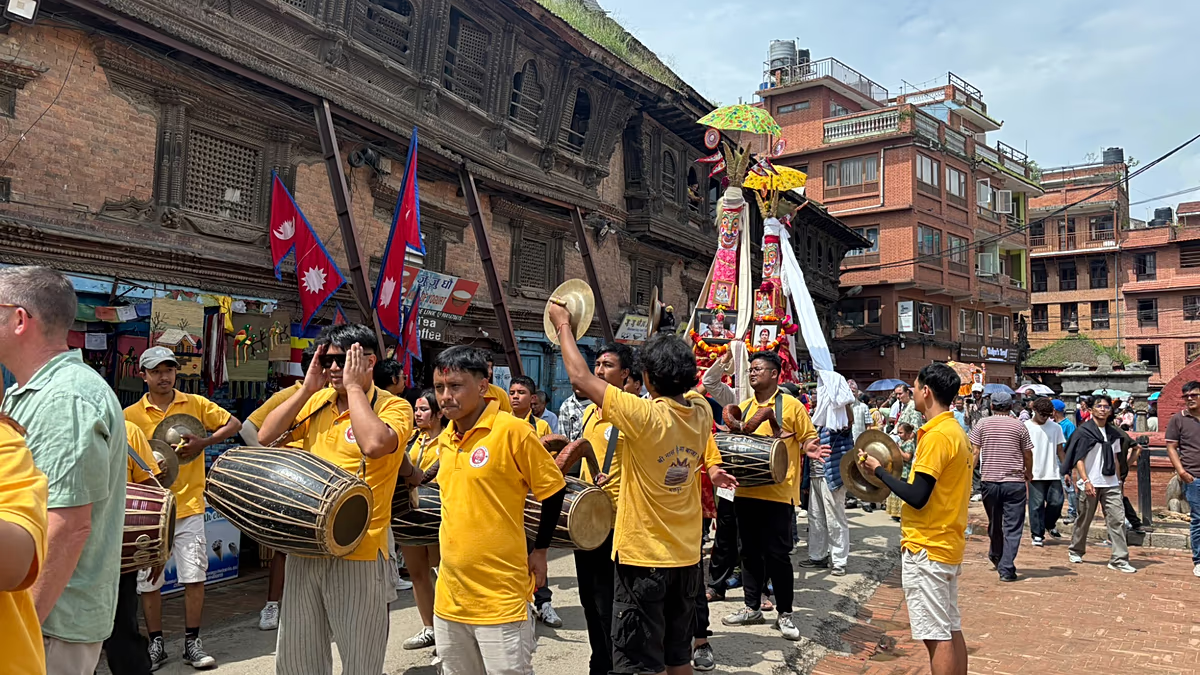
In the days before the festival’s main event, which takes place after the full moon in the tenth month of Nepal’s lunisolar calendar, usually in August or September, Bhaktapur begins to transform. In courtyards tucked behind ancient brick walls, neighbours gather to build taha: sa, the tall bamboo structures at the heart of the procession. Long ago, the festival used actual cows, but today these elegant constructions stand in their place. Each one is made by hand, wrapped in cloth that is generally red for women and white for men, with a painted portrait of a cow placed at the top. Then come the decorations: a photograph of the deceased, images of Shiva, and finally an umbrella to shield the cow from sun and rain—a sign of respect. This is not quick or easy work. It requires bamboo, rope, cloth, paint, and a dozen hands. It requires people who know the right knots and the right order of rituals. “For Sa: Paru, we have to have certain rituals, and these would be impossible if it was just me, or just my family, without the wider community to help us,” Ajay told me as we stood in a courtyard where his family was building the taha: sa for his mother, who had died earlier that year. I watched neighbours arrive with tea and tools, old men offering advice, children running between half-finished structures. No one was weeping. No one was whispering. There was laughter, argument, the clatter of bamboo, the smell of wood and paint. It might take a village to raise a child, but here in Bhaktapur, it takes a community to mark the other end of someone’s life. And in that shared work, grief becomes something you can hold rather than something that holds you.
The festival begins early the next morning, and the sound of it arrives before the procession does. Drums. Bells. The sharp, rhythmic clack of wooden sticks as pairs of dancers perform the Ghintang Ghisi dance. Then the taha: sa appear, a steady stream of tall, decorated structures bobbing above the crowd as they make their way through Bhaktapur’s narrow streets. At first, each group seems to move to its own beat. Some rush, making the bamboo structures sway so wildly that they resemble drunken cows stumbling along the route. Others move slowly, stopping to dance together before continuing. The streets clog quickly, and soon the entire city is moving as one enormous, chaotic, joyful body. The dress code is wonderfully open: some people wear traditional Newari clothing, others wear modern interpretations of it, and just as many wear football kits and Hawaiian shirts. Come as you are, the festival seems to say, and if you don’t mind crowds, you are welcome to join. I was pressed against a wall when I caught my breath and began talking to Mano Dhaubhadel, a Nepali who now lives in the United States. He had lost his younger brother recently and had returned to Bhaktapur for the festival. “This is something you don’t see anywhere else in the world,” he said, his voice calm and warm. “The culture here is just magnificent, and it’s there for everyone to enjoy, not just Newars. The best way to learn is to get involved.” I thought about how strange it would feel to mark a sibling’s death with drums and dancing. But watching him stand there, watching the procession with a faint smile, I began to understand that this was not a denial of grief. It was a way of carrying it, together, out into the open.
To understand the deeper meaning of Sa: Paru, I turned to Peepul Subedi, a priest, PhD student, and curator at The Nanee. He walked with me through the festival crowd, explaining the symbols and rituals with endless patience. “The whole city comes together for this festival, and every household who has a family member who has passed away in the past year will take out this sort of structure,” he told me. “It represents the message that everyone has to die, and all of us are going through the same sort of sorrow—that’s life. We’re not celebrating death by dancing and singing, we are celebrating the fact that the departed soul is moving towards salvation.” That sentence changed how I saw everything around me. The dancing, the music, the laughter—none of it ignored death. It was a collective acceptance of death, a way of saying that grief is not a private burden but a universal condition. The festival is also known as Gai Jatra, and historians believe its roots may go back as far as the 14th century. The name most often connected to it is King Pratap Malla, who is said to have expanded the festival to comfort his wife after the death of their son. He added satirical elements, using humour to mock the powerful and to remind everyone that even kings cannot escape sorrow. That tradition survives in the strangest and most wonderful way: people wearing masks of political figures like US president Donald Trump and Russian president Vladimir Putin, turning grief into a space for protest and laughter. In most of the Kathmandu Valley, the celebration lasts a single day. In Bhaktapur, it continues for eight, with different dances performed across the city each day. I wandered through squares and side alleys, watching the same festival reveal new faces. It was not a show for tourists. It was a living, breathing tradition, centuries old, and I was lucky to be inside it.
Most travel itineraries that include Bhaktapur treat it as a quick detour from Kathmandu. Visitors come to Durbar Square, with its temples and the 55 Window Palace, take a few photographs, perhaps buy an ice cream or a fridge magnet, and then climb back into a taxi. It is a real shame, not only for the locals who miss out on the economic benefit, but for the tourists themselves, who leave without ever feeling the true rhythm of the city. Bhaktapur is a living heritage site, and it rewards those who stay. Life moves slowly here. Early mornings are the best time to wander, when the streets are still cool and the air is filled with the smell of incense and woodsmoke. You will see people praying at Hindu and Buddhist temples, farmers hauling vegetables to market, children getting ready for school. At Pottery Square, ceramics lie in the sun to dry, and you can try your own hand at the wheel in one of the workshops. The Peacock Shop is another must-visit, where the owner will happily talk your ear off and walk you through the traditional process of making Lokta paper. The Nanee, a boutique hotel founded by Ajay and Shailaja Pradhanang, was created specifically to encourage people to linger. “Bhaktapur is a living heritage site, and we wanted that to continue,” Ajay told me. “With The Nanee, we offer guests a small oasis in the beautiful city of Bhaktapur while ensuring that the community, which has done so much to preserve and conserve its heritage, benefits from their stay.” The hotel’s experiences are built in partnership with local people: a morning walk with a housewife, an evening dinner with an artisan, a day spent learning a craft. There are festivals throughout the year, including the famous eight-night Bisket Jatra in April. The longer I stayed, the more I felt I had only scratched the surface. Bhaktapur asks for time, and gives back memories.
I almost did not arrive at all. Hours before my flight landed in Kathmandu for the festival, a series of flash floods near the border with Tibet killed at least 1,369 people, with some 5,000 missing. The news was devastating, and I knew that many travellers were cancelling or considering cancelling their trips to Nepal. That will have a serious impact on a tourism industry already struggling with the effects of the Iran war on flight routes to the country. The popular destinations—the Kathmandu Valley, Mount Everest, the trekking trails—were untouched by the tragedy, and the money that visitors bring is more needed than ever. I thought about this as I stood in the crowded streets of Bhaktapur, watching the taha: sa sway above the heads of the crowd, hearing the drums and bells and laughter. Sa: Paru was not an escape from death. It was a confrontation with it. The festival said, plainly and loudly: we all die, and we are all in this together. In the west, we often treat grief as something private, something to be gotten through quietly. Here, grief is shared with an entire city. It is wrapped in red and white cloth, decorated with photographs and flowers, carried through the streets on the shoulders of neighbours, and sent off with music and dancing. The sound I most associate with death will never be just silence again. Now it is also the sound of sticks clashing, bells ringing, feet moving on ancient stones, a community refusing to let anyone walk through loss alone. That is what Sa: Paru gave me: not an answer to death, but a new way to hear it. And in the end, that may be the most human response of all—to look at the darkness and make a joyful noise.