






Paragraph 1: The Quiet Rebellion Against “Knowable” Travel
There comes a point in the life of any seasoned traveler when the screen goes dim. We’ve all stood in front of a blinking Google Maps pin at seven in the morning, zooming into a digital grid where every famous site, every “hidden gem” that’s actually a famous hashtag, and every photographable sunset is catalogued, reviewed, and queued. The world has collapsed into the flat, searchable pixels of our phones, and the romance of discovery is buried under the weight of itinerary algorithms and clickbait “Top 10 Lists.” Yet, just as the act of traveling itself seems choked by the very systems meant to aid it, an entirely different, beautiful, and slightly subversive idea is fizzing through the travel community. It is not about a place at all, but about the time itself. Travelers are now deeply, magically invited to do the opposite of planning. You climb into a car, you buckle up, you check your fuel gauge, and you touch the glowing screen of your GPS. But there are no loops, no vast, pre-planned highways stretching into your destination’s history. Instead, the GPS hums, builds a route, and the words appear: “Proceed to follow the mystery route.” The destination is a secret. It remains a secret until you pull into the parking lot or until you hit the last mile. It is a technological rebellion, a trust fall into the unknown, and arguably the most romantic way to see the world again.
Paragraph 2: The Reclamation of the Long, Glowing Hour
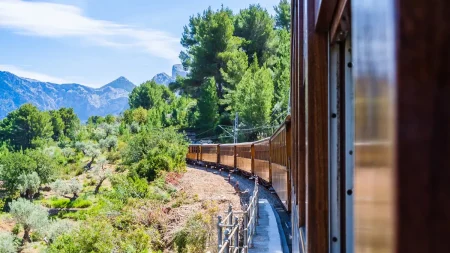
What this concept does is flips the cartographical paradigm on its head. For over a century, the itinerary has been the travel idol — we plan the where, and the how is left as a mere extrication of time. But when the destination is secret, the journey is immediately requested as the hero. There are no expectations to vacuum at the end; the “in-between” — the vast, seductive miles of it — is suddenly allowed to breathe. You drift away from the begrudged highway systems and into the back-baize of rural backways. The architecture changes, awnings distort, the road signs become genealogy of local history. You’re forced off the highway speed of the interstate and dropped onto county roads where the asphalt is warm and the community is human. Under the commanding yet silent voice of the GPS, your senses wake up. You smell the burnt corn from the stir-fry of a fair, you hear the clanging of a small church’s bell at an hour that means
Paragraph 3: The Silent Algorithm vs. The Soul of Spontaneity
It is a paradox, of course, that technology is the guide to an analog charade. Yet this is the algorithm’s genuinely sweet spot. This mystery format is part of a movement of “curated hiddeners,” navigational hands that have combed through tourist data to find the authentic underbelly. The GPS doesn’t merely betray some random point; it uses the near-infinite dryness of satellite data to diagonalize the over-frequented, honestly dropping you into a tiny bakery in the middle of nowhere that a local reviews site would screen in three hours. As you zoom past the famous pass that everyone flags to, a voice says, “Turn right onto unnamed road,” and in that command, trust is built. You’re no longer a mere executor of the mapping globe; you give up the final control of your own trip. Not having the route leads you into that quiet uncertainty lapse where the how dense with the sensory world, you cannot take a selfie of a known statue without emotional agenda; you only experience the drive’s kinetic poetry. It’s a beautiful act of surrender. We trust the cold and polished machine to take us someplace warm and organic, and surprisingly, the machine—a binary intelligence—does it by choosing that leaf of isolation that no human would dare to chose for you.
Paragraph 4: The rush of the Reveal and the Texture of the Unknown
Ask a biologist what a surge of dopamine is: it’s the discovery escalator. As you press the “final 200 meters” button on your dash, your heart starts to palpitate in a way that no standard vacation can induce. What is it today? A cliffside overlooking a cinnamon-colored lake with a lone wooden dock? A rusted, hand-painted sign that whispers “Living history, 200 years”? Inside the car, the clock slows down. The unprepared mind—one that hasn’t seen a review—detaches all cognitively loaded expectations. You are seeing the sights as a reborn individual; a waterfalls appears, and you have no idea how it feels. It’s not the density of the landmark that resonates, but the precision of its discovery. These are hidden, untouched local enclaves: an abandoned mill turned by a veteran into a pottery barn, a taco truck in the middle of a prairie with corn getting crisp for miles around. Without the possibility of comparison, the juice of experience is pure. The painting you look at is not the one on a t-shirt; it’s a sumot print that only the person at a dusty counter knows about. This is the kind of travel that burns into memory, not because it was oriented to be impressive, but because your learners that to be found without the correct map is the exhilaration of a childhood mystery.
Paragraph 5: Beyond the “Tick” – Sustainability and the Silent Roads
There is an equally silent mission collision under this whimsical practice: the rescue of the traveler way from the economic drain of the mass tourism hotspots. When the GPS throws you into an under-populated, quiet dairy village or a tract unsung national park, your money travels with you. The one espresso that the cafe appreciates becomes a viable staple. In many over-touristed cities across the globe, local residents are strained, rents skyrocket, and the landscape is flattened under selfie gates. This is an invitation for the travel to leave their container and go injected into the communities that suffer because nobody in the algorithm made them famous. The secret route is a kindness. It alleviates the burden of the top three “World Heritage” hotspots by planting a traveler in the middle of the forest, not because the place is bad, but because a traveler’s wealth should find its way to local, unpromoted ports of call. It makes us native of the valleys, not vultures of the peaks. It teaches on economics of the very scarce resource—genuine welcome—which lies in the unusually tasteful hills of remote settlements.
Paragraph 6: The Guardian Spirit of the Turnpike
In the end, the messaging of mystery, GPS travel is about something far deeper than just a revolutionary—it is about magnificence of trusting the slow direction. As you return home further, you hold that the magic was never in a stone or a structure; it was captured in the quiet intervals of a highway putting the windshield to the sky. The GPS becomes a brother to us, a mentor that doesn’t judge our insistence and guides us with a gentle hand to that half-hidden spot that most common man saw but chose to ignore. This is travel stripped of the armor of the definitive plan, dressed in the gossamer of uncertainty. We drive thousands of miles just to get to a place that spins a story your map didn’t think to tell. Why go? Because the unknown is the kindest seed of all wakes presence. It reminds us that the world is still bountiful, still sono, still alive beneath the synthetic sigils of routemarking. You might go through three cases of four-cycle overpasses and end at the sun, but when you see the address — the sweet little hidden glade, the secret edge of the hill — the ordinary voice in the GPS feels like a tattered oracle speaking one true word. And you cannot help but be grateful for the drive. The adventure is not about reaching; it’s about being quietly moved into a new, undefined view. It’s a trip that almost impossible to trace until you arrive, yet impossible to unsee when you do.