



Your idea of the best airport in the world might look very different from mine, and that is exactly the point. Maybe you are the kind of traveler who feels a rush of excitement the moment you see a sprawling duty-free shop, with its perfume samples and免税 whiskey glistening under bright lights. Or perhaps you are someone who measures an airport not by its shopping but by how quickly you can get from the terminal door to a train that whisks you into the city center. Maybe you care about how many nonstop destinations you can reach, or whether you can grab a real meal at 2 a.m., or whether you will be stuck in a security line for what feels like a lifetime. We all have our own mental checklists, our own little pet peeves and preferences that make one airport feel like heaven and another feel like a crowded bus station with airplanes. That is why the new edition of the World Consumer Airport Index, compiled by the Consumer Choice Center, is so refreshing. Instead of declaring one single “best” airport through the lens of one judge, it takes a whole range of practical, consumer-friendly factors into account and then splits the results into two separate rankings: one for giant hubs that handle more than 47.2 million passengers per year, and another for smaller airports serving fewer than that. It is a simple but clever way of recognizing that a massive international gateway and a cozy regional airport face very different challenges, and that what makes one great might not even apply to the other.
So what exactly does the index look at when scoring these airports? It goes far beyond the glossy terminal photos and the fancy lounges. The researchers considered whether each airport has direct access to a metro system or national railway network, which is a huge deal for anyone who has ever landed in a foreign city only to discover that the only way to reach your hotel is a ridiculously expensive taxi ride. They also looked at how easy it is to move between gates and terminals, because nobody wants to sprint through endless corridors or take a mysterious shuttle bus that seems to circle the airport forever. The choice of airlines available at the airport matters too, since more competition usually means better prices and more flexibility for travelers. Average departure delays are factored in as well, because even the most beautiful airport in the world loses its charm when you are sitting on the tarmac for three extra hours. And if there is a hotel inside the airport, that earns the hub a few extra points in the index—an amenity that can be a lifesaver for travelers with early morning flights, long layovers, or unexpected schedule changes. There are also two bonus conditions that can push an airport higher up the list. First, if security waiting times are under three minutes, the airport gets a nice little boost. Second, if the airport does not impose nighttime curfews, it gets even more credit. That means flights can come and go around the clock, which is fantastic for red-eye travelers and for anyone who has ever been stuck in a delay that pushes takeoff into the middle of the night. All of these factors together paint a much more complete picture than a simple “cleanest terminal” prize. It is a ranking that actually reflects what it feels like to pass through an airport as a real person, with your luggage, your tired feet, and your impatience with confusing signs.
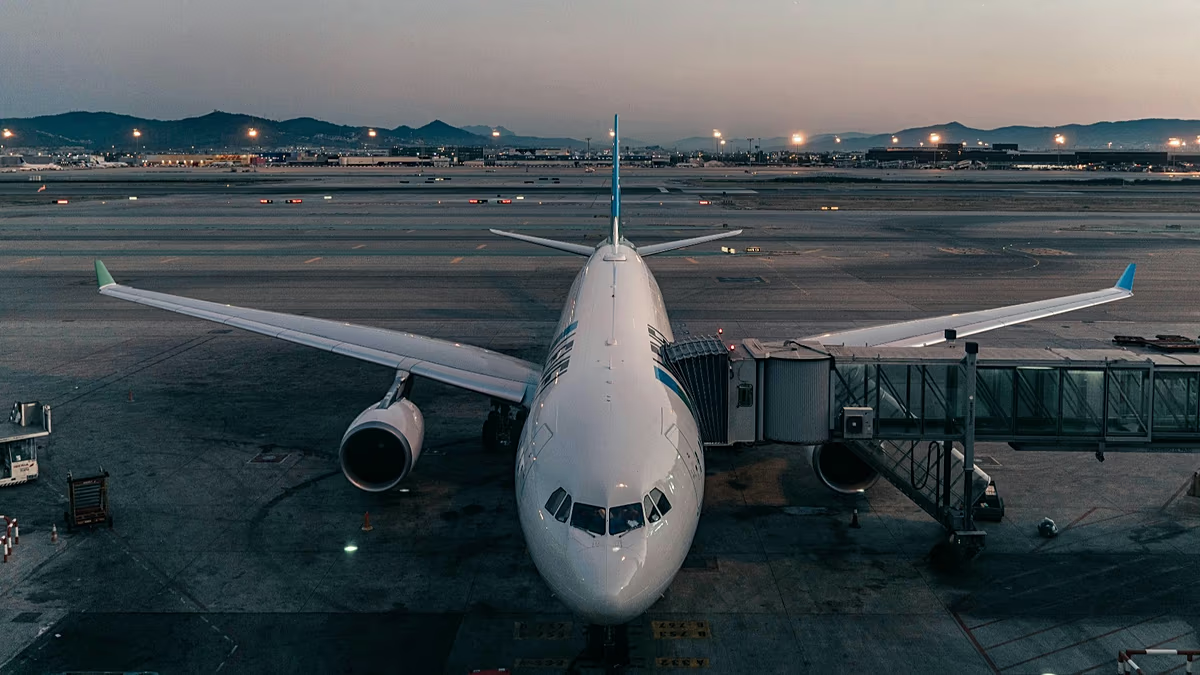
And after all that careful analysis, the results are in, and Europe has plenty to celebrate. Among the large airports, the top spot goes to Barcelona-El Prat Josep Tarradellas Airport in Spain. This is not just a random pick; the airport genuinely impressed the researchers with its performance in the areas that matter most to travelers. Maybe the most striking statistic is the security waiting time: passengers pass through security at Barcelona in just three minutes on average. That is almost miraculous when you think about how many airports in the world treat security lines as a sacred tradition where you are meant to stand, shuffle forward, and contemplate your life choices. Barcelona, by contrast, seems to understand that security is a means to an end, not an obstacle course. Finishing right behind Barcelona is Leonardo da Vinci-Fiumicino Airport in Rome, which shows that Italy knows a thing or two about smooth airport experiences as well. Los Angeles International Airport, better known as LAX, also makes an appearance in the top five, proving that even a notoriously sprawling American airport can get things right with enough effort and good management. Bangkok Suvarnabhumi International Airport in Thailand also earns a spot in the upper ranks, bringing a touch of Southeast Asian hospitality to the list. Charles de Gaulle Airport in Paris, which has a reputation for being confusing to some travelers, still manages to rank fifth, showing that its many terminals and constant bustle are balanced by excellent connections and plenty of airline choices. Further down the list, we see London Heathrow, one of the busiest airports in the world, alongside Tokyo Haneda, Dubai International, and airports in Saudi Arabia and Spain. It is a fascinating mix of cities and cultures, but they all share a common commitment to making the passenger experience less painful.
Of course, not every airport can be a winner, and the index does not shy away from naming the places that leave travelers feeling frustrated. Among the large airports, the worst performers include Antalya Airport in Turkey, Guangzhou Baiyun International Airport in China, and Frankfurt Airport in Germany. That last one might surprise some people, because Frankfurt is a major international hub with a reputation for efficiency. But the index found that Frankfurt struggles with some of the same issues that plague many airports: long distances from the city center, limited transport options that force you into expensive cabs, and delays that can pile up. For the smaller airports, the news is even worse for Seoul Gimpo, Punta Cana, and London Stansted. These airports, according to the research, share some very common pain points. They are extremely far from the cities they supposedly serve, which means you spend almost as much time getting to your destination as you did flying there. They often lack ride-hailing services that are independent of the local taxi companies, so you are stuck paying whatever the meter says. Access to railway services is poor, which is a serious problem in an age when travelers increasingly want sustainable and cheap transport options. And on top of all that, they have long security wait times and a high percentage of average delays. If you have ever stood in a security line while watching your gate change on your phone, you know exactly how these airports make people feel. The index is honest about the fact that a great airport is not just about having nice duty-free shops or a fancy atrium. It is about the little details: whether you can get out of the airport without being ripped off, whether your flight actually leaves on time, and whether you can get a decent coffee without queueing for twenty minutes.
Let us take a moment to appreciate the full list of top large airports, because it tells a story about global travel and what hubs are doing right. The number one large airport in the world is Barcelona-El Prat Josep Tarradellas Airport, followed by Leonardo da Vinci-Fiumicino Airport in Rome, then Los Angeles International Airport, Bangkok Suvarnabhumi International Airport, and Charles de Gaulle Airport in Paris. Rounding out the top ten are King Abdulaziz International Airport in Jeddah, Saudi Arabia; London Heathrow; Adolfo Suárez Madrid–Barajas Airport in Spain; Tokyo International Airport, commonly known as Haneda; and Dubai International Airport. That is quite a diverse list. You have the glitz and glamour of Dubai with its massive terminals and endless shopping. You have the efficiency and punctuality of Tokyo Haneda, which is famously close to the city and beloved by business travelers. You have the sheer scale of Heathrow, which can feel overwhelming but also offers an astonishing number of direct flights to just about anywhere on Earth. And you have two Spanish airports in the top ten, which is a pretty impressive achievement for a single country. What unites these airports is that they have invested heavily in making the passenger journey smoother. They have built train stations right into the terminals, they have hired enough security staff to keep lines moving, and they have worked with airlines to create robust networks of destinations. Some of them have also learned the value of not shutting down at night, allowing travelers to come and go at all hours. It is not just about having a beautiful building; it is about understanding that passengers are human beings who get tired, who miss connections, and who just want to get where they are going with minimal stress.
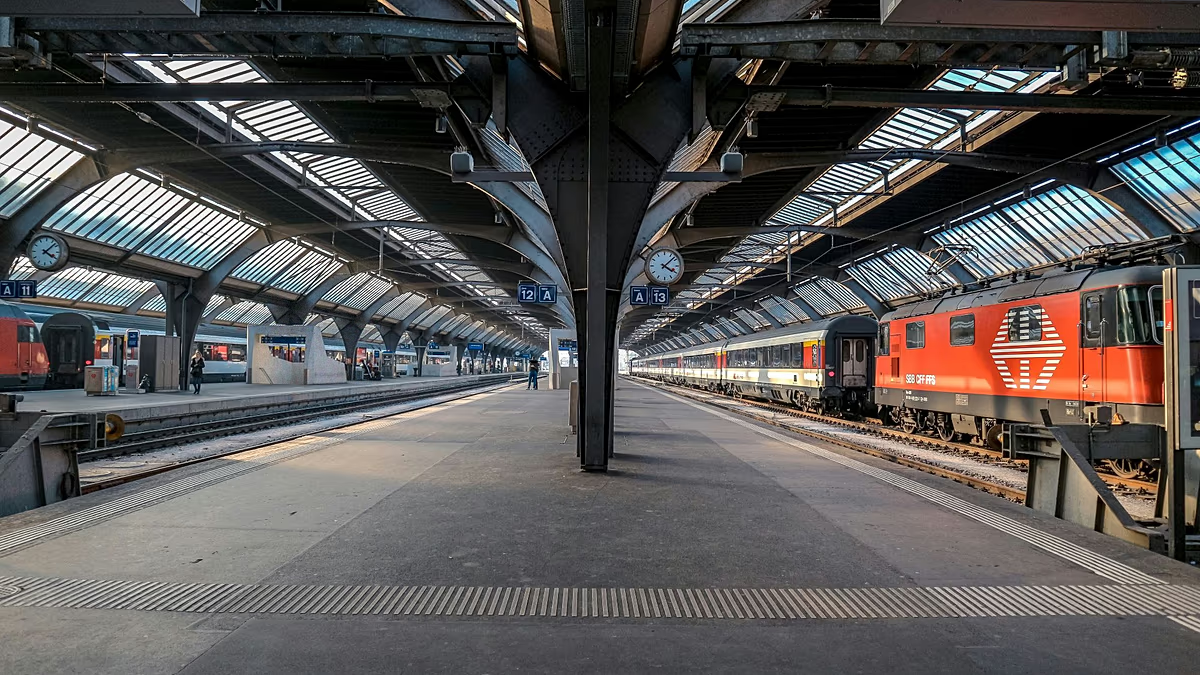
For those who prefer smaller, more manageable airports, the index has a separate winners’ list that is just as interesting. The best small airport in the world, according to the Consumer Choice Center, is Düsseldorf Airport in Germany. It apparently processes passengers almost instantly, which is something that anyone who has ever traveled through a major hub can only dream of. Right behind it is Zurich Airport in Switzerland, a country that is practically famous for its order and reliability, so this result should not surprise anyone who has flown through there. Copenhagen Airport in Denmark takes the third spot, followed by Helsinki Airport in Finland, Milan Malpensa Airport in Italy, Oslo Gardermoen Airport in Norway, Munich Airport in Germany, Vancouver International Airport in Canada, Brussels Airport in Belgium, and Berlin Brandenburg Airport in Germany. There is a clear pattern here: the list is dominated by Northern European airports, with a few notable exceptions. These airports tend to be efficient, calm, and well connected. They do not have the crowd chaos of giant hubs, but they still offer plenty of destinations and good transport links. Vancouver stands out as the only North American representative in the top ten, which is a nice nod to the city known for its friendly atmosphere and beautiful setting. Berlin Brandenburg, though relatively new and still finding its feet after a famously delayed opening, clearly has turned things around enough to earn a spot. The small airport ranking is a reminder that bigger is not always better. Sometimes the best travel experience comes from a place where you can get from the curb to your gate in twenty minutes, where the staff actually seem human, and where you do not feel like cattle herded through a maze. These smaller airports show that you do not need a million gates and a shopping mall to make passengers happy. In the end, the best airport is the one that makes you feel less stressed when you walk out of it than when you walked in. Whether it is a massive international hub like Barcelona or a tidy German regional airport like Düsseldorf, what matters is that the people running it understand the basics: good transport options, short waits, reliable flights, and a little bit of human kindness. So the next time you book a trip, maybe glance at this index and let it guide you. But also trust your own instincts, because you are the one who will be standing in that terminal, and your opinion is the one that truly counts.