


Here it is: a fresh, human take on the latest European Railway Station Index, packed with the key facts, the stories behind the rankings, and what it all means for travellers.
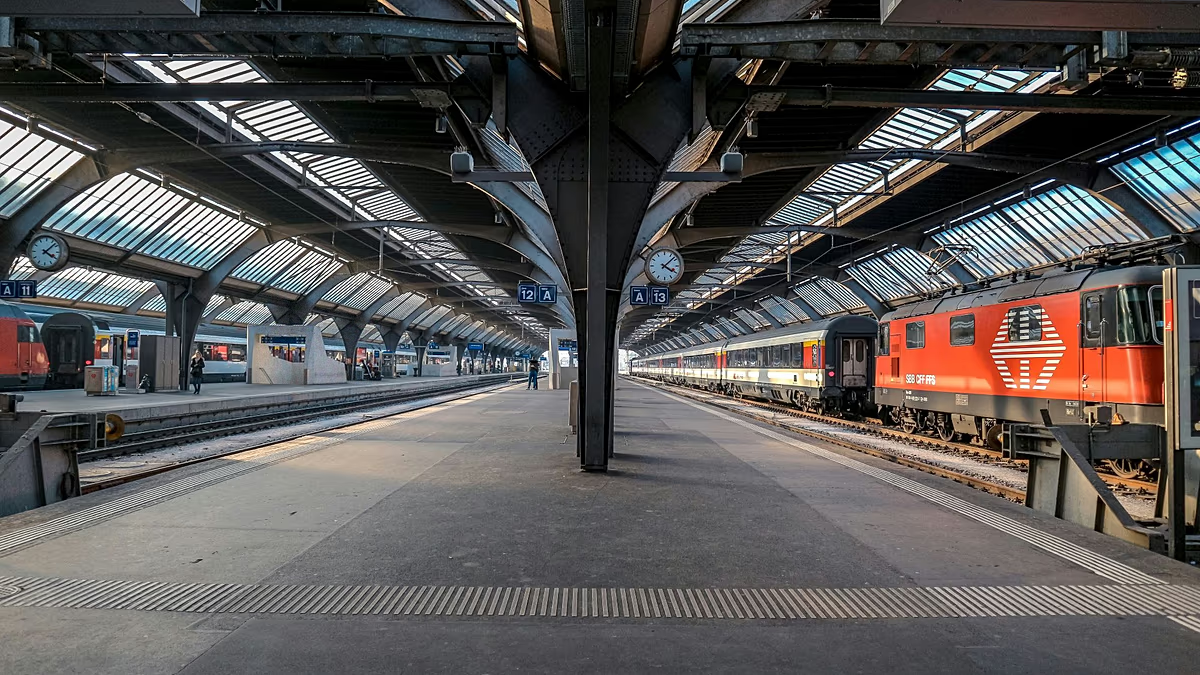
The newest edition of the European Railway Station Index has landed, and it carries some genuinely exciting news for anyone who loves train travel: the best major railway hub on the entire continent is Switzerland’s Zürich Hbf. That’s the word from the Consumer Choice Center, the organisation behind the ranking, which took a long, careful look at 60 of Europe’s busiest stations and judged them on far more than just whether the trains arrive on time. Yes, punctuality plays a huge role—they measured the percentage of services that are delayed and the average wait time—but they also considered the quality of the journey itself: the number of shops, cafés, and services inside the station, how accessible everything is for people with reduced mobility, whether free Wi‑Fi is available, how well the station connects to national and local rail networks, and what kinds of tickets passengers can buy. Switzerland, as ever, continues to set the gold standard for reliability, with a national punctuality rate of 94.1 percent. Zürich Hbf rose to first place overall, and only four percent of its train services were delayed—a remarkable figure for any major station. Bern Hbf, the Swiss capital’s main hub, shared joint fifth place, with a delay percentage of just 1.8. Perhaps the most striking statistic of all, though, belongs to Luzern Hbf: although the station ranked 14th overall, it boasted the most punctual departures in the study, with a staggeringly tiny 0.3 percent of services running late. That’s the kind of reliability that makes Swiss rail so legendary, and it’s the reason why so many travellers happily plan their journeys around it.
On the other side of the railway tracks, however, the news is far less cheerful if you happen to be travelling through Germany. According to the Consumer Choice Center, Germany’s performance has continued to deteriorate compared with previous editions of the index, and the numbers paint a painful picture. Of the bottom 30 stations in the ranking, 15 are in Germany, and the country’s highest‑ranked station is Berlin Hbf—the capital’s gleaming glass cathedral of a station—which languishes in 18th place overall. To make matters worse, 61.1 percent of services at Berlin Hbf are delayed, and the average wait time is a soul‑testing 20 minutes. Now, those figures are not just a blip or a bad month; they reflect a wider national trend. Europe‑wide, the average delay rate across all 60 stations is 29 percent, but in Germany it jumps to 49.4 percent. Similarly, the average wait time across the continent is 8.06 minutes, while in Germany it climbs to 14.74 minutes. For a country whose name has long been synonymous with engineering excellence and meticulous planning, this feels like a profound letdown. Travellers who have stood on a freezing platform in Frankfurt or Munich, watching the departure board tick later and later, will recognise the frustration instantly. The causes are complex—ageing infrastructure, years of underinvestment, and a vast network that sometimes feels stretched to breaking point—but the consequence is simple: passengers are paying the price. Germany still has many wonderful things to offer rail enthusiasts, and some of its smaller regional services work beautifully, but when it comes to the major hubs that the rest of Europe relies on, the country is losing its hard‑earned reputation for precision.
But if Germany’s story is one of decline, Poland’s is a tale of remarkable, exciting ascent. For the 2026 edition of the index, ten new stations joined the ranking thanks to increased passenger numbers across the country, and two of the five best performers among those newcomers are Polish. Kraków Główny, the main station in the historic city of Kraków, took first place among the new entries and an impressive ninth place overall. Poznań Główny, meanwhile, came in third among the newbies and 13th overall. The Consumer Choice Center had plenty of praise for Kraków, noting that its station offers direct routes to Warsaw, Zakopane, Łódź, Gdańsk, and Katowice domestically, as well as convenient links to some of the most beloved cities on the continent, including Berlin, Munich, Vienna, and Prague. But what really makes Kraków Główny shine is the way it has woven itself into the fabric of daily life. The station is fully integrated with the Galeria Krakowska shopping centre, so travellers can step off a train and find themselves surrounded by shops, restaurants, and all the amenities they could possibly need. It’s not just about retail, either: the station has also been praised for its seamless connections to bus and tram services, for providing helpful written and verbal announcements in a clear and accessible way, and for offering a first‑class lounge where passengers can relax in comfort. In other words, this is not just a place where trains stop; it’s a proper gateway, the kind of station that makes you want to arrive early and linger a little longer.
Looking to the future, the Consumer Choice Center points to something even more ambitious on the Polish horizon: an ongoing modernisation of the country’s rail network that includes plans for an additional 4,700 kilometres of new track. That is a staggering amount of railway, and the organisation believes it “ultimately promises to transform Polish rail into one of the most modern rail networks in Europe.” If you have ever taken a train in Poland, you’ll know that the country already has huge potential—its cities are vibrant, its landscapes are beautiful, and its people are welcoming—but it has sometimes been held back by outdated infrastructure. With this level of investment, though, that is changing fast. The new track will link cities more effectively, open up regions that have been underserved, and make rail travel an even more attractive alternative to driving or flying. It’s a story of confidence and ambition, and it sits in stark contrast to the struggles elsewhere in Europe. The full top ten for 2026 reads like a love letter to the Continent’s rail network: after Zürich Hbf, we have Gare du Nord in Paris, then Amsterdam Centraal, then Wrocław Główny in Poland, then a three‑way tie for fifth involving Bern Hbf, Gare Montparnasse in Paris, and Gare Saint‑Lazare in Paris, with London Bridge in eighth and a shared ninth place for Kraków Główny and London St. Pancras International. That mix of Swiss precision, French elegance, Dutch practicality, Polish ambition, and British resilience shows just how varied and rich European rail truly is.
What this ranking really reveals, beneath the statistics, is that a great railway station is about so much more than getting from A to B. Yes, punctuality matters enormously—nobody enjoys standing on a cold platform wondering whether their connection will still be there—but the stations that rise to the top of the list are the ones that treat passengers like people, not just tickets to be scanned. Free Wi‑Fi, clear announcements, comfortable waiting areas, shops and cafés, step‑free access, and seamless connections to other forms of transport: these are the things that turn a functional transfer point into a beloved civic space. Consider how Paris appears three times in the top ten, with Gare du Nord, Gare Montparnasse, and Gare Saint‑Lazare all performing brilliantly. That’s no accident; French stations have benefited from heavy investment in recent years, and travellers can feel the difference in everything from the bright, open concourses to the easy flow of foot traffic. London, too, makes two appearances with London Bridge and St. Pancras International, both of which have been transformed over the past two decades into bright, airy hubs that are as much destinations as they are departure points. And then there is Amsterdam Centraal, a historic building that has been lovingly modernised to meet the demands of the 21st century. The lesson is clear: if you invest in the human experience—if you make sure that someone with a heavy suitcase, a tired child, or a tight connection feels looked after—then people will fall in love with rail travel all over again.
So where does that leave the traveller in 2026 and beyond? For absolute reliability, Switzerland remains the undisputed champion, and Zürich Hbf sets the benchmark for what a major station should be. If you want a glimpse of the future, though, Poland is the place to watch. With Kraków Główny already in the top ten, Wrocław Główny sitting proudly in fourth place, and thousands of kilometres of new track on the way, the country is proving that it refuses to be left behind in the great European rail renaissance. The next few years will be fascinating as those new routes open up, connecting cities and regions in ways that were previously impossible. For Germany, the message from this index is stark but not hopeless: the country has the engineering brainpower and the financial resources to fix its rail network, but it will take political will, patience, and billions of euros to reverse the current trend. In the meantime, passengers can vote with their feet—or should that be their wheel about the railways of Europe, there has never been a better, or more exciting, time to plan a rail adventure, whether that means marvelling at Swiss punctuality, exploring Poland’s rising stars, or simply enjoying the simple joy of watching the world roll by from a train window. So, anyone for a rail escape to Poland?