


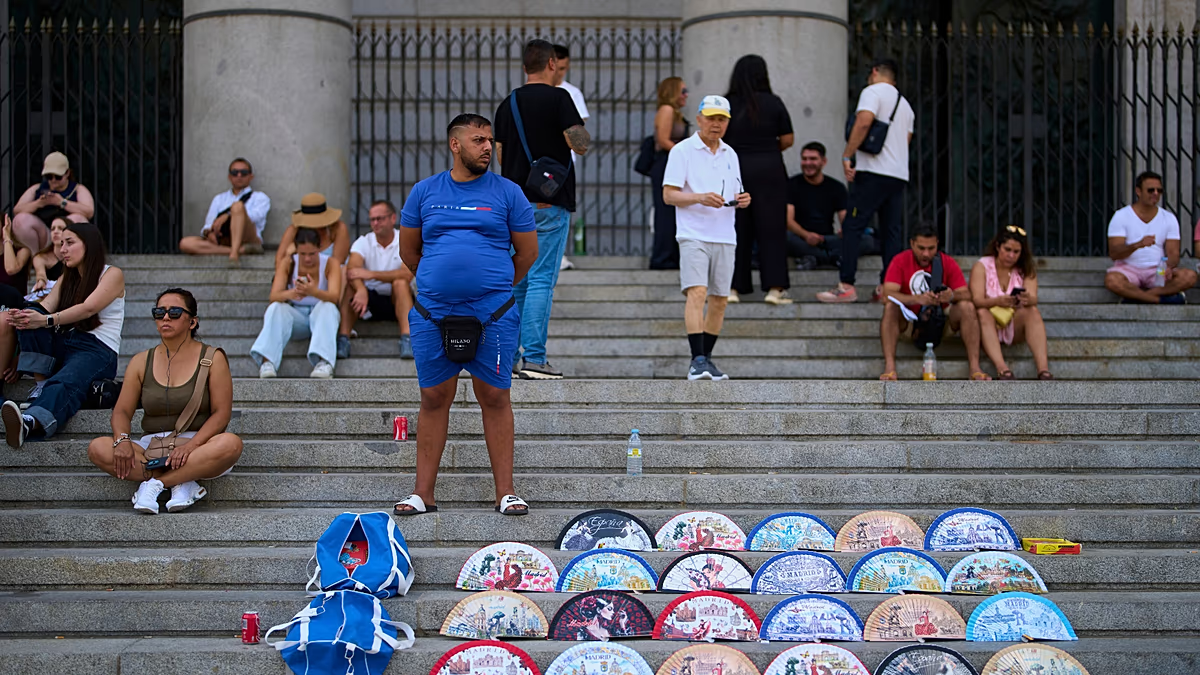
The numbers are staggering, and they tell a story of a country that has become, quite simply, the world’s favorite place to escape to. Between January and July of 2026, Spain welcomed an astonishing 58.1 million international visitors. To put that in perspective, that is more than the entire population of Italy, and it represents a 4.6% increase over the same period last year, a time that was already considered a record-breaking year. But it is not just about the sheer volume of people flocking to its sun-drenched coasts, vibrant cities, and cultural heartlands. The money they are spending has reached an all-time high of €82.05 billion, a 7.8% jump that signals a shift in how people travel and what they value. These are not just tourists grabbing a quick photo and a cheap meal; they are travelers seeking experiences, willing to invest in everything from boutique hotels to Michelin-starred restaurants, guided heritage tours to coastal sailing adventures. The flood of visitors is reshaping the Spanish economy, fueling a boom that touches nearly every sector, from hospitality and transport to local artisans and food producers. While the debate about overtourism continues to simmer in cities like Barcelona and the Balearic Islands, the economic reality is that tourism has become the beating heart of Spain’s financial vitality. The data, released by Spain’s National Statistics Institute, paints a portrait of a nation that has mastered the art of welcoming the world, transforming its natural beauty, rich history, and lively culture into an economic engine of extraordinary power. For every backpacker exploring the Alhambra, every family lounging on a Costa del Sol beach, and every business traveler sipping espresso in Madrid’s grand plazas, there is a ripple effect that sustains livelihoods and builds bridges across borders.
Perhaps the most striking detail in this summer’s travel diary is the enduring dominance of the United Kingdom in Spain’s tourism story. Between January and July, British tourists accounted for 11.5 million arrivals, a 4.6% increase that firmly cements the UK as Spain’s number one source market. The affinity between these two nations is not a recent phenomenon; it is a decades-old love affair with the Spanish sun, a relationship that has weathered economic storms, political upheavals, and even pandemics. French travelers followed closely, with 7.2 million visitors, while Germany contributed 6.9 million, though the German market saw a slight cooling off, dipping by 0.5%. The real growth story, however, comes from unexpected corners. Italy, Spain’s Mediterranean cousin, emerged as the fastest-growing market in percentage terms, sending 3.5 million tourists to Spanish shores, a remarkable 10.3% surge. There was also a fascinating uptick in visitors from outside the traditional European heartland; arrivals from other countries jumped by 16.9% to 717,000, and these travelers spent an extraordinary 24.5% more than they did the previous year. This suggests that Spain’s appeal is diversifying, reaching new audiences in the Americas, Asia, and beyond. In July alone, the UK once again took the crown with 2.2 million visitors, and their spending told an even more compelling story: British travelers injected €3.04 billion into the Spanish economy in just one month, a 4.8% increase year-on-year. This was not the budget-conscious tourist of the past; it was a traveler looking for premium experiences, longer stays, and a deeper connection to the country. The numbers reflect a resilience and a hunger for travel that defies global uncertainties, and for Spain, that means a future that is increasingly intertwined with the wanderlust of its European neighbors and the wider world.
Regionally, the landscape of Spanish tourism is both familiar and evolving, with each autonomous community offering a distinct flavor that draws its own devoted following. Catalonia leads the pack, serving as the undisputed champion of international tourism with 11.94 million visitors between January and July, a 2.9% increase from the previous year. The region’s magnetic pull is easy to understand: Barcelona’s architectural wonders, the Costa Brava’s rugged beauty, and the Pyrenees’ tranquil villages offer a diverse playground for every type of traveler. But the Balearic Islands are hot on its heels, drawing 9.16 million visitors, up 1.8%, as travelers seek the Mediterranean idyll of Mallorca, Ibiza’s legendary nightlife, and Menorca’s quiet coves. The Canary Islands, with their year-round spring climate, attracted 9.02 million visitors, though that number dipped slightly by 0.6%, perhaps a sign of a temporary market correction or shifting consumer preferences. Andalusia, the sun-drenched heart of southern Spain, welcomed 9.02 million tourists, an 8.2% increase that speaks to the enduring allure of Seville, Granada, and the Costa del Sol. Yet the real momentum is happening in places that were once considered secondary stops. Madrid, the capital city, exploded with 9.6% growth, while the Valencian Community, home to the paella-loving coasts of Valencia and Alicante, surged by 8.9%. In July, the Valencian Community alone received 1.63 million visitors, a 9.5% jump, and Madrid welcomed 800,000 tourists, an impressive 11% increase. This shift suggests that travelers are increasingly looking beyond the traditional beach-and-party destinations, seeking the cultural sophistication of the capital, the culinary creativity of Valencia, and the authentic experiences that lie in Spain’s interior. The growth is not a zero-sum game; it is an expansion of the tourism pie, a spreading of prosperity across regions that once relied heavily on domestic visitors or are now reaping the rewards of improved connectivity and targeted promotion.
The current travel boom has also rewritten the spending playbook, revealing a tourist who is richer, more independent, and more experience-oriented than ever before. In July alone, international visitors spent €18.22 billion, a remarkable 10.9% increase year-on-year, and a clear sign that the sector is no longer just about volume but about value. The spending patterns offer a fascinating glimpse into the psyche of the modern traveler. Most visitors stayed for four to seven nights, with 5.7 million tourists falling into this sweet spot, an 8.7% increase that shows a preference for immersive vacations over quick getaways. Perhaps more tellingly, a staggering 8.5 million tourists traveled without a package tour, compared to just 3.1 million who booked one. This is the age of the independent traveler, armed with smartphones, translation apps, and a desire to carve out their own itinerary. They are renting apartments, dining in local tavernas, and venturing off the beaten path. The money they spend reflects these choices: accommodation claims the largest share of expenditure at 19.8%, followed closely by package tours at 19.3%, and international transport at 19.2%. This triad of costs—where you sleep, how you get there, and the convenience of a planned experience—dominates the budget, but the remaining 40% is scattered across meals, shopping, entertainment, and local activities. It is a diversified economy, one that supports not just hotel chains and airlines, but also the local farmer selling oranges at a market in Valencia, the flamenco dancer performing in a packed Seville tablao, and the winemaker pouring a glass of Rioja in a rustic bodega. The record spending is not an abstract statistic; it is a lifeline that preserves traditions, fosters innovation, and creates jobs in every nook and cranny of the country.
What makes these numbers even more compelling is the human reality behind the statistics, the countless personal stories that weave together to form this tapestry of record-breaking tourism. Every arrival is a traveler, but not all travelers are alike. There is the British retiree returning to the Costa del Sol for the tenth time, drawn not just by the sun but by the friends she has made in her local village. There is the French family loading up an electric car and driving across the Pyrenees for a weekend escape to Catalonia, eager to introduce their children to Gaudí’s surreal architecture. There is the German professional spending a long weekend in Madrid, closing business deals over long lunches and staying for a Monday evening at the opera. There is the Italian couple celebrating their honeymoon in the Balearic Islands, toasting to the turquoise water with a glass of local vermouth. And there is the growing cohort of travelers from distant lands—perhaps from South Korea, the United States, or Brazil—venturing across the Atlantic or halfway around the world to experience Spain’s unique fusion of tradition and modernity. Each of these visitors carries a personal narrative, a set of expectations, and a budget that will be spent in different ways. The 14.9% increase in spending from non-traditional markets speaks to a changing global appetite, a longing for places that offer history, security, and warmth. For Spain, this is both an opportunity and a responsibility. The opportunity is to enhance the quality of tourism, attracting fewer but higher-spending visitors who respect the environment and enrich local communities. The responsibility is to manage the phenomenon sustainably, ensuring that the very characteristics that attract tourists—authenticity, beauty, and culture—are not eroded by the very crowds they draw. The Spanish approach to tourism, as reflected in these numbers, is evolving into a delicate balancing act, one that many other nations are watching with envy and curiosity.
Looking at the entirety of this seven-month tourism season, one thing becomes abundantly clear: Spain has not merely recovered from the pandemic-era trough; it has vaulted far beyond any previous benchmark, demonstrating a magnetism that shows no signs of waning. The 58.1 million visitors and €82.05 billion in spending represent more than just economic growth; they represent a global vote of confidence in what Spain offers the world. The country has effectively positioned itself as a year-round destination, no longer reliant solely on the summer sun. The Canary Islands provide a winter escape, the cities of Madrid and Barcelona pulse with urban energy in the spring and autumn, and the northern coastal regions like the Basque Country are now celebrated for their gastronomy and green landscapes in all seasons. This diversification is the secret to Spain’s resilience, a strategic expansion that moves beyond the overcrowded coasts and into the rich, varied heart of the peninsula. The data from the National Statistics Institute, drawn from the Frontur and Egatur surveys, is more than a dry collection of figures; it is a mirror reflecting the changing nature of travel itself. People are spending more, staying longer, and venturing further, seeking a sense of place that transcends the typical tourist checklist. The pace of growth—4.6% in arrivals and 7.8% in spending—indicates a healthy, bullish market, one that is still climbing. For policymakers, business owners, and residents, the challenge is to channel this immense energy into sustainable development, investing in infrastructure, housing affordability, and environmental protection. For the traveler, Spain remains an irresistible invitation, a promise of splendid food, passionate culture, and unforgettable landscapes. The record-breaking numbers of 2026 are not just a milestone; they are a preview of the future, a future where Spain stands tall as a global beacon of hospitality, welcoming the world with open arms and an ever-evolving, human-centered approach to tourism. As the year progresses and the autumn leaves begin to fall, the world will be watching to see whether this remarkable summer becomes the new normal, a testament to the enduring love affair between Spain and the travelers who cannot seem to get enough of it.