


For most travellers, a five-star rating feels like the summit of hotel luxury. But for those in the know, the true peak is now marked by a different symbol: the Michelin key. The same guide that built its reputation on judging restaurants—and the little tyres that funded it—has, since 2024, been applying its famously precise standards to hotels, awarding one, two, or three keys to the very best places on earth. One Key means a “very special” stay. Two Keys means “exceptional”. Three Keys, however, is a category all of its own. Michelin calls it “one of the world’s most remarkable and extraordinary stays and a destination for the trip of a lifetime.” That is not a subtle promise, and Michelin does not do vague compliments. When the 2026 selection was unveiled last week, only 155 hotels in the entire world carried three keys. Eight of them are new to Europe. That is a startlingly short list, and the names on it range from a Palladian fantasy in a Venetian lagoon to a 17th-century convent in Provence, from a Portofino hideaway with the world’s first Dior Spa to a grand old lady on the shore of Lake Geneva. What unites them is not any particular style, but their ability to inspire a kind of devotion in guests—the kind that makes you cancel your sightseeing plans just to sit in the lobby and breathe it all in. Inspectors travel incognito, stay unannounced, and their evaluations are based on a mixture of emotion and exacting detail. The result is a list that says as much about storytelling as it does about thread counts. These are not necessarily the biggest hotels, the most expensive hotels, or even the most famous hotels. They are the ones that linger longest in the memory after checkout, the ones whose particular genius sneaks up on you weeks later in a quiet moment. That emotional resonance is precisely what Michelin’s inspectors are trained to feel, and what separates a genuinely great stay from one that merely looks great on an Instagram grid. The 2026 European crop, in other words, is not just a list of recommended rooms. It is a collection of places with the power to change the way you travel.
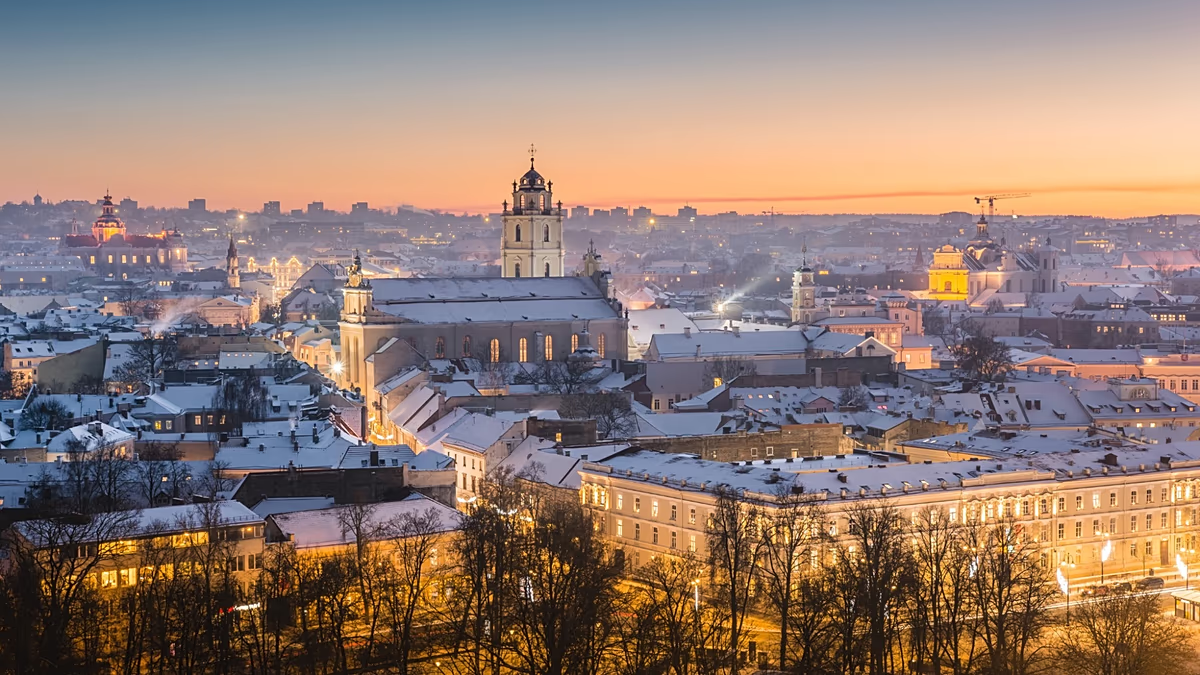
It is fitting that the most talked-about arrival this year is Airelles Palladio in Venice, because it did not simply earn three keys—it also claimed the award for Michelin’s Opening of the Year. That double honour is almost unheard of, and yet anyone who has seen the property understands why. Situated on Giudecca Island, directly across the water from St Mark’s Square, the hotel has the romance of Venice without the tourist chorus. It is spread across four heritage buildings, with interiors that feel like a private museum and a garden growing on terraces that gaze at one of the most beautiful skylines in the world. The facilities are seriously impressive: the largest spa in Venice, three swimming pools, and dining rooms operated by three of the most exciting culinary names on the planet—Nobu Matsuhisa, Norbert Niederkofler and Cedric Grolet. There are exclusive after-hours visits to the Doges’ Palace and traditional Venetian rowing lessons for those who want to feel the city’s pulse from the water. It is the rare hotel that does everything beautifully without ever losing its soul. The only other property to debut at the Three Key level this year is Soneva Secret in the Maldives, a name that has come to mean barefoot luxury in its most extreme form. Together, the two debutants set out the full range of what Michelin keys can mean: one is a Renaissance reverie, a gondola ride away from Piazza San Marco; the other is a Robinson Crusoe fantasy of sandbanks and villas on stilts. If Michelin wanted to prove that its Three Key list is not tied to a single style of travel, it could not have picked a more perfect pair. The former may have all the cultural weight of centuries, but Soneva Secret is a testament to the power of pure escapism—a reminder that extraordinary sometimes means switching off completely, surrounded by the sound of water and nothing else.
Italy once again dominates this year’s European upgrades, with three hotels earning the third key after years of impressing inspectors. In Florence, Collegio alla Querce, Auberge Collection, was named Esquire’s best new hotel earlier this year, and it is not difficult to see why. Housed in a former 16th-century villa that later became a college, the hotel has a rare quality: you can feel the history in its bones, yet every corner has been brought to life with a contemporary, playful energy. The bar sits in the old headmaster’s office, where the cocktails and dishes are inspired by the great explorers who were once part of the school’s story. There is a gorgeous outdoor pool for those warm Tuscan afternoons, and a gentle sense of wit that makes the stay memorable. Further south, on the Amalfi Coast, Borgo Santandrea offers something entirely different. Built into a cliff in the 1960s, it has been transformed into an ultra-chic, ultra-luxe retreat that by some miracle remains as welcoming as it is glamorous. The terrace restaurant in particular is worth the trip alone, its grand vistas of sea and coastline almost impossible to absorb in a single sitting. Then there is Splendido, a Belmond Hotel in Portofino, which may well be the most famous name on this list. With just 53 rooms, a gorgeous outdoor pool, and the world’s first Dior Spa, it offers the kind of old-guard glamour that Portofino has been perfecting since film stars first arrived by yacht. It is intimate without being fussy, glamorous without being intimidating, and now officially one of the best places to stay on earth. Indeed, Italy has long been a laboratory for the art of hospitality, and these three properties show why the country has an unfair advantage in the Michelin stakes. Each one has a distinct personality, but all three share a devotion to something quieter than trendiness: an understanding that luxury is ultimately about emotion. Whether it’s the smell of cypress and citrus at Collegio, the dazzling blue that swallows you whole at Borgo Santandrea, or the whitewashed splendour of Splendido’s terraces, these hotels stay with you long after you’ve unpacked. In a world of cookie-cutter design, they remind you that the best travel is personal, textured and full of surprises.
France also had two properties elevated to Three Key status this year, and both are exceptional in completely different ways. Château de la Chèvre d’Or is perched in the medieval hilltop village of Èze, between Nice and Monaco, and it takes full advantage of its absurd location from almost every vantage point. The two outdoor pools seem to melt into the sea, and the hotel’s own restaurant, La Chèvre d’Or, has held two Michelin stars for years, with a dining terrace that feels suspended over the Mediterranean. You do not need to be a romantic to be undone by this place; you just need to be alive. Everything, from the mosaics on the terrace to the scent of pine and salt air, is arranged to make you slow down, sit still, and let the Côte d’Azur do its work. It is no wonder that artists and writers have been drawn to this coastline for a century; places like this are exactly what they meant when they spoke of the light. Le Couvent des Minimes, by contrast, is a 17th-century convent that has been reborn as a wellness retreat in the heart of Provence. Its 2,500 square metres of Spa L’Occitane en Provence is a sanctuary within a sanctuary, using the same lavender, immortelle and shea that have made the region’s beauty products world famous. The one-starred restaurant Le Feuillée is a love letter to garden cooking, and the former cloisters have been transformed into light-filled corridors where the stone walls seem to exhale calm. Michelin’s reviewers were clearly enchanted by the contrast between the serenity of the building and the energy of its kitchens, spas and gardens. Yet what makes these two French winners so interesting is how they represent the full spectrum of a trip to the Riviera: one is a perfectly composed jewel-box escape, all high views and haute gastronomy; the other is a warm, sensory retreat where the hours are measured in essential oil and the light through an old archway. Both feel unmistakably French, but in that inimitable way the French do so well—never trying too hard, always remembering that true luxury is a mood as much as a list of amenities.
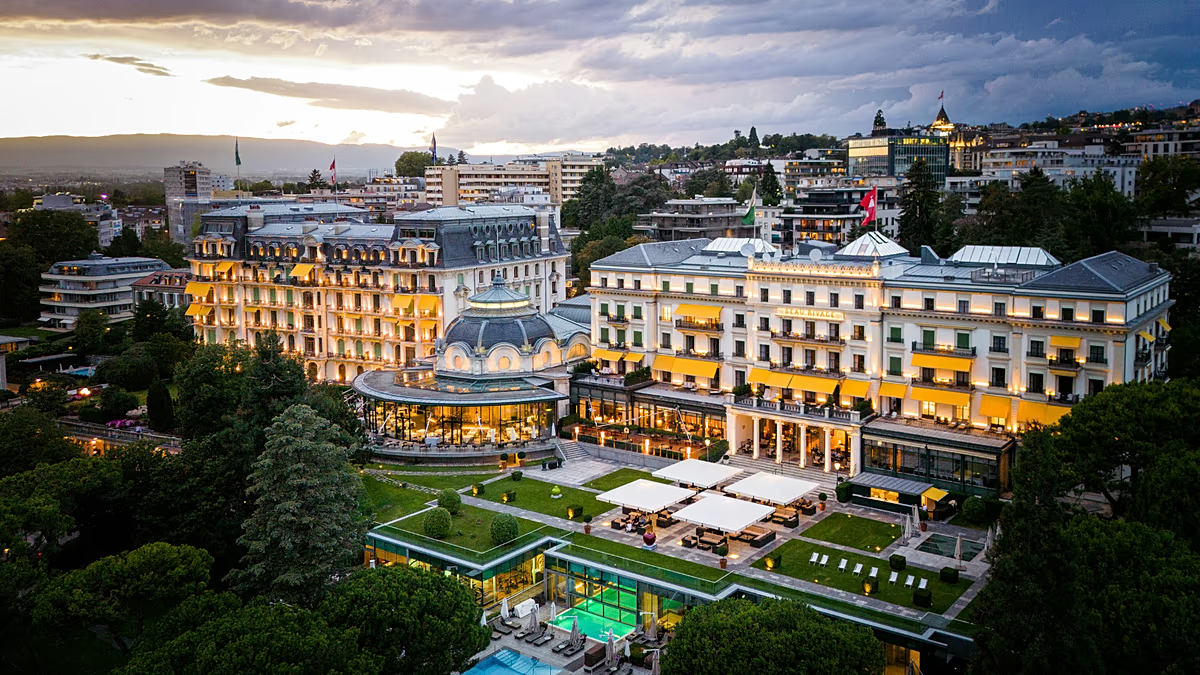
Over the border in Switzerland, two grand hotels have joined the Three Key club, and both are the kind of properties that make you want to cancel your dinner plans and order room service just to stay in bed a little longer. Beau-Rivage Palace, on the shores of Lake Geneva, is described by Michelin as one of the last of Europe’s traditional grand hotels. It has recently been renovated, but the renovation was done with a light, respectful hand, preserving the high ceilings, frescoes and sweeping staircases while adding a quiet contemporary comfort. The extensive spa, tennis and padel courts and golf driving range mean you never have to leave, but you would be crazy not to walk across the road for that extraordinary view of the lake and the Alps. Kulm Hotel St. Moritz is the other Swiss addition, and it is just as classic, just as majestic. Set up in the Engadin valley, it is, in Michelin’s words, “as fine an Alpine five-star gets”. The lake view from its windows is the sort of sight that photographs cannot capture, and its 2,000 square metre spa, outdoor pool overlooking the slopes and exceptional restaurants make it easy to understand why St. Moritz has been a winter playground for over a century. Both hotels are old-school in the best sense: they know service, they understand comfort, and they have no need to chase trends. What feels particularly apt is how these two properties embody Swiss discretion—no flashiness, no gimmickry, just the sound of church bells, the shimmer of water and the sense that someone has thought of everything, down to the angle of the sun loungers. In a world that often confuses loud with luxurious, they are confidence of the most elegant kind. Guests arrive as travellers and leave almost as regulars; the staff seem to learn your name before you’ve taken off your coat, and the memory of those snow-dusted peaks or vast lake sunsets lingers long after the journey home. It is no accident that both properties have attracted royals, writers and Olympic athletes for generations. If a hotel can make the powerful feel peaceful, that is the greatest luxury of all.
What makes these eight European addresses so special is not any single amenity or celebrity chef, but the way they re-define the purpose of a hotel. They are not just places to sleep; they are destinations with their own gravitational pull. From the Palladian calm of Venice to the cliffhanging glamour of the Amalfi Coast, from the lavender-scented corridors of a Provençal convent to the mirror-calm lake in front of a Swiss palace, each of these Three Key properties has been transformed by Michelin into a guarantee. Book any one of them and you are not just buying a room—you are buying a memory, a story, a little piece of the trip of a lifetime. The Michelin Key is still a young currency, but it has already become the most reliable map we have to the world’s most remarkable places. In a travel industry flooded with algorithm-driven recommendations and five-star ratings that all look the same, it is reassuring to know that at least one guide still trusts anonymous professionals who travel in disguise, who have seen everything, and cannot be bought. Indeed, all 155 Three Key hotels share one thing: the power to make you stop thinking about the outside world. The new European eight just demonstrate, yet again, that the old continent still knows a thing or two about the art of the grand gesture. In Italy, they have history; in France, they have soul; in Switzerland, they have ceremony. But all eight have mastered the details that turn a stay into an occasion—a bar hidden in a headmaster’s office, a plate of food with a view of the sea, a spa corridor that smells of Provence, a pool that seems to tip into the sky. These are the moments that linger, the ones that remind us why we travel. So the real question is not where to go next, but which of these eight dreams to slip into first. The answer, of course, is all of them—one lifetime may not be enough, but it is a wonderful excuse to begin the search.