





Paragraph 1: The Symphonic Chaos Above the Aegean
The atmosphere inside the Control Centre in Athens is sterile, cool, and artificially quiet, but the radar screens tell a wildly different story—a molten network of amber blips crawling, weaving, and converging like a panicked school of fish across a topaz sea. Each blip is a vessel full of human stories: honeymooners from New York, backpackers circling the Cyclades, executives bound for a summit in Dubai, and tired families yearning for a cheap thalassa. But for the air traffic controllers seated in the dim glow, this mosaic of motion is not a romantic image; it is an algebra of imminent chaos. In the blistering peak of Greek summer, the connection between the modern and the technological becomes a fragile, percussive environment. In the winter, the system breathes easily with roughly a thousand to fifteen hundred flights per day, enough time for a precipitance of coffee, a burst of friendly banter, a glance at the weather apps. But in the first week of July, that daily average throttles again—close to 2,700 flights—turning calm order into a furious cacophony. Olga Toki, the vice-president of the Hellenic Air Traffic Controllers Association, gestures, not once, but repeatedly to the monitors, her voice edged with the high energy of a long shift. There is no space left, the aircraft fill the sky like locusts. She speaks of the margins, those scarce invisible voids between trajectories that keep a human safe, and which are shrinking every day of summer. The controllers move like chess grandmasters, but with split-second pragmatism. Calm are external shells, but under their headsets, they are improvising jazz musicians, watching the intertwined storylines of metal birds, flouting friction, asking pilots to adjust vectors, kneaded with a heavy burden. It is a demanding orchestration of the elements—heat, mountains, storms, and constant data—that makes even the most routine summer afternoon verge on a dance with the demon of overload. Their prayers are silent, but their are exhausted.
Paragraph 2: The Tourist Tsunami and the Burden of a Small Nation
The reason behind this overwhelming pulse is deeply tied to the very soul of the modern Greek living—the airports have become the gateways of the nation’s furious economic rebirth. The Hellenic Civil Aviation Authority produces statistics that should read like a fantasy novel: an immense frenzy of thermally-thick tourists combusting a mere 10 million in population. Last year, in what was celebrated as a stunning victory, Greek airports greeted over 38 million visitors, a spectacular leap that exceeded the 2019 record by a massive margin of 23%. A once-wounded economy now offers the welcome, but places enormous strain on a transport backbone that has remained patched by decades of deep austerity. Officials across Athens recognize this as a problem, but their hands are tied. In a crisis, the numbers leap from a dry report into physical reality—waiting rooms overflowing at the gates of Heraklion, unfolded suitcases sprawling on the beach, but often the city, as they commute. For viewers in higher latitudes, this is a fantastic boon, but for the control towers and the blades across the Aegean, it is a heavy silk thread knit into the mechanics of flight. Eurocontrol, the watchful European agency that stars over crash probabilities, notes that across south-eastern Europe, the air traffic density has soared to 40% above the same period of 2019—a time which was already considered overly heavy. Rather than releasing pressure, the rising index squeezes tighter. The controller’s job is not merely to reluctantly grant clearance; they must breathe air into the wing structure. But a single misstep in these colossal dimensions could cause ripple effects that hit with a tone that overshadows even the tourist spots. Their fingers trace across the glass surface, their eyes recalibrate; breeze never stops. Tourism may have saved the economy, but for the lonely consoles, it has become an industrial winter that has relieved them of mercy.
Paragraph 3: The Critical Breakdown and a Dashed Promise of Modernization
The fragility of this entire, towering network was violently exposed on a purely ordinary January morning—the season when snow sits on the mountains and air traffic is sparse. Flights lined up and repositioned themselves across the sky, obediently reporting to the controller’s radar. Yet when the professional held down a switch, their fingers touched a said voice, the frequency was lethal. A communications glitch had transformed a gift to clutter—the controllers could visually see the planes, the penetrating green bursts on their radar as clear as daylight, but could not connect vocally with the pilots. It would be like looking at a child drowning directly before you, being unable to call a warning. The terrifying silence forced the authorities to profoundly close the airspace for hours, grounding planes, diverting irregular carriers to neighboring lands, and disrupting the dreams and schedules of thousands of passengers. The shock of the incident provided the sudden public necessity for a modernization. €300 million. that, including of the conversion to a new digital system and the replacement of a long-expired ruler cell. They installed the new digital safeguards in the dog days of August, promising a complete operational rollout by 2028, a timeline that, for many observers, feels perpetually out of reach. An external nervousness amplifies this anxiety; The European Commission, already frustrated by the lag, had filed a complaint at the Court of Justice of the European Union, arguing that Greece failed to adopt the international Performance-Based Aviation Network (PBN) standard in time. While an official said “safety first,” the planners lamented the outdated. This is a roadmap for a trembling transition, burdened by the shadow of eventual inefficacy. The new tech will eventually come, but the worn-out engines of the shift must now pay for their own history out of exhaustion.
Paragraph 4: The Invisible Staffing War Within Ten Holy Sectors
Deep within the payload, the constraints have become numeral and painful. The sky above Hellas is therefore dissected into ten distinct sectors, each considered an exceptional fiefdom where one controller is assigned command, ably assisted by a single fellow, akin to sentinels sorting arrows in real-time. But with the heaviest of traffic, the atmosphere has to rely on the non-existent; a chronic shortage of trained humans. Giorgos Stamoulakatos, a shift supervisor with lines around his eyes, does the math like a bitter accountant; the active pool of 154 controllers stands glaringly below the operational requirement of 250. To combat this fiscal delusion, an eager series of recruitments has begun, with 92 new controllers slated to arrive in 2025 and another soaking 77 in 2026. Yet speech fades, for in the machinery of aviation, a novel face is has no immediate skill; the apprenticeship requires a notorious five years of intense, witnessed training to mature into a seasoned professional who can guide metal in stochastic weather. Areti Anastopoulou, who has spent over three decades as a hearse of the skies, describes her routine as a constant lack of margins. Under normal, calm conditions, a controller will efficiently sequence about twenty aircraft in a golden hour, but in the deep high peak, you will coax forty aircraft to the threshold in the same frame, an act of sour and thought. In one mediocre case, the tower landed 33 jets in sixty minutes, even though hard-wired protocol declares 28 absolute max. She recalls, a heavier sigh, that she must repeatedly ask fatigued crews to slow their airspeed, adjust their category, lose precious fuel in the queue—just to maintain weave the fabric of safety distances. The technical brakes of turn, nail-to-nail, are suffocating.
Paragraph 5: The Global Squeeze and the Human Cost in the Destinations
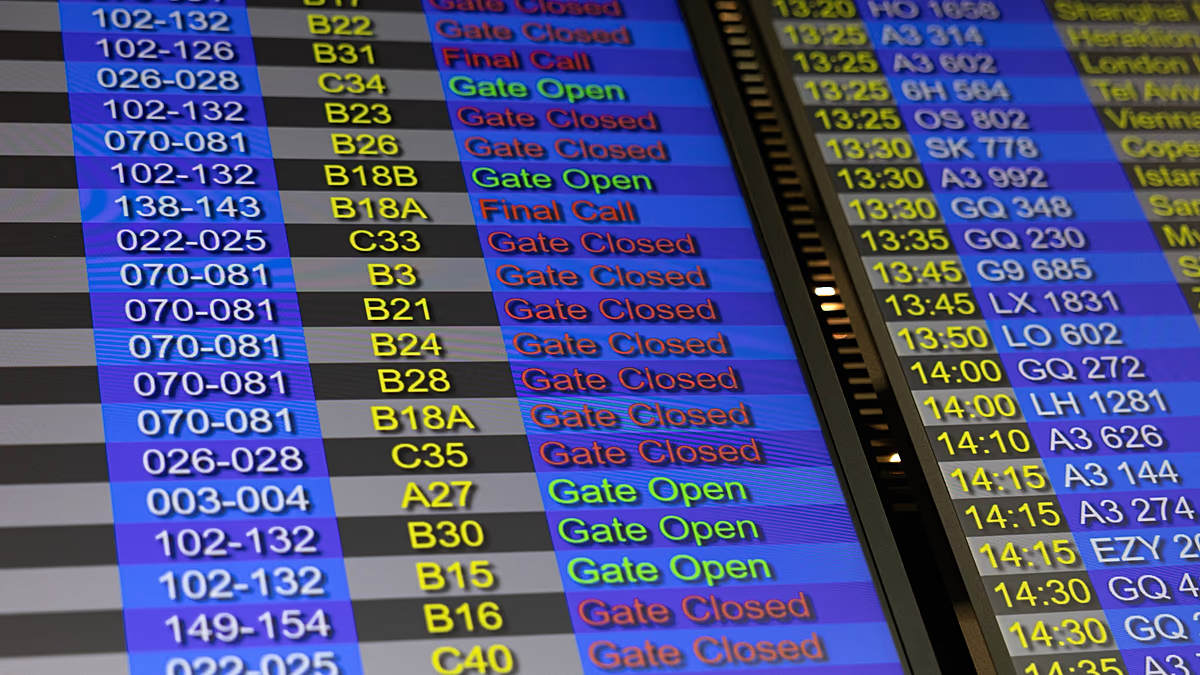
In this modern season, a unique geopolitical plague has hit the men and women in the Greek console. The instability of the Middle East has further extracted dilemmas; warfare has closed gates in the Levant, forcing traffic to reroute around the region. Eurocontrol’s datasets identify that over 300 additional flights now carry their weight through Greek airspace daily, an expanse of roughly 6% of the total service load. Grace lies on the continental aft. Olga Toki reminded us that the country geographically guards the gateway between East and West, and the duties extend further than simply organizing the turnarounds; the integrity of national defense also keeps its an agent. The controllers must monitor the movements of Turkish military jets and unmanned anisotropic UAVs that scatter across undisputed segments, unraveling a veil of work with yet another level of complexity. The impact is visible not just in the tiny technical sectors but in the grimy arrivals terminal. As Jose Lopez steps into Athens from Barcelona, delayed by a foretellable half an hour, he shrugs. Mid-August, he says – such a delay is near usual, his memory hits back on prior waits that stripped whole days. Christos, who oversees the bell-hop of a major Athens hotel, lacks such philosophical proportion. Gentlemen! He screams silently, noticing that delays have swollen his work day. He often orbits the departure screens, checking the feeding of orange numbers, bracing for guests from New York or Sydney to arrive a full seven hours late, collapsing onto their folding him, at the rear of dawn. For them, the geos of vast mechanics slam into the miniscule resentment of personal plans.
Paragraph 6: The Unbalanceable Equation Between Promise and Reality
As the days shorten and the peak slowly recedes, the echoes of these months remain among the viewers. They are humans, but the real issue of Greece’s airspace is its ability to calibrate a tool to the prodigious pressure of its ethos. The controllers are not anti-growth; they are the sweat of the tourism industry, heroes as much as the hotel managers or the beach barbers. As Areti Anastopoulou leans back in her chair, there is a rough but honest synopsis leak: “Tourism built our soul, but we cannot keep feeding it more and more, without pouring fresh water and iron into the infrastructure that delivers it.” The core is the deaccelerating capacity to tend to the facility that—each year—that the country’s future can break through tears. For now, the sparse headphones rest, the pressures swing down, the duty roster resets. But a sense of fatigue hangs over waiting, the certain knowledge that next June, the flood gates of heights will re-open, will slam against the wall. The controller’s work is quiet, anxiety-laden. They do not fight the pandemic statistics; they only have reality to treat. The reality of a complex, modern world that is continually tossing jets into their edges. Is the craft – a final view – is not the formalization of travel, but the creation of safety in a land of unpredictability. In times these, they cannot afford to take a breath, or the aircraft will pause with them. And perhaps the mountain-weighted portraits on the staff board, the tired transfers stand, they symbolize the unexpected cost of breathing hope above.