






For decades, the phrase “economy class sleep” has been something of a cruel oxymoron, representing an elusive dream that millions of travelers chase but rarely quite capture. Anyone who has ever boarded a long-haul flight knows the exhausting, familiar ritual of the dimming cabin lights, the low, hypnotic rumble of the jet engines, and the sudden, desperate scramble to construct a makeshift resting place from a paper-thin airline blanket and a microscopic polyester pillow. In our collective quest to stave off the dreaded, painful reality of the mid-flight neck cramp, we have transformed the travel accessories market into a highly lucrative, multi-million-dollar industry. Travelers routinely pack their carry-on bags to the absolute brim with memory foam U-shaped collars, inflatable wedges, heavy contouring eye masks, and herbal sleep supplements, dragging this bulky, cumbersome gear through crowded airport terminals like protective talismans against the inevitable onslaught of insomnia. Despite our best efforts, creative configurations, and significant financial investments, we often end up slumped uncomfortably over our tiny tray tables or jolting awake in a panic as our heads lurch forward into the cold reality of the economy cabin. However, UAE-based mega-carrier Emirates has decided to directly challenge this taxing status quo by unveiling an exceptionally simple yet fundamentally revolutionary piece of cabin technology that aims to render your personal, carry-on neck pillow completely obsolete. Enter the “U-Dream” headrest, an innovative seating feature designed to transform the economy class sleeping experience from a grueling physical endurance test into a genuinely comfortable, restorative journey. Developed with the modern traveler’s unique anatomy in mind, this built-in luxury is poised to redefine our baseline expectations of economy seating, proving that passengers shouldn’t need a premium business-class ticket to arrive at their destinations feeling human, refreshed, and entirely pain-free.
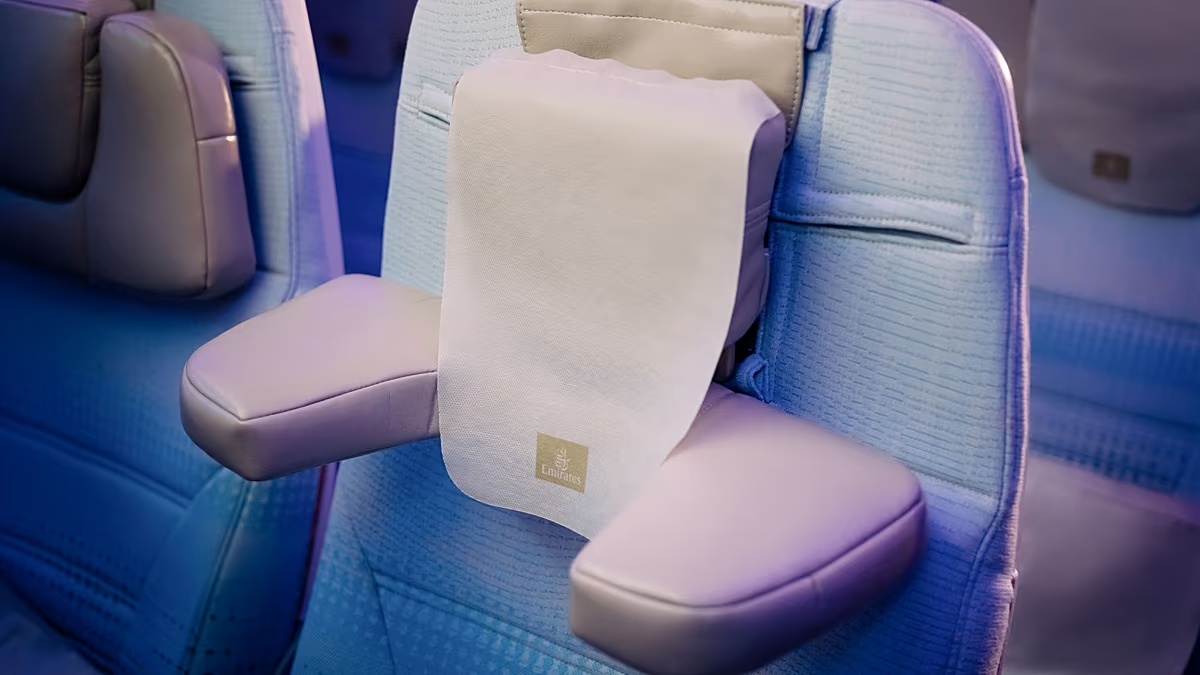
The core design philosophy behind the U-Dream headrest is rooted in a deep, scientific understanding of human biomechanics and the awkward, unnatural positions our bodies assume when confined to an upright airplane seat for hours. Under normal circumstances, when our muscles naturally relax during deep sleep cycles, our neck loses its structural support, leading to lateral tilting or the sudden, jarring forward drop that instantly wakes us up and ruins our rest. The U-Dream addresses this universal human vulnerability by incorporating highly adjustable, flexible side wings directly into the physical structure of the seat’s headrest. These innovative wings can be folded gently inward and precisely molded to cradle the traveler’s head, providing steady, reliable lateral and frontal support that prevents the neck from bending at uncomfortable, strain-inducing angles. This means that whether you prefer to sleep slightly tilted to the left, leaning to the right, or perfectly upright, the headrest conforms dynamically to your specific body, eliminating the need to wedge sweaty, bulky foam rings around your neck. By embedding this advanced support system directly into the aircraft’s fabric, Emirates is effectively democratizing ergonomic resting for everyone in the cabin. Sir Tim Clark, the visionary president of Emirates Airline, proudly announced this innovation as a testament to the carrier’s relentless, ongoing pursuit of customer satisfaction. He pointed out that Emirates has never been an airline to rest on its past achievements, constantly searching for practical, high-impact ways to alleviate the physical and mental stress of travel for those who occupy the main cabin of the aircraft. By fully supporting the neck without requiring extra gear, the U-Dream represents a monumental leap forward in commercial cabin design, changing the game for long-haul passengers who previously had to choose between restless nights or carrying bulky travel accessories.
Emirates’ strategy for deploying the U-Dream headrest across its massive international network is both highly ambitious and carefully calculated, utilizing a phased rollout designed to systematically upgrade their formidable global fleet of aircraft. Currently, three of the airline’s newly delivered Airbus A350 aircraft have been fully outfitted with this state-of-the-art headrest, allowing early holidaymakers and business travelers to experience this unprecedented level of comfort firsthand. For those eager to try out the system themselves, the wait will not be long, as Emirates plans to equip its entire incoming fleet of A350 aircraft with the U-Dream by the end of this year. Looking slightly further into the horizon, the airline intends to extend this physical comfort to its existing long-haul workhorses, ensuring that no passenger is left behind; starting in 2027, the headrest will be progressively retrofitted onto Emirates’ iconic, double-decker Airbus A380s and wide-body Boeing 777s as part of a massive, multi-million-dollar fleet modernization program. This aggressive timeline reflects a deep capital commitment to economy passengers, who historically represent both the financial backbone and the high-volume core of global aviation. By focusing this major quality-of-life upgrade entirely on economy class, Emirates is making a loud, undeniable statement to the global travel industry: physical comfort during travel should not be treated as an exclusive privilege reserved only for the wealthy elite. The logistical scale of retrofitting hundreds of massive, long-range aircraft underscores the carrier’s firm belief that a superior, thoughtful economy product is the ultimate differentiator in an increasingly competitive market, establishing a new global standard where sleeping comfortably on a transatlantic or transpacific flight is treated as a basic human consideration rather than a premium upgrade.
This exciting wave of economy class innovation is not occurring in a vacuum, as other major international airlines are also beginning to realize that treating economy passengers like tightly packed cargo is a short-sighted and self-limiting business model. Recently, Chicago-based United Airlines made massive waves across the industry by announcing a bold structural redesign for its prized Economy Plus rows, aiming to eliminate one of the most universally despised, stress-inducing aspects of commercial flying: the dreaded middle seat. In these newly configured rows, the middle seat will be completely removed, transforming what was once a cramped, high-friction space of shared armrests into a spacious, convenient table shared between the aisle and window passengers, granting them unprecedented elbow room and physical breathing space. This design thoughtfully acknowledges the psychological and emotional toll of being squeezed into close, sweaty physical contact with strangers, offering economy travelers a welcome sense of personal territory that was previously unimaginable in the main cabin. Furthermore, United has unveiled its highly anticipated “relax rows,” a series of innovative economy seats specifically engineered to easily convert into flat, horizontal sleeping surfaces during flight. By allowing weary passengers to fully stretch out across a row of seats, the airline is directly addressing the painful physical limitations of upright seating, offering a compelling, affordable compromise for budget-conscious families, elderly travelers, and individual fliers who desperately need to lie down during long, grueling overnight flights. Together, these redesigns demonstrate a profound, compassionate shift in corporate aviation mindset, moving away from maximizing raw passenger density toward optimizing the physical and mental well-being of the human beings on board.
Perhaps the most radical, boundary-pushing departure from traditional economy class limitations comes from the southern hemisphere, where Air New Zealand has officially launched its highly anticipated “Skynest” bunk beds on its ultra-long-haul routes. Recognizing that spending seventeen or eighteen hours straight inside a standard, upright economy seat can be deeply debilitating to the human body, the innovative Kiwi carrier has designed a dedicated, quiet sleep zone featuring stacked, capsule-style bunk beds. Instead of requiring passengers to purchase an incredibly expensive business class ticket for the entire duration of a long journey, Air New Zealand allows economy travelers to book a comfortable, quiet, and private four-hour sleep window in one of these cozy micro-cabins. Each bunk in the Skynest is meticulously prepared by flight attendants with premium, fresh bedding, a full-sized pillow, gentle privacy curtains, personal lighting, and independent ventilation, creating a serene, peaceful sanctuary far removed from the ambient noise and hustle of the main cabin. Once a passenger’s scheduled four-hour block concludes, they return to their standard economy seat, allowing another passenger to take their turn in the clean bunk. This shared-economy sleeping model represents a massive paradigm shift in how we conceptualize international air travel, treating deep sleep not as a continuous luxury tied to a single expensive seat, but as a modular, time-shared utility available to everyone. It perfectly complements innovations like Emirates’ U-Dream headrest and United’s seat-to-bed conversions, offering a diverse, exciting array of practical solutions to the complex biological puzzle of keeping the human body rested, healthy, and happy while traveling at thirty-five thousand feet.
As we look toward the future of global aviation, these combined, customer-focused innovations from Emirates, United Airlines, and Air New Zealand signal a compassionate, human-centric turning point in commercial travel history. For far too long, the prevailing narrative surrounding economy class travel has been one of survival, characterized by shrinking legroom, paper-thin cushions, deteriorating customer service, and absolute physical and mental exhaustion. By investing heavily in ergonomic research, advanced spatial reconfigurations, and modular sleep systems, these forward-thinking airlines are proving to the world that passenger comfort and corporate profitability do not have to be mutually exclusive concepts. They are openly acknowledging that a traveler is not merely a ticket number or luggage weight to be balanced, but a living, breathing human body that gets stiff, a mind that experiences travel anxiety, and a spirit that deserves dignity during long, exhausting journeys across time zones. The introduction of the U-Dream headrest, the elimination of the cramped middle seat, and the advent of shared, clean bunk beds are collectively elevating the humanity of the economy cabin. Ultimately, this hard-fought revolution in passenger comfort ensures that traveling across our beautiful globe is no longer a painful physical ordeal to be dreaded, but a comfortable experience to be embraced. By prioritizing our basic physical needs, these upgrades allow us to arrive at our far-flung destinations with our bodies intact, our minds alert, and our natural sense of adventure fully preserved, ushering in a brighter, more humane era of flight.