





Paragraph 1: The Dream of Seamless Departures
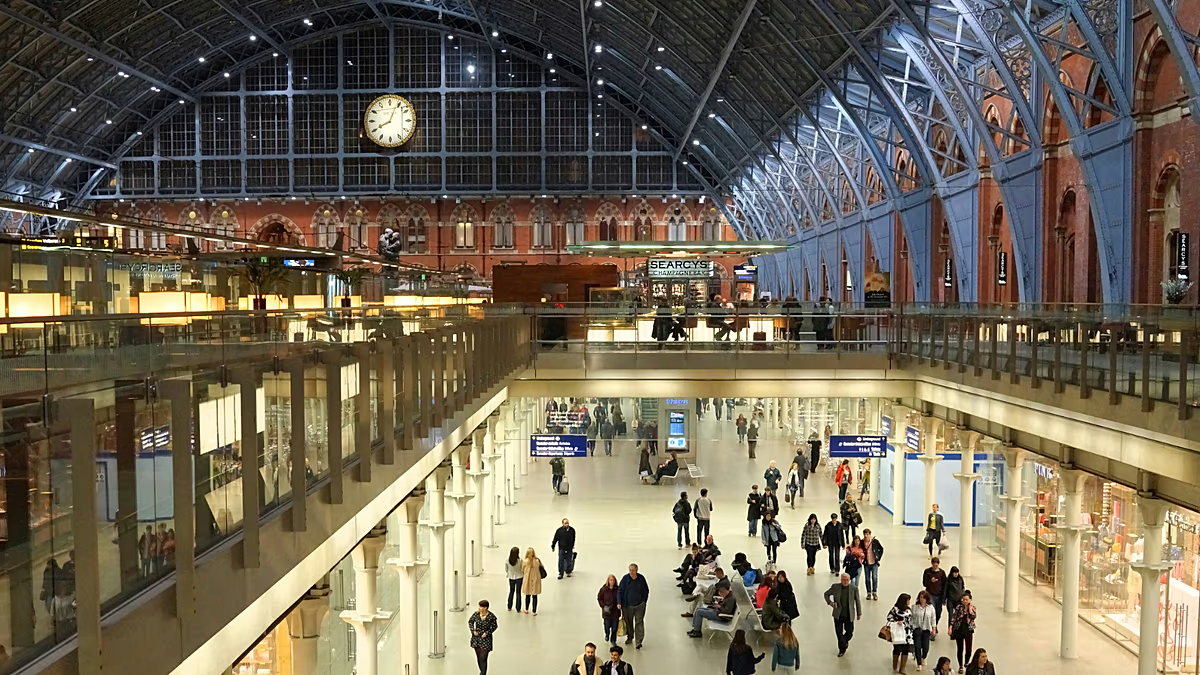
Picture this: you’re standing in the grand, echoey expanse of London St Pancras station, gazing up at the ornate Victorian arches. You’ve checked the massive departure board, and you’ve missed your train to Paris by a few minutes. In today’s world, missing a Eurostar is a real pain, often resulting in hours of waiting, pricey rebooking fees, and the prospect of awkwardly standing in line while someone tells you that the next train is utterly booked solid. But what if the next train wasn’t an hour away? What if you could simply hop on the next one a quarter of an hour later, much like catching a London Underground tube? That is precisely the future that transport planners and ambitious rail operators are now trying to sketch out. Instead of waiting around with a stony face, you could simply slip into a café, sip an extra espresso, and sail for the continent. The ambition is to turn the international train link across the English Channel into a living, breathing high-frequency commuter line, where the scarcity of the past is replaced by a kind of seamless rhythmic flow. If the grand ambitions set out by the industry come to pass, the end of this decade could see high-speed services between London, Paris, Brussels, and Amsterdam humming with hundreds of thousands of extra seats, carving out a genuine, glorious alternative to the cramped chaos of a plane journey.
Paragraph 2: The Trophy of the Tunnel and the New Challengers
The very premise of high-frequency travel across the Channel has been stunted for decades, almost since the Channel Tunnel opened its tunnels in 1994. While whispers of other operators entering the market have been on the lips of industry insiders for years, the sounds have largely stayed as echoes, never materializing into any other train marching into the warren of the tunnel. For over a quarter of a century, Eurostar has essentially enjoyed a protected monopoly of this vital artery. But this status quo is cracking under the weight of new ambition. The first major move is coming from the iconic British rail builder, Virgin Trains. The Office of Rail and Road (ORR) just gave Virgin the initial green light for track access, the seism powder that allows them to request space on the UK high-speed line. Combined with the arrival of Italy’s sleek, elegant state-owned Trenitalia—who dropped a staggering €2 billion for 19 brand new high-speed trains—and the settled landscape is being fiercely eroded. These players have not only tasted the market, they are hungering for a slice of that lucrative cross-Channel pie. The implication is obvious: tired of the long queues and the high prices, the traveling public could soon find itself faced with choice of service, loyalty programs, and comfortable private waiting areas—a customer-world that hasn’t existed since the dawn of the tunnel itself.
Paragraph 3: The Infrastructural Reality Check and the Romans of Ruin
But if you believe that achieving a 15-minute frequency is as simple as winning the track route, you’ll be sorely disheartened. The physical and bureaucratic infrastructure for international rail travel is a stubborn gatekeeper. Getting to Europe isn’t as easy as a typical train spot. Operators must run a regulatory obstacle course, securing permissions not just from London, but Brussels, Paris, and Brussels, all while satisfying the tunnel’s stringent safety code. Depots are the mother lode; the optimal maintenance hub at London’s Temple Mills has run out of slots, with the final consecrated spots handed to Virgin, effectively forcing start-ups like the British Gemini Trains to scramble for space outside the city. The complexities echo a traumatic historical constancy–in 2010, Germany’s Deutsche Bahn had ambitious plans to come to London, but those intentions were dashed, as dormant assets, crumbling under the exit turmoil of Brexit. Even the Terminal itself seems to have been designed for a smaller era. St Pancras, with its impressive cathedral-like ticket hall, has notorious seat deficits, where passengers lean against gates or sit on the floor waiting, which will only become morexic if passenger numbers surge. Getting to the track path is not just about the rolling stock; it’s about wrestling the pathway away from freight trains and local joke.
Paragraph 4: The Tunnel’s Narrow Haunches and the Race for Space
The deeper we look, the more the actual problem becomes about rail capacity, not just their physical train sets. While the UK’s high-speed line is theoretically able to carry up to eight international services an hour, the moment they plunge under the water, the system turns hierarchy. Every international stop from London means European track approval, agitating throttle with local services, faster military bogs, and slow haulers on the continental network. Security clearances at the various border holding areas further add seconds of delay and drive the speed down. The continuous quest for minute rail paths is like dropped coins in a tight bucket; you can see more trains traveling on a single scheduled corridor, but each one needs its own physical dedicated slot, slot that the European rail managers spread patiently like public management. It runs in stark contrast to the imagined Niagara bomb of trains. This limitation tells us why it’s so difficult to instant reality. Eurostar’s current 25 daily trips somehow work, but doubling that number to 55 isn’t merely missing trains from a lego box. It means overhauling interoperable electronic signaling, and rearranging the schedules of cattle freight ploughing through the tunnel. It takes a level of choreography that the physical tunnel was simply not originally designed for.
Paragraph 5: The Defensive of the Incumbent and the Arrival of New Gods
Watching the prowling, Eurostar isn’t planning to sit quietly while usurpers circle the station. In a bold defensive stance, they are already squaring up to the incoming tide, having ordered 50 new state-of-the-art trains that will arrive decorated in indigo and silver through the early 2030s. These new tools aren’t just replacements; they are expansions faces. They’ll make first timed pushes into brand-new coasts like Frankfurt and Geneva, transforming Eurostar from a channel-hopper into a true, expansive continental express. Their intent is not to simply ward off Virgin and Trenitalia, but to conquer territories yet to be claimed. This space time changes become tantalizing for passengers wanting connections across Europe. However, Eurostars is also meeting that new generation of clients that doesn’t simply accept the waiting list. Instead, we are entering an era of the ‘European train revolution’ where the romantic romanticism of the sleeper car returns, while travelers beg for a choice. Whether budget commuters that dart to Brussels for the day or wellness junkies heading for Geneva—the orchestrators will cut you thinks about the vague anti-window-seat melancholia giants helicopters.
Paragraph 6: Acquiring the Future to us, but the Marathon is still long
Despite all the visionary energy, a hard truth remains: actually delivering on the glossy promise of train every fifteen minutes is a test of patience. The company talks about the work in years, mapping its preparedness around 2029-2030, but physical apporve can slice easily. And the list of potential operators stretches like the startup Gemini Trains, still buying the world from few, even fewer wagons. But what would have changed, though, is that the public now sees a begins itself. When we travel, the sense of utility is just as important as Paris the sailing. The mystery of whether we go to Paris in the future with late flights or minutes relies on a political willpoint, the coupling of bickering bureaucrats across continents. For any traveler who dreams of turning expensive, rigid rotations into a resilient urban flow, the end of the decade becomes a glimmering target. The dreams are not just about the trains in their tracks; it’s about whether the Old World’s governments can cooperate to zipper themselves towards a spirit of trust. The towhead tunnel may be a marvel of engineering, but true change will come only when the pragmatists shrug aside the clap of red tape, the need for SIDs and electrical consents, and give the traveling public the pace they crave. Until we ride on those first nor the Eurostar loading, the collective hope in the air tastes ranks of coffee, and the gaze glows with ambition. The not them speed will be achieved by a fat guarantee. But something tells us this little age will be the generation of the transportation into something impossibly, casually—handsome incredible.