






Walking Holidays: The Thoughtful Way to Experience Europe’s Most Beloved Destinations
There’s something profoundly different about experiencing a place on foot. The rhythm of your own steps, the scent of wild herbs crushed underfoot, the unexpected conversations with locals who would otherwise remain strangers—these are the moments that transform a simple vacation into something approaching a pilgrimage. And it seems travelers are catching on to this ancient wisdom. Across the United Kingdom, searches for “walking holiday” have surged by an impressive 60% compared to last year, as more people discover the profound satisfaction of slow, immersive travel. This autumn, as Europe’s most cherished destinations brace for the familiar onslaught of visitors, those who choose to explore on foot might just find themselves experiencing something far more meaningful than the typical tourist itinerary—both for themselves and for the communities they visit.
The conversation about overtourism has dominated travel discussions for years, but walking specialists argue that the problem isn’t simply about how many people visit—it’s about where they concentrate and how they move through a place. Annie Antonatou, a walking holiday specialist who calls Greece home, has witnessed this firsthand on the island of Santorini, which serves as Greece’s busiest cruise port outside Athens. She explains that walking holidays naturally disperse visitors across villages, trails, and lesser-known islands rather than funneling them into famous viewpoints during peak hours. This distribution isn’t just better for travelers seeking authenticity—it’s essential for the survival of small communities. When walkers meander through villages and remote areas, they naturally support local businesses: the family-run guesthouse where they rest their heads, the ferry company that carries them between islands, the bakery supplying their morning bread, the taverna where they share a meal with fellow travelers. These small encounters, Antonatou emphasizes, are precisely what keeps village economies thriving.
The philosophy extends beyond simple economics. Veriano Verde, a local guide born and raised near Amalfi, Italy, leads walking tours along the Amalfi Coast—a region that made headlines earlier this year when a viral video showed residents feeling trapped in their own homes as tourists squeezed shoulder-to-shoulder through narrow lanes and queued for ferries. Verde sees walking as a genuine win-win solution. Local people and businesses benefit from visitors who linger, while his guests enjoy a more intimate and memorable experience of the real Amalfi and its surrounding villages. The beauty of staying in a small village, he notes, is experiencing the true authenticity of daily life as locals live it. Even today, many residents of the region live just three hundred to four hundred steps from the main road, and in some areas, people navigate almost entirely on foot. Walking holidays, it seems, read like a how-to guide on combatting overtourism: traveling slowly, outside peak season, through lesser-visited areas with the guidance of locals who know the land intimately.
For those dreaming of the Amalfi Coast, the famous Path of the Gods remains one of the most spectacular walking routes in Europe. Verde describes it as something that “is hard to even describe with words—you simply have to experience it, losing yourself suspended between sea and sky.” What elevates this route beyond mere scenery is its connection to traditional ways of life. Walkers encounter shepherds tending their flocks, visit traditional buffalo mozzarella farms in the mountain town of Agerola, and discover that the coast offers far more than the crowded main squares. Verde encourages visitors to wander beyond the Duomo steps in Amalfi proper, to become gloriously lost in a labyrinth of stunning vistas, or to follow the path to the neighboring town of Atrani. The timing matters tremendously here. While summer transforms the coastline into a human river, Verde suggests the true magic happens during spring’s gentle awakening or autumn’s golden calm. His most treasured recommendation, though, is a winter escape when the entire coast seems to belong exclusively to you, with the sea crashing below and the ancient paths stretching out in peaceful solitude. A week of guided walking through this dramatic landscape with Exodus Travels begins at approximately £1,469 per person, not including flights—a modest investment for memories that will last far longer than any crowded beach day.
The Greek islands offer another compelling case for exploring on foot, particularly when you pair the iconic beauty of Santorini with the quieter charms of neighboring Cycladic islands. Antonatou suggests combining the dramatic caldera of Santorini with walks on Naxos, Sifnos, Milos, Andros, or Tinos, where travelers encounter local people, learn about endemic plants and traditional agriculture, and sleep in family-run guesthouses while dining on produce grown or caught locally. She describes this as an experience that is “immersive rather than rushed.” The Santorini Caldera Trail from Fira to Oia earns her praise as one of the world’s great coastal walks, offering uninterrupted sea views that stretch to the horizon. Yet her personal favorite is the ascent to Mount Zas on Naxos, the highest peak in the Cyclades, where mythology and dramatic scenery intertwine—according to Greek legend, Zeus himself spent part of his childhood there. For Antonatou, these experiences reveal something essential about Greek island culture: that famous destinations like Santorini represent only one chapter of a far richer story. Through walking, travelers come to understand that Greece’s true wealth lies not in its postcard views but in its layered history, its resilient communities, and its profound connection to the natural world. The optimal seasons for such adventures span from late spring through early summer or autumn, when wildflowers carpet the hillsides or warm seas invite post-walk swims.
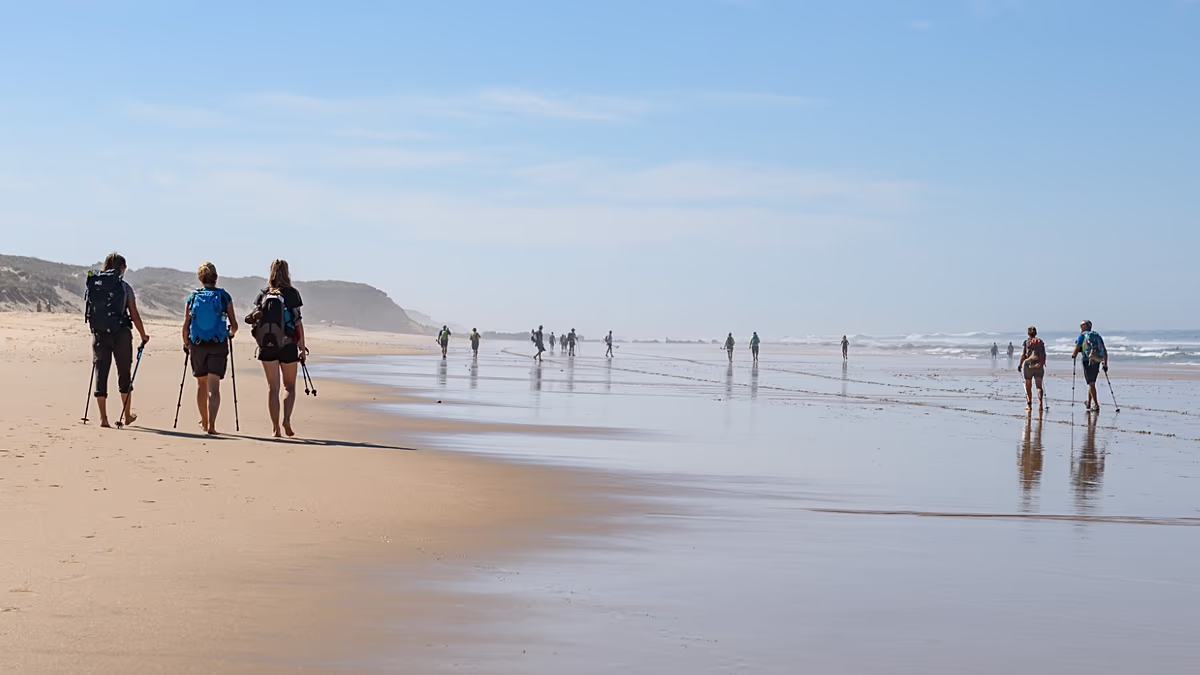
Portugal’s Algarve region presents yet another compelling case for walking as the antidote to mass tourism. While many visitors know this southern coast for its bustling resorts and golf courses, Ricardo Estêvão, manager of Portuguese walking specialist Vincentina Travel, reveals a completely different side through the region’s network of trails. The Fishermen’s Trail stretches 450 kilometers along some of Portugal’s most spectacular and unspoiled coastline, and walking it opens up a world that most tourists never glimpse. The route passes Cabo Sardão, where white storks nest on sea cliffs in one of the few places on Earth they do so, and winds through landscapes that remain wild and untamed. Yet Estêvão notes that the most profound moments often have nothing to do with the views. Travelers frequently tell him about unexpected encounters: conversations with local fishermen mending their nets, exchanges with small café owners who have welcomed walkers for generations, or shared meals at family-run restaurants overlooking the Atlantic where the day’s catch is grilled simply and served with love. These human connections define the walking experience in ways that no guidebook can capture. Estêvão emphasizes that walking routes require ongoing maintenance, conservation, and education to remain viable. By supporting official trail organizations like Rota Vicentina and patronizing local businesses, walkers help ensure these unique landscapes remain protected and accessible for generations to come. He recommends traveling between March and June or September to November, deliberately avoiding the intense summer months when crowds and heat diminish the experience for everyone—visitors and residents alike.
The Dalmatian Coast of Croatia offers yet another compelling argument for exploring on foot, particularly if you know where to look. While Dubrovnik’s ancient walls draw massive crowds from cruise ships, the nearby Pelješac Peninsula presents a quieter, more authentic version of Adriatic life. Here, walkers can hike through medieval towns and terraced vineyards, sampling some of Croatia’s finest wines along the way. The nearby island of Mljet, accessible by ferry, is a national park that feels worlds away from the tourist throngs. Its walking routes range from gentle loops around the saltwater lakes of Veliko Jezero and Malo Jezero, where you can pause for swims in crystalline water beneath pine forests, to more challenging climbs that reward hikers with sweeping views across the Adriatic. Even in Dubrovnik itself—perhaps the most overtouristed city in the region—there’s an escape from the cruise ship crowds. A hike up Mount Srđ from the eastern edge of the Old Town rewards those who make the effort with spectacular panoramic views over the terracotta rooftops and the shimmering sea beyond. Timing is crucial here too; September and October are ideal months when the grape harvest animates the Konavle Valley and Pelješac Peninsula with festivals celebrating the region’s winemaking heritage. For those determined to walk Dubrovnik’s famous city walls, the secret is to arrive before nine in the morning or after four in the afternoon, when the day-trip crowds have yet to arrive or have already departed.
The environmental and social benefits of walking holidays extend far beyond the immediate travel experience. When travelers choose to explore on foot, they participate in a form of tourism that respects both natural ecosystems and human communities. Walking requires no new infrastructure, produces minimal carbon emissions, and creates economic opportunities that stay within local communities rather than flowing to international conglomerates. The walker’s pace—roughly three to four kilometers per hour—allows for a depth of observation impossible from a bus window or cruise ship deck. You notice the changing textures of soil, the calls of birds, the subtle shifts in architecture as you move from one village to the next. You have time to stop and speak with a farmer, to linger in a tiny church, to accept an invitation for coffee from someone you just met. These are the experiences that create lasting memories and genuine cross-cultural understanding. Moreover, walking holidays naturally distribute tourist spending across a wider geographic area, helping to sustain rural economies that might otherwise struggle. Every meal eaten in a village taverna, every night spent in a family-run guesthouse, every ferry ticket purchased for a smaller island—these choices add up to meaningful support for communities that receive far less attention than their more famous neighbors.
As the travel industry grapples with the challenges of overtourism, walking offers a template for a better way forward. It embodies the principles of sustainable tourism: low impact, high engagement, economic benefit to local communities, and genuine cultural exchange. The experts interviewed for this piece all emphasize the same conclusion—that walking holidays create a win-win situation for travelers and destinations alike. Visitors gain access to authentic experiences and meaningful connections, while local communities benefit from visitors who respect their homes and contribute to their economies in sustainable ways. Perhaps most importantly, walking cultivates a mindset of gratitude and stewardship. When you have walked a trail yourself, when you have felt the sun on your face and the stones beneath your feet, you develop a personal connection to that place that no photograph can replicate. You become an advocate for its preservation rather than merely a consumer of its scenery. In an era when mass tourism threatens many of the world’s most beloved places, choosing to walk represents both a personal choice for deeper travel and a collective commitment to the future of these destinations. It is, quite literally, a step in the right direction.
Sarah Faith, senior values writer at Responsible Travel, captures this philosophy perfectly when she emphasizes that walking holidays offer travelers the opportunity to connect meaningfully with the places they visit. By choosing to explore Europe’s most beautiful destinations on foot, travelers join a growing movement of conscious tourism that values quality over quantity, authenticity over spectacle, and sustainability over convenience. The trails of the Amalfi Coast, the caldera paths of Santorini, the wild headlands of Portugal, and the ancient routes of Croatia all await those willing to slow down and truly see them. As the autumn light softens and crowds thin, there has never been a better time to lace up your boots and discover that the journey, taken step by step, offers far more than any destination could promise alone.