






Did you miss the eclipse? If you were one of the many people who never quite got around to booking a flight to Greenland, Iceland, or Spain last time, you probably know the feeling. It’s that quiet, familiar pang of FOMO when the internet fills with golden-hued photos and everyone you follow seems to be standing in a crowd, staring open-mouthed at the sky. You tell yourself it was just an eclipse, but deep down you know you missed something primal, something ancient, something that makes you feel connected to every human who ever looked up in wonder. Here is the good news: the universe is not done with you yet. Next year, in 2027, a total solar eclipse will trace a breathtaking path across parts of Europe and North Africa, and the experts are already calling it the eclipse of the century. The travel world has noticed, too. easyJet has recorded a 70 percent boost in bookings among British travellers to destinations along the path of totality, and they have given the phenomenon a name: the “eclipse effect.” That is not just a clever marketing phrase. It is a warning. It means people are booking a year in advance, grabbing flights and hotels before the rest of us have even started to think about it. If you were hoping to make a spontaneous decision when the date gets closer, you may already be too late. But if you act now, if you start scanning for flight tickets this very week, you still have a chance to be one of those lucky souls who stands under the moon’s shadow and feels the impossible happen.
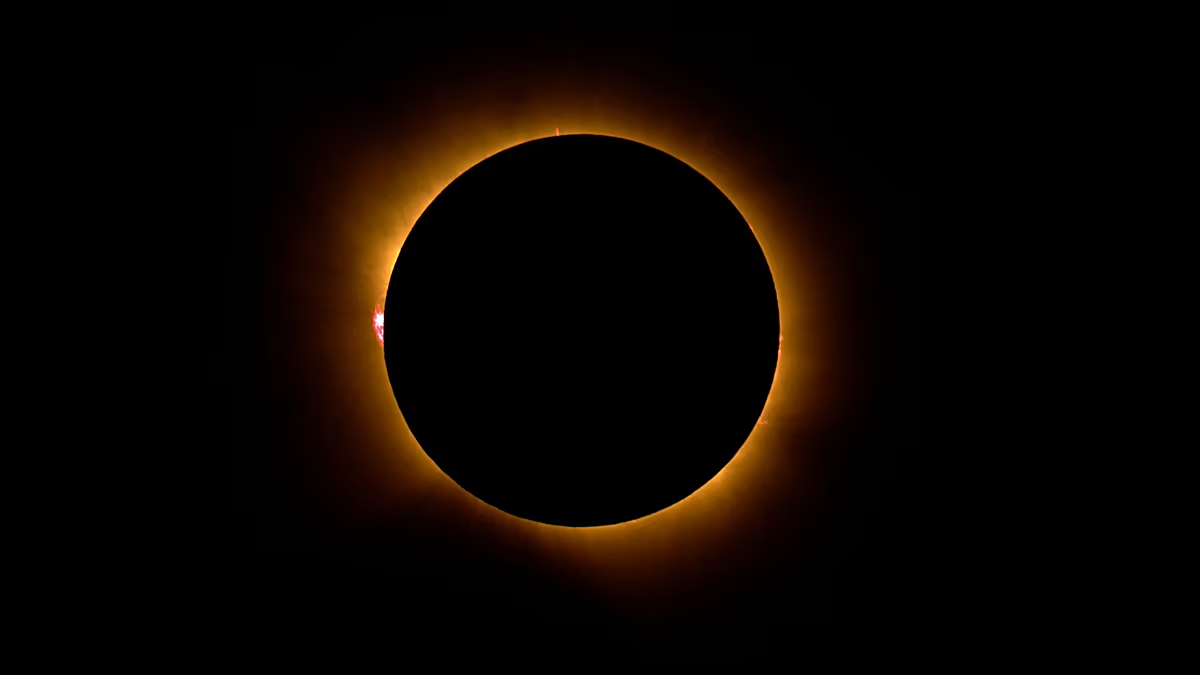
What makes 2027 such a big deal? Let’s put it simply: a total solar eclipse happens when the moon slides perfectly between the sun and the Earth, turning daylight into a strange, hushed twilight for a few precious minutes. But not all eclipses are created equal. The 2026 eclipse gave observers just over two minutes of totality at its maximum; at its best points it was spectacular, but it was also brief, teasing, like a curtain that flicked open for a moment and then closed. The 2027 event, on the other hand, is the longest total eclipse on easily accessible land until the year 2114. At the point of greatest eclipse, in Egypt, the sun will be completely covered for six minutes and twenty-three seconds. That is more than six full minutes of darkness in the middle of the day, enough time for stars to appear, for the temperature to drop, for birds to fall silent and for a crowd of strangers to share a deep, collective gasp. It is the kind of thing that astronomers dream about and the kind of experience that stays with you forever. It is also an event you can actually reach without an expensive expedition to some remote corner of the planet. The path of totality will cross places like southern Spain, the tiny territory of Gibraltar, and Egypt, meaning you can combine the celestial show with a proper holiday, a bit of culture, and maybe even a beach day. You do not need to be a scientist to understand why this is worth your time. You just need to imagine standing outside as day turns to dusk, feeling a strange chill on your skin, and watching the world go completely still. That is not something you see on a screen. That is something you feel in your bones.
The scramble has already begun, and the numbers are startling. easyJet’s UK Country Manager, Kevin Doyle, said the 2027 total solar eclipse is “a once-in-a-generation travel opportunity” and that the airline is already seeing growing interest from Brits who want to experience it for themselves. He singled out Egypt, Gibraltar, and Spain as destinations that offer “an incredible combination of an unforgettable celestial event and a truly memorable holiday.” But it is the booking data that really tells the story. easyJet has seen bookings to Spanish locations including Seville, Almeria, and Malaga rise by 69 percent since the recent August eclipse. Gibraltar has recorded a 29 percent spike in bookings. And if you think that sounds busy, wait until you hear about the hotels. When Euronews Travel looked for a three-night stay in Seville starting on 1 August, Booking.com showed that 87 percent of places to stay were already unavailable for those dates. In Gibraltar, the situation is even more extreme: a staggering 98 percent of properties were already sold out. That is not a typo. Ninety-eight percent. In other words, if you have been waiting for a sign to make up your mind, this is it. The astrotourism boom is no longer a niche trend. It is a full-blown movement, driven by travellers who want more from a holiday than a nice hotel and a pool. They want to witness something awe-inspiring, something that reminds them of the vast and mysterious universe we all live in. And they are willing to book early, plan carefully, and move fast to get it. If you don’t want to be the one scrolling through other people’s eclipse photos again, you need to join them before the last places disappear.
So what could this cosmic holiday actually look like? Imagine Gibraltar, for instance. The tiny peninsula, famous for its towering limestone Rock and its colony of Barbary macaques, is set to be right in the path of totality. Flights with easyJet start from just £34.99, which is around €40.85 — a bargain for the chance to witness one of nature’s greatest shows. But Gibraltar is much more than a viewing platform. It is a fascinating blend of cultures, shaped by centuries of Spanish, Moroccan, Portuguese, and British influence. You can wander through the narrow streets and hear a wild mix of accents and languages, eat cuisine that pulls from three continents, and watch the sun set over the sparkling waters of the Mediterranean. One of the highlights is a walking tour of the Upper Rock, where you will find the impressive 70-metre-long Windsor Suspension Bridge. It hangs over a deep ravine, swaying gently as you cross, and offers sweeping views of Gibraltar Bay. Imagine standing there on the day of the eclipse, with the bay glittering far below and the sky gradually turning from blue to an eerie twilight. As the moon moves across the sun, the temperature will drop, the light will become strange and silver, and the whole scene will feel like something out of a dream. The other eclipse-watchers around you will stop talking, then someone will gasp, and then the darkness will come. It is the kind of moment that makes you feel small in the best possible way, tiny and insignificant, but also enormously lucky to be alive.
If Gibraltar feels a little too small for a longer holiday, Málaga offers the perfect alternative. The flight prices are the same, starting at £34.99, and the eclipse will be visible there too. Málaga is a city that knows how to enjoy life. It is the birthplace of Pablo Picasso, and it spoils its visitors with a stunning choice of sixteen beaches, each with its own character. You could spend the morning at the Picasso Museum, which houses a wonderful selection of pieces gathered from the private collection of two of his relatives, alongside more than two hundred works that span his extraordinary range of styles, materials, and techniques. Then, in the afternoon, you could put your toes in the sand, eat some fried fish, and wait for the sky to begin its slow, mysterious transformation. On eclipse day, you will be surrounded by thousands of other people who have come from all over the world for the same reason. There will be families with children, old couples holding hands, and groups of friends who decided to turn an astronomical event into an adventure. When the sun begins to disappear behind the moon, the light turns an odd, metallic colour, and the sea seems to glow. The seagulls stop crying. The waves seem slower. And for those six or so minutes, time feels suspended. It is a strange and beautiful thing to share with so many strangers, and it is something no photograph can ever capture properly. Málaga gives you the culture, the food, the sunshine, and the beach — and then it gives you one of the most extraordinary shows the universe can produce.
So if you have been waiting for a reason to travel, here it is. The 2027 total solar eclipse is offering you a chance to be part of something truly rare, something that will not happen again on easily accessible land until 2114. That is not just a lifetime away — it is a century away. The people who miss it will see it in history books. The people who go will remember it for the rest of their lives. You don’t have to be an astronomer or an eclipse chaser to appreciate this. You just have to be a person who loves adventure, who wants to feel wonder, and who understands that some things are better experienced in person than through a screen. The travel industry is already seeing the eclipse effect: flights are filling, hotels are disappearing, and prices will only go up as the date gets closer. If you don’t want to miss this one, now is the time to start scanning for tickets. Tell your friends, mark your calendar, and make a promise to yourself that you will be under that shadow. Whether you end up in Gibraltar, Málaga, or Egypt, you will come home changed. You will have seen the sun turn to black, the stars come out in the day, and the world hold its breath together. That is the kind of memory you can’t buy, but you can book a flight to go and make it. The universe is calling. All you have to do is answer.