



There is something quietly magical about stepping aboard a ship that has outlived every single vessel of its kind, especially when that ship still moves through the water with the same soulful rhythm it had eighty years ago. This October, visitors to London have a rare and beautiful invitation: to celebrate the 80th birthday of the Waverley, the world’s last seagoing paddle steamer, while cruising the River Thames. But the Waverley is not just a machine from another era; she is a living, breathing piece of British maritime history, a grand old lady of the water who has somehow kept her engines roaring and her decks full of curious passengers long after her peers were retired to museums or scrap yards. Boarding her is like stepping through a time portal, into an age when steamships were the height of travel and the Thames was alive with paddle wheels churning through dark water. There is the unmistakable scent of coal smoke and oil, the deep throb of a 2,100 horsepower steam engine beneath your feet, and the gentle slap of the paddle wheels against the river. It is not just a boat ride; it is an experience that wraps around your senses, a living memory of a time when travel was slower, louder, and somehow more meaningful. To sail on the Waverley is to feel connected to all the people who have stood on her decks before you, and this October, the ship will celebrate that long, rich connection in a way that feels both festive and deeply personal.
The story of the Waverley begins on the River Clyde, at the Pointhouse Yard in Partick, Glasgow, on 2 October 1946. She was built to serve the industrial and coastal communities of Scotland, carrying passengers and goods along the coasts and islands where roads were poor and the sea was the highway. She was named after the Waverley Novels by Sir Walter Scott, a series of historical romances that captured the Scottish imagination, and the name stuck with her like a poetic badge of honor. For decades, she worked hard, a faithful servant of the sea, taking day-trippers and holidaymakers to seaside towns, offering them a modest escape from the gray routines of post-war Britain. But by 1974, the world had moved on. The era of paddle steamers had long passed, and her commercial career was over. She was no longer considered useful enough to keep running, and could easily have been scrapped. Instead, she was sold to the Paddle Steamer Preservation Society for exactly £1, a token price that speaks volumes about her true value. What followed was one of the most heartwarming rescue stories in maritime history. Volunteers, enthusiasts, engineers, and ordinary people who simply loved her refused to let her disappear. They restored her, lovingly brought her back to life, and returned her to the water in 1975, not as a forgotten relic but as a working museum, a tourist attraction, and a living tribute to the age of steam. Since that second launch, she has carried more than six million passengers and sailed across countless British destinations, and a recent independent assessment revealed that her voyages have contributed an astonishing £11.6 million, around €13.5 million, to the British economy. That is the kind of legacy you cannot put a price tag on, though it is nice to know that this grand old lady still pays her way.
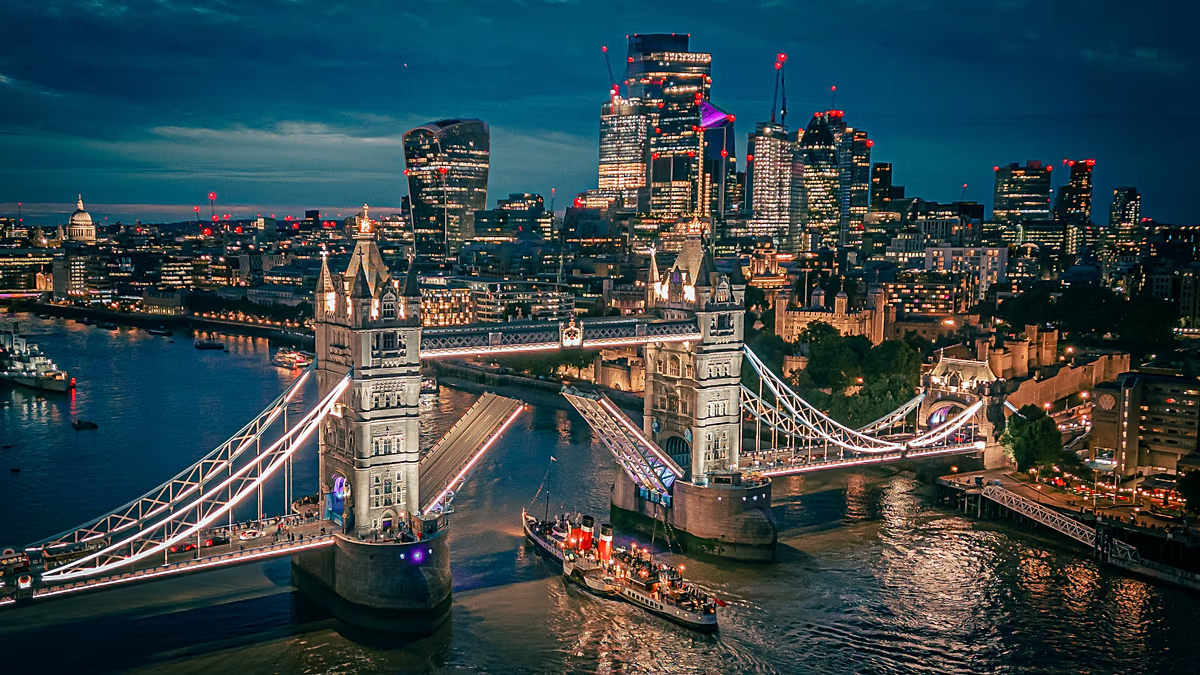
This year’s anniversary is not just about looking backward; it is also a chance for passengers to be part of the story. On 2 October, the Waverley will depart from London Tower Pier for a special birthday sailing that promises to be as joyful and stylish as the ship herself. The decks will be filled with the sounds of live music, featuring the Bel Canto Vintage Sisters, a jazz trio whose harmonies and swing rhythms evoke the golden age of 1940s jazz and bring the spirit of the ship’s earliest days back onboard. For £47, just over €54, passengers can enjoy a one-way journey from the heart of London to Gravesend in Kent, a riverside town steeped in literary history. Gravesend was home to Charles Dickens, and it was at Gad’s Hill Place, his beloved country house, that the great English author wrote some of his most famous works, including Great Expectations. On select days, visitors can even tour the house itself, making this a perfect excursion for literature lovers and history buffs alike. But even if you never step off the boat, the journey itself is a spectacle. Departing from Tower Pier, the Waverley glides along the Thames, past some of London’s most iconic landmarks, the O2 Arena, Canary Wharf, and Tower Bridge, all seen from a perspective that feels more romantic and timeless than any modern river cruise could ever offer. You can stand at the rail, feel the wind in your face, watch the water roll and churn beneath the huge red paddle wheels, and imagine what it must have been like to travel this way in the 1940s. For a few hours, the city becomes a backdrop to a memory, and the Waverley becomes the main character.
If you want to spend a whole day in the Waverley’s company, there are even more adventurous options available. One of the most fascinating itineraries is the return cruise to and from Southend-on-Sea, which offers passengers the chance to see three extraordinary Second World War-era forts built in the Thames estuary: Shivering Sands, Red Sands, and Knock John. These are not your ordinary military relics. They stand in the middle of the water, rusted, weather-beaten, and mysterious, as if guarding the river from some forgotten conflict. Seeing them from the deck of a historic paddle steamer is an experience that feels particularly poignant, a layer of maritime history stacked on top of another, each one reminding you of how much the Thames has witnessed over the years. The full day itinerary departs at 9:30 in the morning and returns at 9:00 at night, giving passengers ample time to soak in the scenery, chat with fellow travelers, enjoy food and drink, and simply listen to the ship’s rhythmic heartbeat as she carries you through the water. For £81, or around €95, a return ticket offers one of the most immersive river experiences you will ever find, and it is hard to imagine a more fitting way to spend an autumn day on the Thames. Paul Semple, General Manager of Waverley Excursions, sums it up beautifully, saying, “The remarkable thing about Waverley is that, 80 years after her launch, she continues to sail and attract new generations of passengers.” And that is exactly the point. The Waverley is not just a museum piece; she is a bridge between generations, a place where grandparents can share the memories of their own childhood with grandchildren who have never known a world without smartphones. Onboard, you will hear stories, laughter, maybe even a sing-along, all set against the backdrop of one of the most beautiful rivers in the world.
The celebration, however, extends far beyond this single birthday sail. Throughout the season, the Waverley will depart from a variety of ports across England and Scotland, including Southampton, Swanage, Yarmouth, Portsmouth Harbour, and, in Scotland, from Dunoon, Glasgow, Greenock, Kilcreggan, Blairmore, and Kilcreggan. Every cruise is different, shaped by the currents, the weather, and the people on board. But there is one constant: the ship herself, and the dedicated people who keep her running. It is worth remembering that the Waverley does not operate like a modern commercial ferry. She is maintained and crewed by a passionate team of professionals and volunteers, many of whom have given years of their lives to preserving her. They are the unsung heroes of this story, the engineers who tend to her antique machinery, the stewards who keep her decks spotless, the volunteers who greet passengers and share the ship’s history with pride. Semple often speaks of this community, noting how delighted they are to celebrate the anniversary with “the passengers, supporters and volunteers who have played such an important part in keeping Waverley sailing.” And taking a closer look at the reality of keeping a vessel like this alive really does make you appreciate the scale of that task. With a steam engine of 2,100 horsepower, she is hungry, thirsty, and demanding; she needs constant attention, regular maintenance, and significant funding to keep her boilers working and her paddles turning. Every ticket purchased, every donation made, and every passenger who steps aboard helps to ensure that she will remain part of Britain’s maritime heritage for years to come. It is a wonderful, cyclical feeling: the more people who come to experience the Waverley, the more it protects her future. So in a way, every person who sets foot on her deck becomes a small part of her preservation story, adding their own chapter to a book that has been written over eight decades and is still being written today.
In the end, the Waverley’s 80th anniversary is not really about milestones and statistics, though those are certainly impressive. It is about memory, continuity, and the strange human need to stay connected to the past. When you stand on the deck of the Waverley, you are surrounded by eighty years of collected stories, of seaside holidays and day trips, of young lovers holding hands at the rail, of elderly passengers returning to the ship they knew as children, of school groups laughing and learning, of quiet moments of reflection and exuberant celebrations. You become part of that long, living timeline, a thread in a tapestry that stretches back to the ship’s birth on the Clyde and forward to whatever future still lies ahead. The Thames, too, is a storyteller. It has carried Romans, Saxons, kings, poets, merchants, and dreamers. On an autumn morning, with the light low over the water and the Waverley churning her way along the river, it is not difficult to imagine all those centuries flowing past you. The water does not remember, but we do, and the Waverley is one of those rare machines that seems to hold memory inside her hull. She is a reminder that history is not always dry and distant; sometimes, it is loud and rumbling and smoke-scented, right beneath your feet. So if you have the chance, go and see her. Step aboard, find a spot by the rail, listen to the jazz, watch the old forts slide by, and raise a glass to the grand old lady who quietly insists that some things are worth preserving. Because eighty years after she first touched the water, the Waverley is not just still sailing. She is still alive, still beautiful, and still making memories. And that, perhaps, is the finest celebration of all.