


There is a particular electricity in the air when an industry that prides itself on anticipating the future suddenly realizes it has to chase the present. Travel in the Middle East is no longer just about sun-drenched layovers, glittering shopping malls or the steady stream of business travellers moving between financial capitals. It is being reshaped by algorithms, shifting appetites and a generation that is less interested in collecting passport stamps than in collecting moments. At the centre of this transformation is dnata, the Dubai-based aviation and travel services company that belongs to the Emirates Group, and its new group chief executive officer, Nabil Sultan Al Murr. Sultan recently stepped into the top role, taking control of an operation that stretches across 162 cities in 37 countries, spanning ground handling, cargo, travel services, catering and retail. It is a vast and complex portfolio, but when he talks about the future of travel, he does not dwell on logistics first. He talks about how people dream, plan and decide. Speaking with Euronews Travel at Arabian Travel Market in Dubai, he painted a picture of an industry in which artificial intelligence is not a distant promise but a daily reality, and where the old codes of holidaymaking—sun, sea, sand in summer—are being joined, and sometimes replaced, by a thirst for snow, silence, fjords and northern lights. The old certainties are gone, he suggests, and the companies that survive will be those that move at the speed of their own customers.
The most obvious force rewiring travel is artificial intelligence, and Sultan is blunt about its potential. “I honestly think that AI and technology will bring in huge advantages in terms of improving the whole passenger experience and being able to put out the best offers and products,” he said. For dnata, the impact has been almost immediately tangible. Consider what happens behind the scenes when a hotel room is booked. The company manages thousands of hotel supply contracts, and in the old days, every contract had to be read, interpreted and manually entered into a distribution system. That process could take months. A single rate loading, a contractual nuance, a seasonal price adjustment—months. Now, with AI, the same information is processed almost in real time. Distribution lists update in a heartbeat, deals appear across platforms before a competitor has even decided to respond, and the sluggish, human-paced back office gives way to something far more fluid. The ripple effect reaches the traveller long before they step into a terminal. Inspiration, booking, rebooking, itinerary changes, customer service queries, even the moment of check-in at a kiosk: all of these are quietly being transformed by machine learning. Sultan argues that this is not only about efficiency, but about opening a more personal conversation between travel companies and their clients. If a system can understand what a traveller has enjoyed in previous trips, and what they are searching for in the middle of the night, it can place before them an offer that feels almost magical. The industry, once built on fixed packages and brochures, is becoming an adaptive organism. And for Sultan, the point is not to marvel at technology for its own sake, but to make the passenger feel as though the entire travel apparatus—airlines, hotels, ground crews and algorithms—has been designed around them.
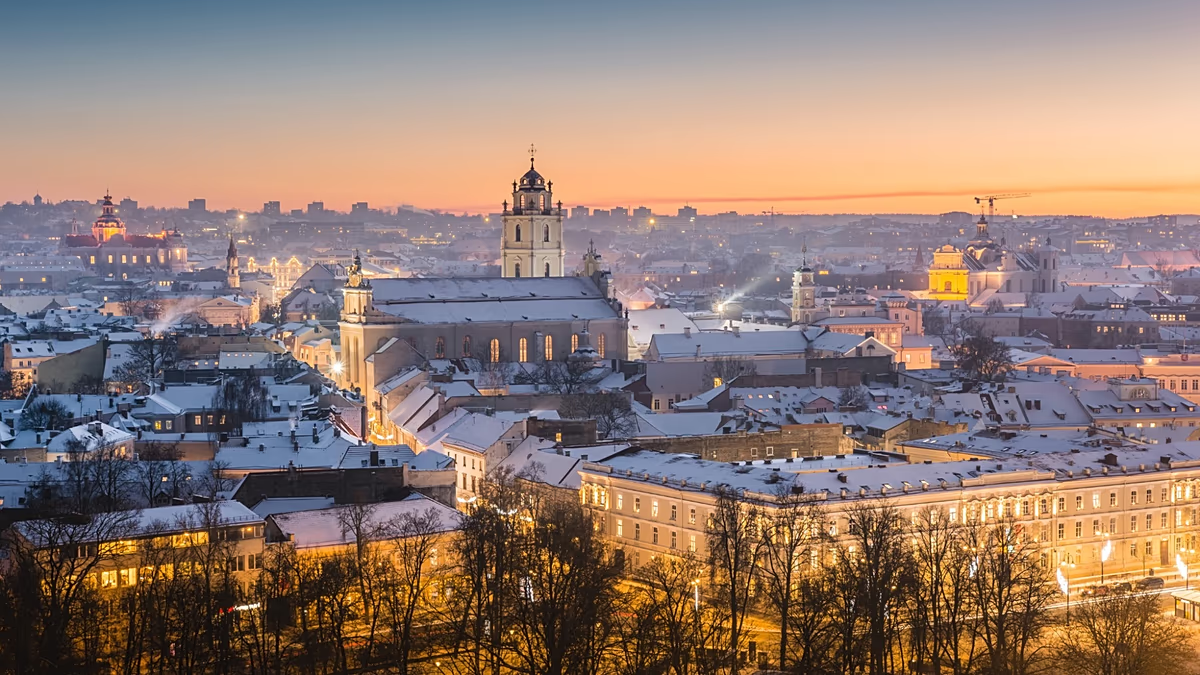
Technology may reshape how people book, but it does not necessarily change what they yearn for. And what Middle Eastern travellers are beginning to yearn for is, quite literally, cold. Sultan points to a shift that would have been almost unthinkable four or five years ago. “People going out for skiing, which was never the trend almost four to five years ago, is becoming such a huge trend,” he says. In a region where summer temperatures soar and air conditioning is not an indulgence but a necessity, the idea of a winter holiday has begun to exert a strange and powerful pull. It is not just skiing, either. It is the full romantic vocabulary of winter: the crunch of snow underfoot, the soft orange light of a log fire, the eerie green veils of the Northern Lights. dnata has responded by launching a winter programme featuring around ten ski destinations, but the product goes beyond pistes. Sultan mentions Finland as an example, noting that travellers are drawn to the aurora borealis and to experiences that feel both vast and quiet. “These are all new kinds of features and experiences that we’re trying to bring to the traveller and actually meet their emerging demand that we continue to see,” he says. There is something deeply human in this development. The desire to travel has never been purely logical. It is driven by image, emotion and the pull of the unfamiliar. For travellers from the Gulf, snow is the ultimate unfamiliar. It used to be that they would fly to places like Switzerland or Austria for business or to escape the heat, but the idea of choosing winter for its own sake—of booking chalets, ski lessons, thermal spas and night sledding—was not part of the mainstream culture. Now, families from Dubai and beyond are packing puffer jackets and renting snow chains, and tour operators are racing to keep up. This is not simply a shift in climate preference; it is a shift in the very picture of a desirable holiday, from the beach towel to the fur-lined boot.
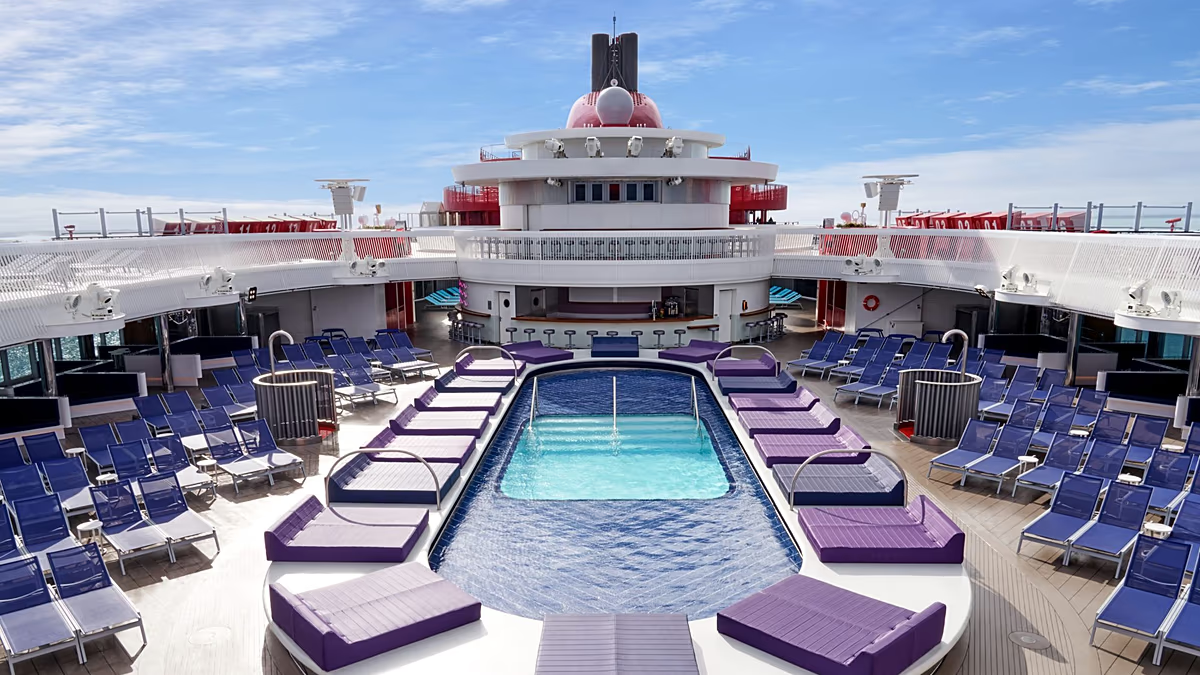
Another sign of how quickly the map is being redrawn is cruising. For a long time, the cruise industry treated the Middle East as a peripheral market—a place to dock briefly for a desert excursion before sailing onward to opulent ports in Europe or Asia. The idea of Gulf residents themselves boarding a cruise ship for a week at sea seemed almost exotic. “We see cruising now is becoming a huge trend. And you know that was never the case in this part of the world,” Sultan observes. But suddenly, it is. Families are beginning to understand that a cruise offers something few other holidays can: the chance to unpack once, wake up in a new city, and be surrounded by food, entertainment and distraction at every hour. The cruise ship is a self-contained world, and for travellers who value both comfort and novelty, it is as appealing as any five-star resort. Cruising also fits neatly into the broader trend toward experiences rather than mere sightseeing. A cruise is not just a hotel that floats; it is a moving itinerary of tastes, shore excursions, shows, pools, sunsets and the strange, calming ritual of watching the horizon from a deck with no land in sight. dnata is responding by positioning itself to capture this growing demand, even as it works to keep the rest of its sprawling business in motion. Sultan acknowledges that the tourism industry as a whole has been extraordinarily dynamic, and that keeping up is the central challenge. “I think the tourism and travel industry has been so dynamic and has been changing so rapidly and we’ve been seeing that,” he says. “The key thing, of course, is to keep up with all of these changes and continue to introduce new elements in the whole entire experience.” Cruising, in that sense, represents something more than a niche: it is a sign that the sector can still create entirely new cultures of holidaying from scratch, and that the Middle East, so often seen as a stopover, is increasingly a launchpad for the world’s most ambitious travel habits.
If cruising is the present, then the next generation is the near future, and Sultan is convinced that the industry will have to learn a new set of languages to speak to it. “Five years from now there’s probably going to be a whole new trend, especially with the Generation Z, who probably look at different sorts of priorities in their travel experience,” he says. What are those priorities? It is tempting to reduce Gen Z to a list of clichés—sustainability, authenticity, social media-worthiness—but Sultan points to something more tangible: food. “Food and healthy food is becoming a real trend,” he says. “So how do we bring that element into travel?” The question is deceptively simple. Food has always been part of travel, but usually as a pleasant accompaniment, a regional specialty to sample, a street-market souvenir. For Gen Z, it is often the organizing principle of a trip. Travellers plan entire holidays around a restaurant, a street food stall, a wine region or a farm-to-table dinner. They seek out destinations because of a cuisine they have only seen on a screen, or because a particular kind of healthy eating—spa cuisine, plant-based tasting menus, organic cooking classes—has become a way of life. Sultan suggests the rise of food tourism is nothing less than a revolution. It changes how operators think about package design, how hotels arrange their kitchens, how destinations market themselves and how travel companies decide what to recommend. It also underscores a broader truth: the traveller of tomorrow is not looking for a standardized resort with a buffet; the traveller of tomorrow is looking for a story they can taste, digest and remember. dnata, with its catering and retail divisions embedded in its operations, is in a unique position to understand this. The question, as Sultan sees it, is not whether the industry should pay attention, but how quickly it can translate that attention into products and services. “We’re staying very close to the customer to really understand how we position our product offering,” he says. The whole experience, from inspiration to return flight, is being rebuilt around the curious, demanding, health-conscious, food-obsessed traveller.
Underlying all of this is a broader commercial restlessness. dnata is not standing still; it is actively evaluating opportunities in emerging markets, including the Middle East itself, Africa, the Indian subcontinent and Eastern Europe. These are regions where a rapidly expanding middle class, rising connectivity and youthful populations are creating fresh demand at a moment when older travel patterns are up for renegotiation. But Sultan’s comments suggest that growth is not simply a matter of finding new airports or new flight routes. It is about understanding the human dimension of travel—the reasons people go, the experiences they crave, the fears they bring, the memories they want to make. AI will not be the whole story. Ski trips will not define every traveller. Cruises will not replace all hotels. But together, these shifts point to an industry that is learning to listen faster and speak in more accents. The hotel contract that once took months now appears in a database in seconds; the ski holiday that barely existed half a decade ago is now a winter season theme; the cruise that was a foreign concept is now a family favourite; and the foodie journey that once seemed niche is becoming a mainstream way of exploring the world. Sultan seems not so much daunted by the pace of change as invigorated by it. “The tourism and travel industry has been so dynamic and has been changing so rapidly and we’ve been seeing that,” he repeats, almost with relish. The key, he insists, is to keep up with all these changes and continue to introduce new elements into the entire experience. That is the essence of his vision for dnata: an organization that moves with the traveller, anticipates the traveller and, above all, remembers that behind every booking is a person with a reason to go. The Middle East has long been a crossroads, a place where routes converge and journeys begin. Now it is also a place where the future of travel is being mapped, one algorithm, one snowflake and one ship deck at a time.