


Every year, as the holiday-planning season begins, Lonely Planet releases its much-anticipated Best in Travel list, a carefully curated guide to the places and experiences that deserve your attention in the year ahead. For 2027, the publisher has once again called on its worldwide community of travel experts, local writers, and passionate explorers to weigh in, and the result is a fascinating mix of the obvious, the overlooked, and the wonderfully unexpected. The list is divided into two major categories: the 25 best places to visit and the 25 best experiences to book. While the full collection spans the globe—from the cool, quirky corners of New Zealand’s Dunedin and Waitaki to the affordable shores of Fulidhoo in the Maldives, which offers a refreshingly down-to-earth alternative to the usual resort islands—it is Europe that offers a particularly rich and varied selection this year. From quiet corners of Italy and Croatia to medieval Spanish cities, Swedish coastal escapes, and a German town that changed the face of modern design, the European picks feel less like a roundup of overcrowded icons and more like an invitation to travel with intention. There are also experiences that get to the heart of what travel should be: slow journeys, scenic roads, ancient pilgrimage routes, and island-hopping adventures that reconnect people with both nature and history. In a time when conversations about overtourism and responsible travel have become impossible to ignore, this list feels like a gentle nudge in the right direction—not toward the crowded capitals, but toward the regions, towns, and landscapes that make Europe so endlessly captivating. It is not a rejection of the classics, but an expansion of them, an encouragement to look beyond the postcard and discover the stories that lie just off the beaten path.
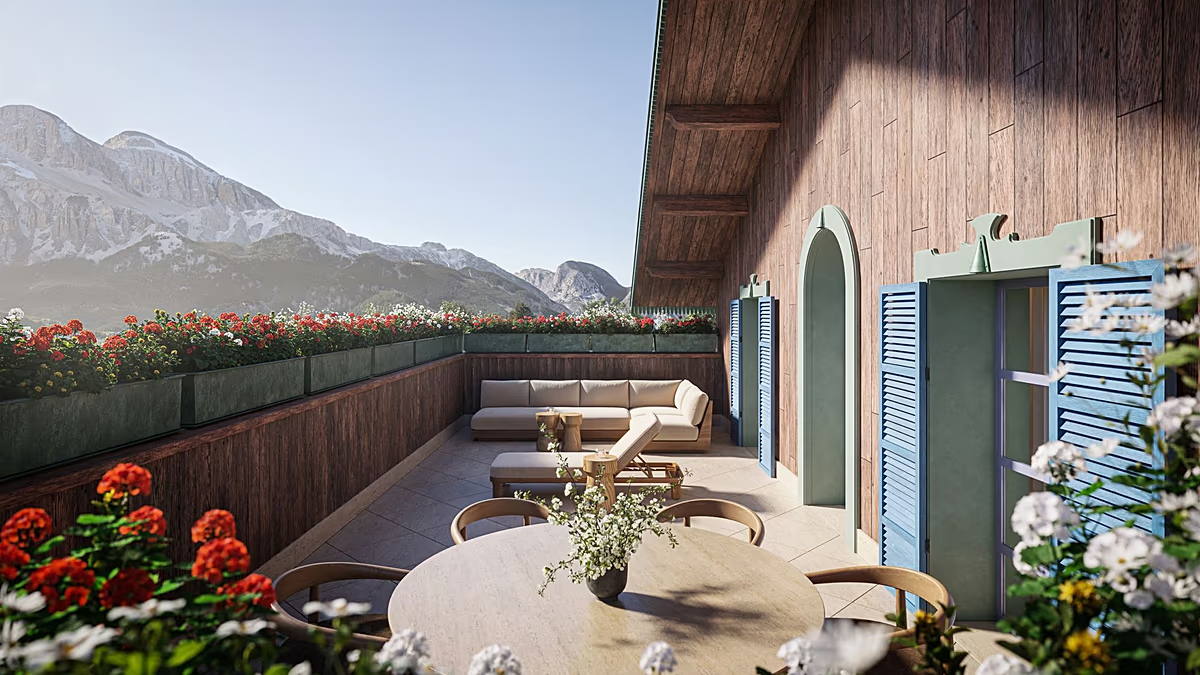
Take Italy, for example. When most people think of the Veneto region, they immediately picture Venice, with its canals, gondolas, and dreamlike piazzas. And yes, Venice is beautiful—but it is also overwhelmed, and in recent years it has become something of a cautionary tale in discussions about sustainable tourism. Lonely Planet’s 2027 list wisely redirects attention to the rest of Veneto, a region that offers just as much beauty, history, and culinary magic without the shoulder-to-shoulder crowds. The Dolomites rise dramatically in the north, their jagged peaks drawing hikers, skiers, and photographers alike, while Lake Garda shimmers in the south, surrounded by charming villages and lakeside promenades. Then there are the cities beyond Venice: Verona, with its Roman arena and romantic Shakespearean associations, and Padua, a historic university town filled with art, arcades, and a sense of intellectual energy that has persisted for centuries. It is a reminder that Italy’s strength has always been in its layered richness, and that some of the best travel experiences come from staying somewhere long enough to let the place reveal itself. Further south along the Adriatic, Lonely Planet also highlights Šibenik in Croatia, one of the country’s oldest cities. Unlike the more famous Dalmatian hotspots, Šibenik has managed to keep a distinctly authentic, local character, and it is celebrated for its impressive architecture, which blends Renaissance and Gothic styles, its gastronomic delights that draw heavily on fresh Adriatic seafood and Mediterranean produce, and a colorful calendar of festivals that keeps the streets alive throughout the year. It is the kind of destination that rewards curiosity, where every narrow stone alley seems to lead to another discovery, whether a quiet café, a historic church, or a dazzling view of the sea.
Spain has been in the news a great deal because of overtourism, with major cities struggling to balance visitor numbers with the needs of local residents. But Lonely Planet’s 2027 list makes the point that tourism in Spain is not inherently a problem—it all depends on where you go and how you behave. León, in the north of Spain, is a perfect example of a destination that welcomes visitors and has plenty of room for them. This medieval city sits along the French Way of the Camino de Santiago, the legendary pilgrimage route that has drawn travelers for over a thousand years. For modern pilgrims and tourists alike, León’s main attractions are its magnificent Gothic cathedral, which is widely regarded as one of the finest examples of high Gothic architecture in the country, and Casa Botines, a striking building designed by the modernist genius Antoni Gaudí. The city has a deeply historic atmosphere, with ancient walls, narrow streets, and vibrant tapas bars that embody the warmth of northern Spain. Further north, the concept of the “coolcation”—the growing trend of swapping scorching Mediterranean beaches for cooler, more relaxed northern destinations—continues to gain momentum, and for 2027 Lonely Planet has singled out Skanör-Falsterbo in Sweden’s Skåne province as the coolest of them all. Known as the Swedish Riviera, this pair of twin towns sits on a beautiful peninsula where sandy beaches stretch along the coast, dunes roll gently beneath wide skies, and the pace of life slows to a calm, coastal rhythm. The area is also home to nature reserves that attract birdwatchers and walkers, making it an ideal destination for those who want to reconnect with the outdoors. Finally, in Germany, the spotlight falls on Dessau, a city synonymous with the Bauhaus movement, the revolutionary art and design school that reshaped the modern world. Despite its small size, Dessau packs an enormous cultural punch, with its Bauhaus buildings now recognized as UNESCO World Heritage sites and its legacy still visible in architecture, furniture, and everyday design. It is an extraordinary place for anyone curious about how ideas become objects, and for those who appreciate the bold, clean lines that define modern aesthetics.
The list’s second half, dedicated to experiences, is equally inspiring, and it begins on foot. For walkers, one absolutely unmissable journey in 2027 is St Cuthbert’s Way, a 100-kilometre trail that winds through the Scottish Borders and into Northumberland, following the historic path taken by the beloved seventh-century saint. This is not just a walk; it is a pilgrimage, and every step carries with it a sense of history, legend, and the quiet beauty of the British countryside. The route passes through rolling hills, river valleys, ancient woodlands, and tiny villages, and it culminates at the spectacular Holy Island of Lindisfarne, a place of profound spiritual significance that is only accessible at low tide. It is impossible to traverse this trail without feeling a connection to the centuries of travelers who came before, and the landscape itself seems to tell stories of faith, endurance, and peaceful solitude. The endorsement has not gone unnoticed by national tourism leaders. Patricia Yates, the CEO of VisitBritain and VisitEngland, welcomed the recognition warmly, noting that Britain is blessed with breathtaking landscapes, stunning coastlines, and remarkable history and heritage, and that it is fitting that a trail which effortlessly combines all three has received such glowing praise from global travel experts. She also pointed out that more than one in three international visitors already enjoy countryside walks during their trips to the North East, and with VisitEngland launching its major domestic coastal campaign, there is a sense that St Cuthbert’s Way is about to receive far more attention. For anyone who values slow travel, meaningful journeys, and the simple joy of putting one foot in front of the other, this is an invitation that is hard to resist.
For those who prefer four wheels to two feet, Lonely Planet recommends another extraordinary journey: a road trip along Route Napoléon in France. This legendary route traces the path taken by Napoleon Bonaparte in 1815 when he returned from exile, and it passes through some of the most dramatic and beautiful landscapes in the south of France. The road winds through Grasse, the world’s perfume capital, where the hillsides are blanketed with fragrant flowers; through Castellane, with its dramatic limestone cliffs; and through Sisteron, where the old citadel guards the entrance to the region. In 2027, the route will celebrate its 95th anniversary, making it an ideal time to experience this classic drive, especially for travelers who want to combine luxury, history, and the romance of the open road. If you would rather swap the car for a boat, Lonely Planet also suggests sailing around the Aeolian Islands of Italy, a volcanic archipelago north of Sicily where rugged coastlines meet crystal-clear waters and the authentic Italian lifestyle is still very much alive. Each island has its own personality, from the steaming crater of Stromboli to the chic harbors of Lipari and the tranquil, vine-covered slopes of Salina. There is a sense of wildness here, a reminder that the Mediterranean is not only about crowded beaches but also about untouched beauty, hidden coves, and the slow pleasure of life at sea. For another maritime adventure, you can dive into the waters of Greece’s Aegean Sea to discover centuries of maritime history, exploring shipwrecks, ancient ports, and underwater sites that tell the story of Mediterranean civilization. And in Ireland, Lonely Planet points travelers toward Killary Fjord, tucked along the famous Wild Atlantic Way, a 2,600-kilometre coastal road that wraps around the island’s western edge. While the Wild Atlantic Way itself is a magnificent journey, Killary Fjord is described as a strong contender for the most breathtaking place in the country—a dramatic inlet surrounded by mountains, where the green of the hills meets the silver of the sea. Whether you arrive by road, by foot, or by boat, it is a landscape that leaves a lasting impression on the soul.
In the end, what makes Lonely Planet’s 2027 Best in Travel list so compelling is not just the destinations themselves, but the way they encourage travelers to think differently. Instead of rushing to the most famous monuments, the list invites us to explore regions, to follow old roads, to walk in the footsteps of saints and emperors, and to discover the authentic character of places that have often been overshadowed by their more famous neighbors. It acknowledges the realities of overtourism and responds not with lectures, but with alternatives—beautiful, practical, and deeply rewarding alternatives that prove it is still possible to see the world without destroying the very things we love about it. The European selections are particularly strong because they capture a spirit that is often difficult to define but easy to feel: the joy of standing in a medieval square in Spain, of watching the sun set over the Swedish coast, of tasting fresh seafood in a Croatian harbor, of walking through a small German town that changed the way we all live, of breathing in the salty air of an Italian island, of feeling the ancient pull of a pilgrimage trail. These are not just places to visit; they are experiences to absorb, stories to carry home, and memories that stay with you long after the journey ends. For 2027, Lonely Planet seems to be saying that the best way to travel is not to check off famous sights, but to slow down, stay curious, and embrace the unexpected. And in a world that is always rushing somewhere, that is perhaps the most valuable recommendation of all.