





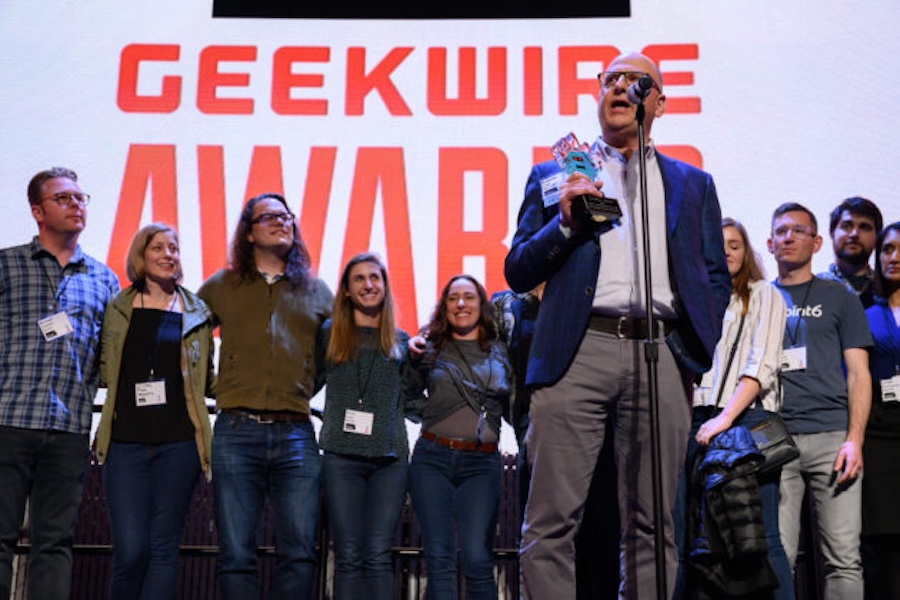
For months, a quiet buzz had been circulating through the Pacific Northwest’s tight-knit startup ecosystem, fueled by hints from one of its most prominent figures that a major new project was on the horizon. Robbie Cape, the celebrated Seattle tech entrepreneur who spent years at the helm of the virtual primary care pioneer 98point6—famously accepting the coveted Health Innovation of the Year trophy at the 2019 GeekWire Awards—has finally broken his silence to reveal his next big act. Partnering with the renowned startup foundry Pioneer Square Labs (PSL), Cape has officially launched a stealthy new venture called The Instrument, which aims to thoroughly reconstruct and revitalize the traditional insurance sector. This move represents a fascinating evolution for Cape, whose career has spanned pivotal roles at Microsoft, the creation of the popular family scheduling tool Cozi, and even a recent, unexpected stint helping launch Mt. Joy, a sustainable chicken restaurant concept in Seattle that he departed in May 2025. The Instrument, which was quietly incorporated earlier this spring, is the culmination of months of collaborative ideation, marking Cape’s highly anticipated return to the high-stakes world of venture-backed technology companies.
The journey to this announcement, however, was neither swift nor straightforward, marked instead by the profound introspection and vulnerability that often characterizes a seasoned founder’s search for their next mountain to climb. In an exceptionally candid post shared with his professional network on LinkedIn, Cape pulled back the curtain on a grueling nine-month job search that very nearly led him down a completely different developmental path. At one point, the search had progressed so far that he was on the verge of accepting an executive role at an established healthcare enterprise located in Utah’s booming tech corridor. Ultimately, the gravity of his roots in Seattle and a yearning for a specific kind of entrepreneurial partnership kept him local. Cape noted that a primary catalyst for staying was PSL partner Greg Gottesman, whom he described as the rare breed of venture investor who possesses both the rigorous intellectual toughness and the unvarnished authenticity required to navigate the volatile waters of early-stage company building. For Cape, the opportunity to build alongside a trusted, truth-telling ally like Gottesman outweighed the comfort of a pre-established executive seat, proving that in the startup world, the caliber of your partnership is just as vital as the product itself.
Perhaps the most refreshing and humanizing aspect of Cape’s transition into the insurance tech space is his radical transparency regarding his personal and financial motivations, offering a stark contrast to the often-cliché altruistic narrative that dominates Silicon Valley and Seattle tech PR. For the first time in his decades-long career, Cape openly admitted to choosing a business opportunity that was not fundamentally anchored in a mission to heal, feed, or repair the world at its core. Reflecting on his past endeavors—ranging from making primary healthcare accessible via mobile devices with 98point6, to streamlining family chaos with Cozi, to advocating for sustainable agriculture with Mt. Joy—Cape acknowledged that his pivot to insurance was driven by a desire to tap into a massive, highly lucrative financial engine. He described insurance as a staggering trillion-dollar global sector built on incredibly resilient, time-tested business models that possess an unparalleled capacity for generating generational wealth. By admitting that this sheer wealth-creation potential was deeply compelling—even more so than he was initially comfortable acknowledging—Cape demystified the modern entrepreneurial drive, offering a rare, honest look at the complex interplay of ambition, financial realism, and self-awareness that influences elite builders.
No visionary founder can successfully challenge a legacy industry alone, and to ensure that The Instrument possessed the operational velocity needed to execute its goals, Cape immediately set about reassembling his historic core team. Joining him as co-founders in this new endeavor are two key former colleagues from his transformative days leading 98point6: Chief Technology Officer T Van Doren and Chief Product Officer Matt Witcher. The significance of these hires cannot be overstated, as Van Doren was famously employee number one at 98point6, while Witcher joined shortly thereafter as employee number eight. In the highly chaotic and emotionally taxing environment of a brand-new startup, having a leadership trio with a deeply ingrained, pre-existing shorthand is an invaluable asset that drastically reduces friction and speeds up decision-making. This reunion represents a powerful form of entrepreneurial “trust capital,” allowing the co-founders to skip the awkward phase of establishing group dynamics and instead dive directly into tackling the complex architectural challenges of restructuring legacy financial systems, secure in the knowledge that they have already weathered the storm of scaling a major tech enterprise together.
While the specific consumer-facing mechanics of The Instrument are still being closely guarded behind a minimalist landing page, the strategic breadcrumbs left by Cape and his team hint at an incredibly sophisticated, technologically advanced infrastructure. Operating under the evocative domain name of “theinstrument.ai” and anchored by the simple, provocative tagline of “insurance reimagined,” the company is clearly positioning itself to harness the transformative power of artificial intelligence. The global insurance sector, notoriously bogged down by archaic legacy systems, manual underwriting processes, and confusing, slow-moving claim procedures, presents an incredibly fertile ground for AI-driven disruption, where predictive algorithms and natural language processing can streamline risk assessment and personalize policy coverage. By leveraging these cutting-edge digital capabilities, The Instrument aims to dismantle the historical pain points of the industry—such as opaque pricing and bureaucratic delays—and replace them with a responsive, transparent, and highly optimized experience. It is a dual-pronged strategy: using advanced technology to maximize statistical efficiency and profitability on the back end, while creating a user-friendly product that restores clarity and trust for consumers on the front end.
Looking ahead, the path for Robbie Cape and the team at The Instrument is loaded with both immense promise and the typical, high-stakes pressure of a venture-backed launch. Months into the partnership with Pioneer Square Labs, Cape reports that his excitement has only deepened since the day he and Gottesman originally shook hands, signaling a strong alignment of vision and a highly productive working relationship that has successfully transitioned from the initial honeymoon phase to hard operational realities. For the Seattle technology community, Cape’s latest move is a compelling case study in professional adaptation, demonstrating how a successful founder can continuously reinvent themselves by applying their hard-won leadership lessons to entirely new and highly complex industries. Driven by a powerful combination of seasoned entrepreneurial instincts, a world-class founding team, and an unabashed pursuit of massive commercial scale, The Instrument is setting out to prove that even the most stubborn, trillion-dollar industries can be redesigned from the ground up. Whether this venture achieves its lofty goals of redefining modern insurance remains to be written, but Cape’s audacious return ensures that all eyes in the Pacific Northwest will be watching closely as this next chapter unfolds.