






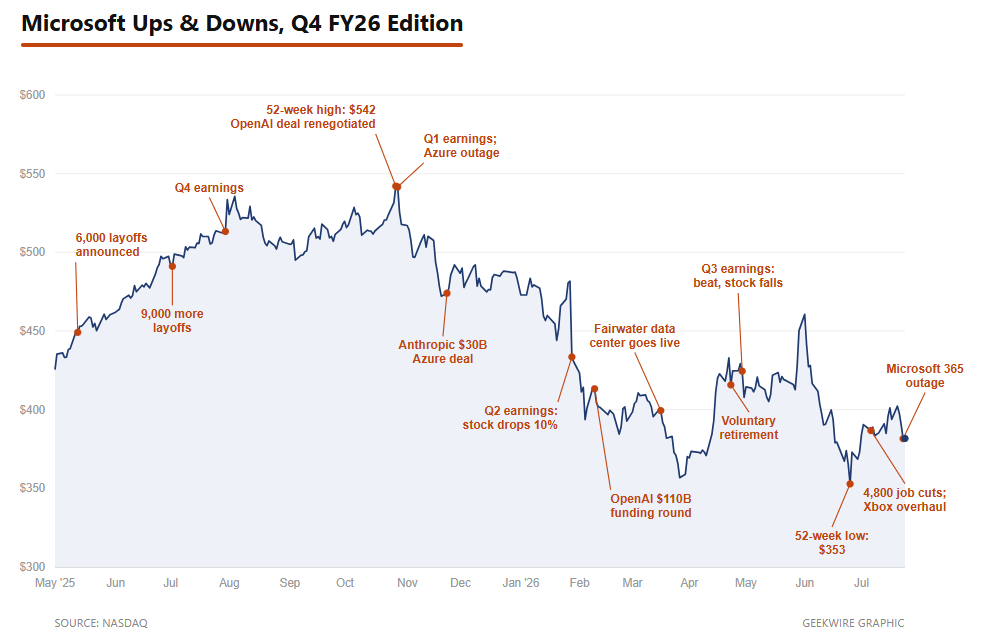
There is a strange and telling paradox unfolding on Wall Street: Microsoft has spent the last several quarters consistently shattering earnings expectations, delivering historic profits and massive revenue, yet its stock is hovering near a one-year low. This disconnect reveals a fundamental shift in market psychology, transitioning from the raw euphoria of the initial artificial intelligence boom to a cold, analytical era of demanding real business proof. As Microsoft prepares to report its fiscal year-end results, the numbers on its ledger are no longer just symbols of success; they are under intense scrutiny by investors who are beginning to fear that the costs of building the AI future are rising much faster than the cash flowing back from it. For the fourth quarter of the 2026 fiscal year, Wall Street is demanding absolute perfection, with consensus estimates pegged at a towering $87.7 billion in revenue—a 14.7% leap from last year—and earnings per share of $4.24, implying that safe, middle-of-the-road guidance will no longer satisfy a highly nervous market. Over the course of the full fiscal year, Microsoft’s projected revenue of $329 billion represents a spectacular 17% growth rate, but the real story is not how much money the tech giant is making, but rather the dizzying, unprecedented speed with which it is spending those profits to build out the physical infrastructure of the next technological age.
The primary lightning rod for investor anxiety is capital expenditure, an area where Microsoft is shattering records to secure the silicon and real estate needed for artificial intelligence. Chief Financial Officer Amy Hood has warned the market to brace for a quarterly capital spending bill exceeding $40 billion, illustrating a relentless upward trajectory from previous quarters. For the calendar year, Microsoft’s capital spending is projected to reach a jaw-dropping $190 billion, a figure driven not only by the sheer volume of server campuses and graphical processing units being acquired but also by a painful $25 billion premium caused by soaring global component prices. This massive financial outflow has triggered immediate alarm bells across the sector, especially after Google’s parent company, Alphabet, experienced a sharp 7% stock drop despite beating expectations, simply because its own elevated capital expenditure forecast spooked a market suddenly worried about delayed returns on investment. This shift in sentiment is supported by credit rating heavyweights like Moody’s, which recently pointed out that while demand for AI is undeniably real, the ultimate return on an aggregate $785 billion industry-wide infrastructure spend remains highly speculative and unproven, raising the stakes for Microsoft’s upcoming forward-looking guidance.
This heavy capital investment is directly eating into the profitability of Microsoft’s core business, as reflected in the steady contraction of its legendary cloud gross margins, which have slipped from 72% three years ago to an expected 64% this quarter. Because Microsoft must spread the immense cost of depreciating data center equipment across several years, these hardware expenses act as a slow drag on the company’s balance sheet, creating an early warning indicator of how capital intensity impacts overall profitability. At the same time, the performance of its crown jewel, the Azure cloud platform, is locked in a tight game of expectations, where even hitting the upper limit of its projected 39% to 40% growth rate can result in market sell-offs if “whisper numbers” among elite traders are missed. Compounding this challenge is the physical reality that Microsoft cannot build data centers fast enough, forcing the company to restrict customer capacity so it can prioritize its internal AI tools like Copilot, a supply bottleneck so severe that Microsoft has had to quietly source extra computing power from its direct competitors, Amazon and Google. This operational pressure was further highlighted by a disruptive five-hour Azure outage on July 23, exposing the system vulnerabilities that Microsoft must address if it wants conservative enterprise clients to trust its AI cloud with their daily operations.
Meanwhile, the commercial monetization of Microsoft’s generative AI services is progressing as a slow battle of adoption rather than an instant landslide. While the company’s overall AI run rate has climbed to an impressive $37 billion, the flagship Microsoft 365 Copilot is experiencing a classic adoption bottleneck, securing 20 million paid seats which represents a modest 4.4% of Microsoft’s massive 450-million commercial user base. To break through this corporate hesitation, Microsoft is aggressively shifting its commercial strategies, launching a massive $2.5 billion “Frontier Company” consulting division to embed 6,000 highly skilled engineers directly into customer organizations to hand-hold businesses through the complex realities of AI deployment. Additionally, Microsoft is completely changing how it extracts revenue from developers, transitioning GitHub Copilot from a predictable flat-rate subscription model to a flexible, usage-based pricing structure to lower the barrier to entry while capturing more upside from high-volume corporate clients. These aggressive maneuvers highlight the deep divide between the theoretical ease of coding an AI app and the friction-filled reality of convincing traditional enterprise customers to restructure their core workflows around Microsoft’s expensive new tools.
Perhaps the most complex financial variable in Microsoft’s portfolio is its highly concentrated partnership with OpenAI, which is hidden within its impressive $627 billion backlog of Remaining Performance Obligations (RPO). While this enormous RPO figure—representing nearly doubled contract commitments over the past year—looks like a reassuring safety net of guaranteed future revenue, closer inspection reveals that almost half of this backlog is tied directly to OpenAI, a single partner that is still burning through cash and losing money. The structural fragility of this arrangement became even more apparent after the two companies renegotiated their alliance, removing OpenAI’s exclusive commitment to use Azure’s cloud, a strategic shift that leaves Microsoft’s future backlog growth looking far more vulnerable to market forces than its top-line figures suggest. This concentration risk creates an intricate dilemma for Microsoft: its primary high-volume customer for AI cloud services is a structural joint venture that is itself highly dependent on Microsoft’s continued financial backing, making the ultimate validation of this massive AI buildout feel circular to critical observers.
Finally, Microsoft’s rapid push into the automated future of computing is contrasted by a significant human and institutional restructuring within its own walls. The company is absorbing a heavy $900 million charge to fund a major voluntary retirement program, a historic first in its 51-year history that saw nearly a third of eligible U.S. workers accept exit packages as part of a broader corporate push to systematically reduce executive headcount. While these painful labor reductions will help preserve operating margins in the long term, Microsoft is also battling consumer headwinds, as global memory and storage shortages have severely damaged PC hardware shipments, leading to an expected 20% drop in Windows OEM software licensing fees and forcing price hikes for its Xbox gaming consoles. As Microsoft steps up to the earnings microphone alongside other tech giants like Meta, Apple, and Amazon in one of the most critical weeks of the financial calendar, the stakes could not be higher. The company’s upcoming report will offer a defining verdict on whether the massive capital investments of the artificial intelligence revolution can translate into sustainable corporate profits, or if Microsoft is building an incredibly expensive highway system before the world is ready to buy the cars.