





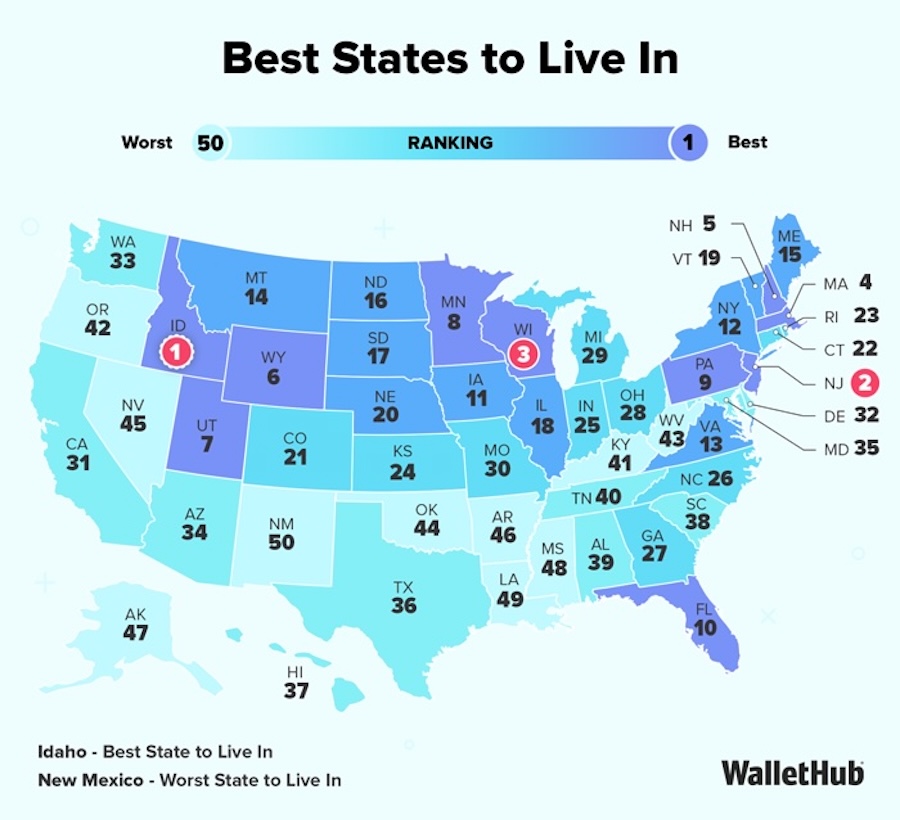
The concept of home is one of the most deeply personal and emotionally charged ideas in the human experience, far transcending the sterile boundaries of spreadsheets, statistics, and demographic data. Yet, in our modern, hyper-analytical world, we are constantly subjected to comparative assessments that attempt to quantify the unquantifiable: our happiness, our security, and the overall quality of our daily lives. This tension between personal lived experience and external evaluation was thrust into the spotlight on August 10, 2026, when journalist Kurt Schlosser published a compelling look at WalletHub’s latest annual study, “Best States to Live In.” For those who call the Pacific Northwest home, the findings were a sobering pill to swallow. The personal finance website ranked Washington State at a mediocre No. 33 out of the 50 states, assigning it a modest overall score of 49.70. To the millions of people who look out their windows every morning at the majestic, snow-capped peaks of the Cascade Range, the deep blue waters of the Puget Sound, or the towering, mist-shrouded canopy of the Hoh Rain Forest, such a ranking feels like an existential disconnect. It forces us to ask a fundamental question about how we value our surroundings: how can a place of such breathtaking natural beauty and immense economic opportunity find itself relegated to the bottom half of a national livability index?
To understand this discrepancy, one must look closely at the complex machinery of WalletHub’s evaluation system, which grades each state across five deeply influential but highly divergent pillars: affordability, economy, education and health, quality of life, and safety. While Washington performed admirably in categories like economic dynamism and general quality of life—reflecting its status as a global hub of innovation, culture, and outdoor recreation—it was completely undone by a devastating finding in another category. The study placed the Evergreen State dead last, at No. 50, in its safety ranking, a metric that aggregates violent crime and property crime rates. For the average resident, this statistical rock-bottom is not merely a number on a chart; it represents a daily, visceral anxiety. It is the frustration of finding shattered glass on a rainy Seattle street corner from yet another car break-in, the uneasy feeling of walking through neglected urban corridors after dark, and the broader social weariness that comes from watching communities struggle to address systemic crises of homelessness, substance abuse, and public disorder. When safety collapses, it casts a long shadow over even the most beautiful landscapes, transforming a high quality of life into a fragile luxury that many residents feel is slipping through their fingers.
This paradox becomes even more striking when one looks across the state line to Washington’s immediate neighbor, Idaho—a comparison that highlights a profound ideological divide in how Americans define a successful life. Despite sharing a massive geographical border and a love for the rugged landscapes of the American West, the two states could not have fared more differently in the 2026 rankings. Idaho claimed the coveted No. 1 spot on WalletHub’s list, celebrated as the absolute best state to live in. What makes this victory so fascinating, and perhaps a bit baffling to Washingtonians, is that Idaho actually scored a whopping 21 spots worse than Washington when it came to sheer “quality of life” metrics, such as cultural amenities, environmental variety, and recreational infrastructure. Instead, the Gem State secured its crown through the pragmatic power of low tax rates, financial stability, and what WalletHub described as an ideal environment to “build and grow wealth.” This creates a fascinating philosophical debate about the nature of human contentment: is a life better lived in a state that offers a lower cost of living, fiscal predictability, and a safe harbor for your savings, or is it better lived in a place that offers rich cultural diversity, progressive social infrastructure, and world-class scenery, even if it comes with high taxes and public safety challenges?
The journey to Washington’s current rank of No. 33 is also a story of historical decline and gradual, painful stabilization, reflecting the state’s turbulent post-pandemic evolution. Looking back at the data from previous years reveals a clear downward trend that mirrors the growing pains of a region grappling with hyper-growth and its inevitable fallout. In 2023, Washington was still riding relatively high, comfortably positioned at No. 28. By 2024, it had slipped to 35th, and by 2025, it hit a low point at 36th, before making its modest three-spot recovery to 33rd in 2026. This trajectory is a mathematical representation of a very human struggle. Over the last several years, the rapid influx of high-paying technology jobs fueled an unprecedented real estate boom that priced out working-class families, teachers, and first responders, forcing them into grueling commutes or out of the state entirely. The worsening affordability crisis, combined with highly publicized debates over public safety policies and drug decriminalization, left many long-time residents feeling a sense of displacement and nostalgia for a gentler, more accessible version of the Pacific Northwest. The slight rebound in 2026 suggests that while the state may be starting to stabilize, the wounds of rapid societal transformation remain deep and slow to heal.
At the heart of Washington’s identity crisis is a fierce, ongoing tug-of-war between its massive corporate footprint and the daily realities of its local communities. On one hand, the state is an absolute powerhouse of global commerce, serving as the birthplace and home of industry titans like Microsoft, Amazon, Costco, and Starbucks. This economic muscle was validated in July 2026 when Washington climbed three spots to No. 11 in CNBC’s annual “America’s Top States for Business” rankings. Yet, this corporate prosperity exists in a state of high tension with local tax policies and social initiatives that critics argue are increasingly hostile to business and wealthy individuals. The introduction of capital gains taxes and aggressive local ordinances in Seattle has sparked intense debates about whether the region is killing the golden goose of technological innovation. Indeed, in June 2026, Seattle fell to No. 13 in a global ranking of the best U.S. cities for attracting foreign business and investment, signaling that international markets are paying close attention to the city’s political volatility. This creates a difficult balancing act for policymakers, who must figure out how to generate the tax revenue needed to fund schools, healthcare, and transit without driving away the very industries that pay for them, all while trying to keep the state affordable for the average citizen.
Ultimately, the sheer volume of conflicting data points highlights the inherent absurdity and beautiful complexity of trying to reduce human communities to a single, definitive rank. Depending on which list you read in 2026, you could find a completely different version of reality: WalletHub placed the state at 33rd, CNBC ranked it near the top for business, and yet another study earlier in the year declared Seattle to be the single best city to live in across the entire United States. This cognitive dissonance reminds us that data is ultimately a mirror of the biases and priorities of those who collect it. For a young, wealthy software engineer, Washington might indeed feel like the best place on earth—a playground of high salaries, Michelin-star dining, and weekend ski trips. For a retired senior on a fixed income or a young family trying to buy their first home, the state’s crushing cost of living and safety concerns might make it feel like an impossible place to survive. In the end, the true “livability” of a place cannot be calculated by an algorithm or dictated by a personal finance website. It is found in the quiet, unquantifiable moments of everyday life—the smell of rain on cedar, the warmth of a local coffee shop on a gray winter morning, and the resilient spirit of neighbors working together to make their communities safer, kinder, and more inclusive, regardless of what the rankings say.