


In the year 2000, when Nikesh Parekh first planted his roots in the vibrant technology and venture capital landscape of Seattle, the industry was fueled by a romantic, almost legendary narrative. It was an era best captured by David A. Kaplan’s seminal book, The Silicon Boys: And Their Valley of Dreams, which detailed the miraculous symbiosis between daring entrepreneurs and visionary financiers. Back then, the playbook was simple, intimate, and profoundly human: passionate, gritty founders toiled away in dusty suburban garages, and venture capitalists acted as talent scouts, writing relatively modest checks, rolling up their sleeves, and working alongside those founders to build enduring, blue-chip institutions. Legendary investors like John Doerr of Kleiner Perkins became myths themselves by backing formative giants like Intuit, Netscape, Amazon, and Google in their infancy, proving that VC was as much about partnership and shared risk as it was about capital. Fast forward more than a quarter of a century to 2026, and that pastoral landscape of collaborative company building has undergone a breathtaking, high-velocity evolution. The contemporary venture capital ecosystem has largely abandoned the patience of the garage for the astronomical allure of late-stage, once-in-a-generation liquidity events. Driven by the gravity-defying trajectories of structural powerhouses like SpaceX, Anthropic, and OpenAI, today’s institutional capital is obsessed with hyper-scale and immediate dominance. Modern venture capital has ballooned into an asset class of unprecedented scale, with more dry powder sitting in funds than at any other point in financial history. Yet, paradoxically, this avalanche of available money has made it harder than ever for the average entrepreneur to secure a first meeting, let alone a term sheet. Unless you are building underlying, foundational artificial intelligence infrastructure, the gates to conventional venture funding are increasingly locked, forcing a painful but necessary reckoning for founders around the world who must now look beyond the venture ecosystem to survive.
This shift has birthed a psychological phenomenon we might call “Anthropic envy,” a desperate scramble among elite investment firms to replicate the extraordinary home runs of the recent past. A prime example is Spark Capital’s Yasmin Razavi, a former McKinsey consultant who had the foresight to write a contrarian $75 million check into Anthropic when the broader Silicon Valley consensus hesitated at a $4 billion valuation in 2023. Today, that stake is valued at a mind-boggling $7 billion—yielding an almost unimaginable hundredfold return in barely three years. This sensational success has catalyzed a FOMO-driven gold rush, distorting the entire allocation of early-stage capital. The raw data tells a startling story of extreme polarization: in 2025, U.S. venture capital firms deployed an impressive $319 billion into startups, but the momentum only accelerated into 2026, with an astonishing $412.7 billion deployed in just the first six months of the year—rapidly eclipsing the entirety of the previous year’s total. However, this sea of liquidity is not lifting all boats; instead, it is pooling in a tiny, exclusive harbor. According to data from Silicon Valley Bank, a staggering 33% of all U.S. venture capital dollars went to the top 1% of companies by valuation in 2026, a massive leap from the already skewed 12% concentration observed in 2022. This hyper-concentration reveals a chilling truth for the broader entrepreneurial ecosystem: while there is more cash circulating in the tech ecosystem than ever, it is being funneled into a hyper-elite circle of heavily subsidized champions, creating a feast-or-famine dynamic where a minute fraction of startups are drowning in capital while the remaining ninety-nine percent are left to starve in a funding desert. It represents a dramatic departure from the broad-based capital allocation that once fertilized a diverse array of businesses, replacing healthy, competitive diversity with centralized financial monopolies.
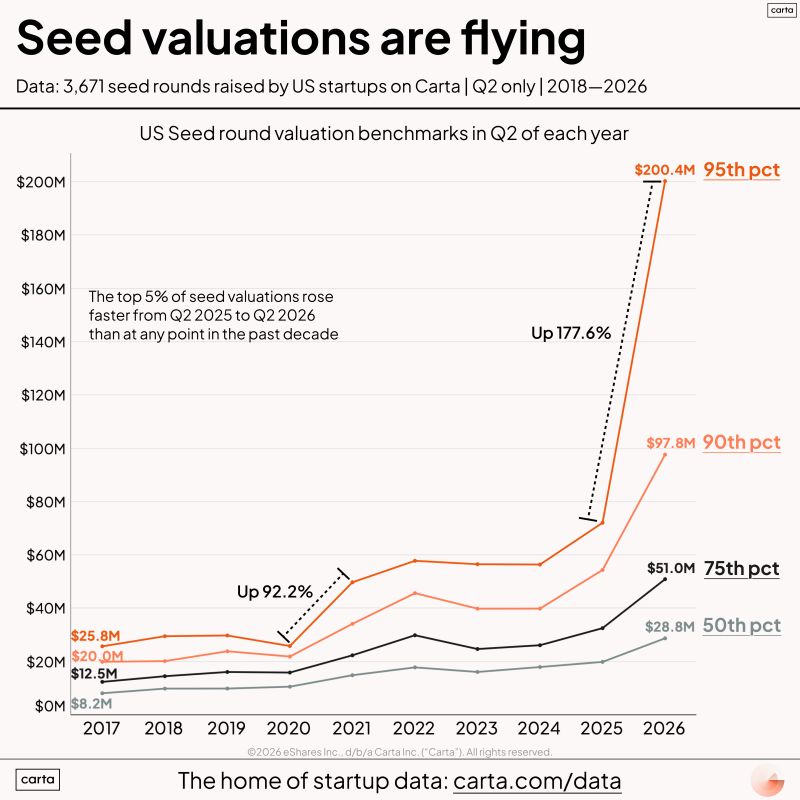
As a direct consequence of this capital concentration, the entry requirements for conventional venture backing have escalated to unprecedented heights, turning what used to be a progressive ladder into a vertical, impassable wall. The “right company”—the one that fits the highly specific, hyper-scalable mold sought by modern VCs—can command seed valuations that defy historical logic, but the expectations for their subsequent performance have grown equally terrifying. Data compiled by Peter Walker at Carta illustrates this valuation divergence clearly: the top 5% of seed-round valuations skyrocketed by a breathtaking 177% year-over-year, climbing from an already substantial $72 million to an astonishing $200.4 million in the second quarter of 2026, even as the absolute number of funded companies plummeted. This means a tiny pool of golden startups are raised on astronomical valuations, but the road ahead of them is fraught with systemic danger because the gap between seed funding and Series A has expanded into an abyss. Carta’s historical graduation tracking reveals that whereas 30.6% of startups that raised a seed round in early 2018 successfully graduated to a Series A within two years, that progression rate collapsed to a mere 15.4% for the 2022 cohort, and continues to languish. For today’s founders, the practical, cold-hard-realworld takeaway of this trend is incredibly sobering: the median annual recurring revenue required to successfully raise a Series A round has roughly tripled over the last several years, now demanding a scale of approximately $3.5 million in ARR. Startups are now expected to achieve mature, mid-market business operational metrics while still operating on the lean, experimental budgets of an early foundation, leaving many highly viable, moderate-growth companies entirely stranded. This creates an environment where executing exceptionally well is no longer enough; founders must hit near-miraculous numbers just to stay in the venture game.
This structural polarization has fundamentally altered the sociological fabric of founder-investor relationships, reducing what was once an art of potential into a rigid system of elite tier-listing. Prominent voices within the industry, such as Reid Christian of CRV, argue that in order to successfully raise capital in this cautious environment, a startup must be instantly “Legible to Capital.” In practice, this means that the modern venture ecosystem has largely abdicated its ability to evaluate raw business fundamentals or unusual, slow-burning innovations, choosing instead to fund only two narrow profiles of enterprise. The first profile includes early-stage, “stupidly obvious” teams loaded with elite academic credentials and corporate pedigree who can command $50 million to $200 million valuations based on nothing more than a loose concept and high-status association. The second profile comprises late-stage, de-risked giants where the business model is so obvious and mature that investing in them requires almost no investigative analysis or imaginative risk-taking. For anyone operating outside these two safe-harbor extremes, the venture landscape has become a cold, inhospitable theater where investors indulge in a homogenous pack-mentality. If a founder lacks the highly sought-after demographic markers—if they are not young, hyper-credentialed, serial operators from elite institutions, or socially connected “nepo-founders”—they find themselves fighting a losing battle against the collective, risk-averse pattern recognition of a notoriously herd-driven industry. The tragic consequence is that thousands of brilliant, practical, and highly capable founders building resilient, capital-efficient businesses are systemically locked out of the market simply because they do not fit the specific archetype of the Silicon Valley elite. This reliance on demographic checklists rather than actual market friction represents a massive market failure, creating an artificial divide between pedigree and actual entrepreneurial execution.
Despite these daunting structural barriers, the shifting landscape does not mean the entrepreneurial dream is dead; rather, it demands that savvy founders adapt by mastering a brand-new operational playbook designed for a multi-polar financial world. For the select few building generational AI platforms, the traditional, high-stakes venture path remains a viable target, provided they can match their scaling metrics with the intense, near-impossible expectations of modern VCs, as seen with dynamic local successes like Seattle’s Tin Can—a landlines-for-kids startup that executed brilliantly to unlock follow-on capital. However, as Kirby Winfield of Ascend wisely counsels, if a founder cannot realistically project reaching $3 million to $5 million in ARR within eighteen to twenty-four months of landing their first commercial contract, conventional venture equity is simply the wrong tool for their business. Fortunately, a diverse array of alternative financing mechanisms has emerged to fill the void left by risk-averse VCs. Angel syndicates represent an agile and founder-friendly alternative, allowing entrepreneurs to piece together smaller cheques from successful individuals who move fast, demand less control, and don’t carry the structural baggage or existential signaling risks of a major institutional fund. For businesses that possess strong margins and steady income, venture debt offers a powerful, non-dilutive mechanism to extend runway, though it is usually structured as a bridge to a defined milestone alongside existing institutional support. Most promisingly, revenue-based financing has exploded as a flexible, fast-growing alternative, allowing margin-rich, predictable-revenue SaaS businesses to secure multiple months of upfront operating capital repaid as a modest percentage of their monthly recurring revenue, matching perfectly with the needs of healthy companies that have been unfairly stranded by the institutional funding market. By diversifying options, founders can build sustainable growth engines on terms that truly work for them rather than yield to the pressure of hyper-growth.
Ultimately, the single most powerful and liberating pivot a modern entrepreneur can make in 2026 is a return to fundamental business discipline: prioritizing rapid, organic profitability over the hollow validation of investment press releases. The cheapest, most resilient, and most non-dilutive capital a startup can ever secure is not found on Sand Hill Road; it is found in the pocketbooks of satisfied, paying customers. The most inspiring founders in the current ecosystem are no longer spending their precious cognitive energy chasing elusive investor meetings or endlessly polishing pitch decks for cynical analysts; instead, they are heads-down, relentlessly focused on building superior products and creating tangible value. This customer-centric shift has been supercharged by the democratization of advanced generative artificial intelligence, which allows lean, agile teams to achieve unprecedented operational leverage and manage their burn rates with surgical precision, accomplishing with three people what used to require a team of thirty. By focusing on capital efficiency and reaching profitability early, a startup successfully detaches its survival from the chaotic, unpredictable whims of the venture capital casino and reclaims absolute control over its corporate destiny. As Aviel Ginzburg of Foundations and Founders’ Co-op pointedly observes, venture capitalists themselves are currently navigating a profound identity crisis, realizing that they are no longer the omnipotent gatekeepers of innovation but are themselves being disrupted by the very forces they seek to control. For the modern founder, this realization brings a powerful sense of liberation: when the traditional financial gatekeepers lose their way, the true power shifts back to those who actually build. In this brave new world, the ultimate metric of success is no longer how much money you raised, but how much value you can independently create.