





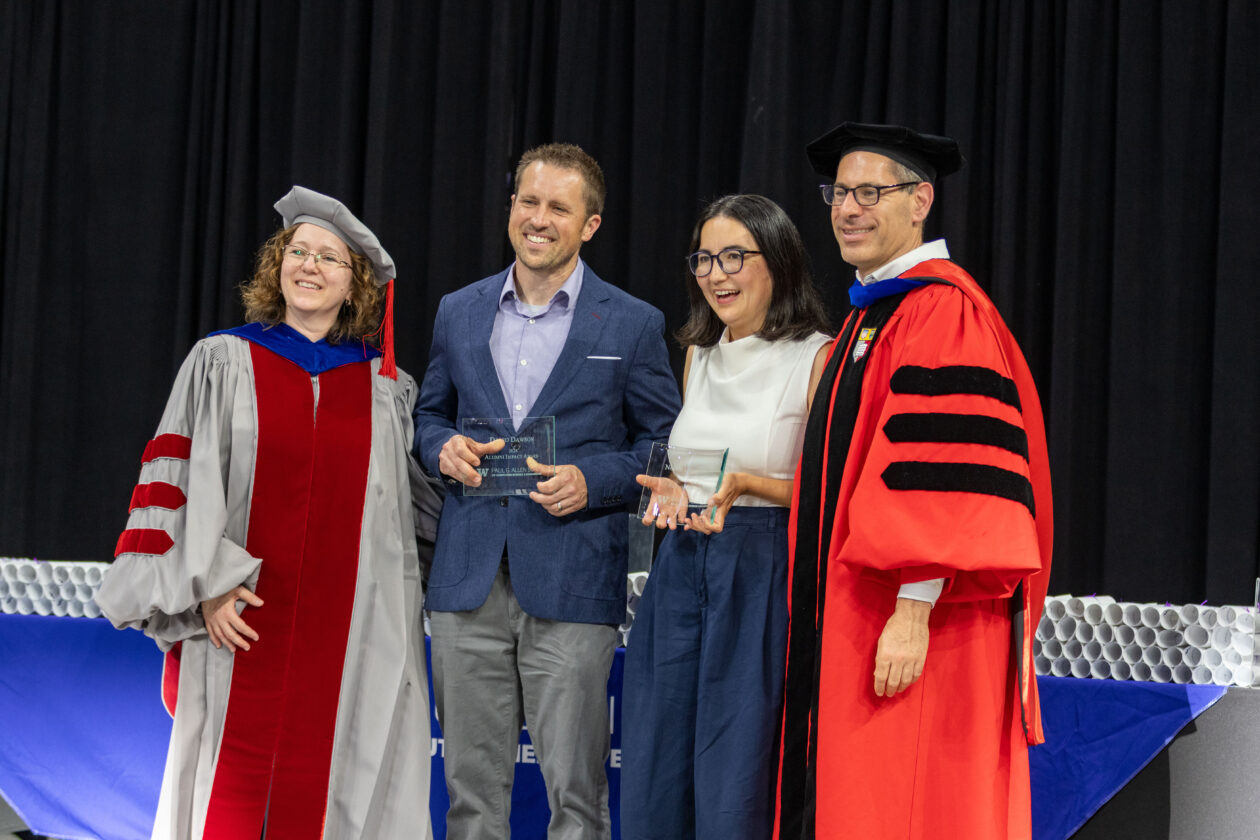
The celebration of academic achievement often centers on abstract numbers, research papers, and ceremonial handshakes, but at the University of Washington’s Paul G. Allen School of Computer Science & Engineering, graduation is framed as a launching pad for tangible, real-world utility. On the warm evening of June 12, 2026, the local tech community, proud families, and academic leaders gathered to honor the next generation of computational thinkers, but the spotlight also turned backward to reflect on the legacy of those who had already walked those halls and carved out paths of deep-seated empathy and practical progress. Allen School Director Magdalena Balazinska and Vice Director Dan Grossman took the stage to announce the recipients of the prestigious 2026 Alumni Impact Awards, honoring two exceptional individuals who took the technical skills and emotional intelligence honed during their college days and applied them directly to solving some of our most nagging, everyday frustrations. David Dawson, the co-founder of the eco-friendly disposal service Ridwell and the marketing compliance platform MarkOS, alongside Dr. Nodira Khoussainova, the co-founder of the wildly successful open-source machine learning startup Streamlit and the neurodiversity-focused productivity app Focused Space, stood before the crowd of eager graduates as symbols of what is possible when innovation meets human need. This annual celebration serves a purpose far beyond mere recognition; it acts as a living proof-of-concept for the students sitting in the audience, demonstrating that the rigorous, occasionally exhausting hours spent over keyboards and logical proofs in the Allen Center can eventually blossom into multi-million-dollar companies that dramatically alter both the physical and psychological landscapes of our daily experiences. By showcasing these human stories alongside the rigorous, technical breakthroughs, the Allen School proved that computer science is not just an insular scientific discipline, but a profound medium for social good, environmental stewardship, and cognitive equity.
David Dawson’s journey from a 2006 computer science graduate to a celebrated serial entrepreneur is a testament to the power of building businesses around human community needs rather than chasing technology purely for technology’s sake. For over two decades, Dawson has been a quiet force in the Pacific Northwest’s vibrant startup ecosystem, getting his feet wet as a pioneering engineer at Zillow during its formative years before striking out to launch various hospitality, delivery, and technology ventures. However, his most widely recognized breakthrough came in 2018 when he confronted a mundane domestic dilemma: the sheer, exasperating difficulty of responsibly disposing of common household items like old batteries, lightbulbs, and stubborn plastic film that municipal recycling programs routinely reject. Rather than accepting this systemic environmental loophole as an unfixable reality, Dawson co-founded Ridwell, a subscription service that bridges the gap between eager household recyclers and specialized regional processing facilities. What began as a simple neighborhood collection route driven by immediate community frustration has grown into a highly sophisticated logistics and tech platform that recently surpassed 150,000 active subscribers across multiple states, successfully diverting millions of pounds of hazardous waste and hard-to-recycle materials away from landfills. Dawson has recently teamed up with fellow tech visionaries Marius Ciocirlan and Wesley Yun to launch MarkOS, a cutting-edge artificial intelligence platform designed to continually audit and update marketing media, ensuring complex corporate assets remain strictly compliant in real time as brand messaging rapidly evolves in the digital age. Looking back at his formative years at UW, Dawson fondly recalled how his professors and mentors normalization of failure gave him the psychological safety net and emotional resilience needed to navigate the unforgiving, volatile waters of early-stage startups, proving that learning to pick oneself up and ask for help when things inevitably fall apart is just as critical an export of the Allen School as software architecture.
In parallel, Dr. Nodira Khoussainova’s stellar career trajectory illustrates how deep technical research and profound human empathy can merge to create life-changing technologies that serve the human mind. After earning her doctorate in computer science from the Allen School in 2012, Khoussainova honed her data engineering prowess at Twitter, where she led the product insights and experimentation division, giving her a front-row seat to the massive scale of human-computer interaction and its unintended psychological consequences. In 2018, she co-founded Streamlit, an open-source framework that revolutionized the AI landscape by allowing data scientists to build beautiful, functional web applications for their machine learning models in a fraction of the time, leading to an impressive $800 million acquisition by data warehousing giant Snowflake in 2022. Yet, even as she reached the pinnacle of financial and corporate tech success, Khoussainova remained deeply attuned to the silent, growing struggles of the creators behind the screens, observing how remote work, modern digital distractions, and neurological differences like ADHD were accelerating a crisis of isolation and fracturing professional cognitive focus. Inspired to find a solution that integrated cognitive science with digital environments, she co-founded Focused Space in 2021, an innovative platform designed to help neurodivergent professionals capture the elusive “flow state” through the neuroscience-backed phenomenon of virtual “body doubling.” By matching users for parallel, quiet work sessions over video, Focused Space provides an on-demand, non-judgmental environment of gentle accountability, turning the lonely, overwhelming experience of remote labor into a collaborative, focused sanctuary where individuals can thrive together. This pivot from high-level machine learning frameworks to intimate, health-focused behavioral platforms illustrates how tech leaders can pivot their analytical talents toward healing the fractured human attention span.
The striking differences in how these two awardees utilize their computer science education highlight the incredible versatility of the Allen School’s analytical training programs. For Khoussainova, her doctoral research and deep exposure to design paradigms paved the way for what she describes as a systematic approach to business leadership, asserting that running an entire enterprise is, at its foundational core, a complex systems engineering problem. Every variable must be modeled, from customer user-funnels and team communication cadences to product development cycles and technical constraints, treating the organization as an interconnected machine where human behavior and digital inputs influence one another dynamically and predictably. Conversely, Dawson’s retrospective appreciation centers on the relational, social dimensions of his academic journey, emphasizing that the most valuable lesson he carried from the university was not a specific coding language or network protocol, but the personal resilience and willingness to seek assistance when things do not go according to plan. These two complementary perspectives beautifully demonstrate that a computer science degree from the Paul G. Allen School is not merely about writing efficient algorithms or managing server clusters; it is a holistic discipline of building robust technical systems and nurturing the human networks that design and utilize them. Vice Director Dan Grossman echoed this dualism in his graduation address, noting that Dawson has spent his life building technology companies explicitly rooted in purpose, placing the people, the planet, and his community first. By synthesizing the cold logic of systems thinking with the warm, vulnerable necessity of human community, both winners have shown that the best technology is that which serves the human spirit and structural efficiency in equal measure.
The long-term legacy celebrated during the graduation ceremonies does not begin or end with Dawson and Khoussainova; rather, they form the latest chapters of a deep-seated institutional tradition of using technology as a force for social, environmental, and physical restoration, as illustrated by previous award winners. Consider Joe Heitzeberg, the 2019 recipient, who leveraged modern software supply chains to create Crowd Cow, a sustainable direct-to-consumer platform that gave consumers direct transparency into where their food came from, successfully bolstering small, local family ranches while challenging the opacity of industrial factory farming. Then there is Paul Mikesell, the 2023 awardee, who co-founded Isilon Systems before turning his immense technical talents toward mechanical agriculture by founding Carbon Robotics. Mikesell’s revolutionary company designed and built self-driving tractors that roam agricultural fields using high-resolution computer vision and high-intensity lasers to vaporize weeds, completely eliminating the need for toxic chemical herbicides while solving the severe labor shortage currently threatening the modern organic and traditional farming sector worldwide. Additionally, 2022 winner Dr. Heather Underwood redirected her technical expertise into the biological and medical fields as the former CEO of EvoEndo, where she pioneered a groundbreaking, sedation-free endoscopy device that spares pediatric and adult patients the significant physical risks and emotional traumas of general anesthesia, building upon her early, life-saving research that supported healthcare workers and midwives in remote areas of Kenya using automated training tools. Each of these stories highlights how the core principles of data structures, image processing, and distributed systems can be pulled out of standard silicon-valley setups and utilized to feed communities, heal sick children, and clean up traditional industries.
Further demonstrating the profound range of the Allen School’s alumni impact, previous awardees have systematically bridged the gap between academic innovation and direct societal advocacy, showing how technological tools can actively protect the vulnerable and empower the marginalized. The 2024 recipient, Stanford Professor Karen Liu, has utilized her formidable engineering background at the Stanford Movement Lab to champion assistive robotics, biomechanical modeling, and fluid, physics-based character animations, dramatically improving the lives of individuals living with severe motor control disabilities and creating new paradigms for physical therapy. Similarly, 2025 laureate Dr. Nicki Dell, an associate professor at Cornell Tech, took her technical insights into the dark online corners of interpersonal relations to co-found the Clinic to End Tech Abuse (CETA). Dell’s pioneering research and direct clinical outreach provide critical, practical security resources for survivors of intimate partner violence who are being actively tracked, harassed, or monitored by abusers utilizing stalkerware and hidden digital tracking devices, a body of humanitarian work so immensely critical that it earned her a highly coveted MacArthur “Genius” Grant in 2024. As the newest class of graduates walked across the stage to receive their diplomas under the guidance of Balazinska and Grossman, the stories of both old and new awardees served as a vivid, inspiring mosaic of what is possible when computer science is guided by empathy and moral conviction. This rich history leaves these new specialists with the unmistakable and powerful truth that their computer science degrees are not just keys to lucrative careers, but powerful, versatile implements designed to construct a cleaner, healthier, safer, and ultimately more compassionate world.