



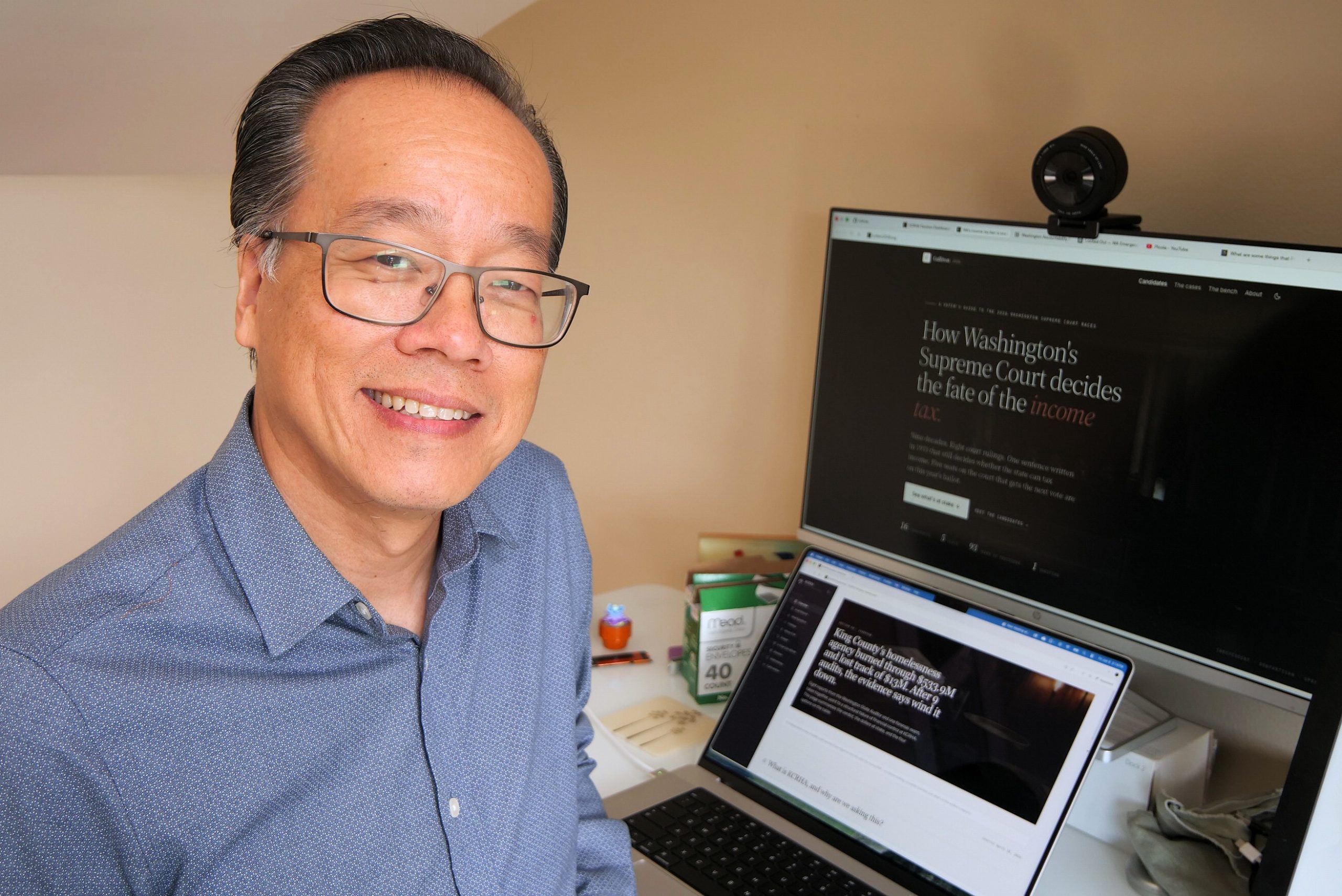
Throughout the colorful and often tumultuous history of American democracy, the evolution of political advocacy has always been deeply intertwined with the emergence of disruptive communication technologies. In the late eighteenth century, the fiery rhetoric of Thomas Paine’s Common Sense and the complex constitutional arguments of The Federalist Papers were forged on noisy, labor-intensive wooden printing presses, distributed by hand to a nascent public hungry for direction and agency. Today, that age-old tradition of the citizen pamphleteer is undergoing a radical, silicon-driven renaissance in the quiet home offices of modern tech hubs, proving that the basic human drive to persuade and inform remains unchanged. In Seattle, Washington, Viet Nguyen, a highly experienced and veteran technology communications executive and former political campaign manager, sits before a glowing monitor displaying a sophisticated civic website called Culliton2026.org. Nguyen is the spiritual descendant of those early American pamphleteers, but instead of ink-stained hands, heavy lead type, and manual distribution networks, his tools of persuasion are advanced large language models and autonomous AI agents. Armed with a modest budget of artificial intelligence tokens and a deep, lifelong understanding of local political structures, Nguyen has constructed an interactive digital arena that allows everyday citizens to explore, analyze, and engage with complex judicial elections in ways that were previously the exclusive domain of highly funded political action committees and elite consulting firms. By harnessing the predictive, synthetic, and analytical capabilities of generative AI, he has successfully bypassed the traditional gatekeepers of political media, showing how a single motivated individual can leverage cutting-edge technology to shape public discourse at a critical electoral inflection point. This new era of digital pamphleteering raises profound, fascinating questions about how political information is consumed, verified, and utilized in the modern public square, demonstrating that while the mediums of delivery may shift from paper to pixels, the fundamental democratic impulse to influence the trajectory of governance remains entirely unaltered.
At the heart of Nguyen’s digital experiment is a high-stakes, multi-million-dollar political battle over the future of Washington state’s tax structure—specifically, the controversial “millionaires’ tax” enacted by the Legislature and signed by Governor Bob Ferguson in March 2026. Designed to levy a 9.9 percent statewide tax on personal income exceeding $1 million starting in 2028, the fiscal policy has deeply polarized the state’s vibrant business and tech communities, with opponents warning it could spark an exodus of high earners, entrepreneurs, and innovative enterprises. To understand the legal vulnerability of this new legislation, one must travel back to the depths of the Great Depression and the landmark 1933 state Supreme Court ruling in Culliton v. Chase, which struck down a graduated income tax and established a long-standing precedent that income is property and must therefore be taxed uniformly. Nguyen, who personally opposes the new tax and has written public op-eds arguing its unconstitutionality, designed the website Culliton2026.org specifically to demystify the upcoming state Supreme Court races that will ultimately decide whether this historic legal precedent stands or falls. Since five of the court’s nine seats are on the ballot, the website serves as an interactive voter guide, assessing the judicial philosophies of sixteen candidates to determine how they might rule on the tax. The site’s crowning feature is a dynamic “Balance of Power” simulator, which allows visitors to drag and drop different candidates into vacant bench seats, instantly recalculating the projected court majority and showing how a handful of votes could shift the state’s constitutional landscape. By translating dry, dense legal histories and judicial records into a digestible, interactive dashboard, the platform attempts to fill a massive civic knowledge gap, offering voters a clear, albeit controversial, window into the ideological leaning of candidates who historically run quiet, low-profile campaigns that receive very little mainstream media coverage.
What makes Culliton2026.org truly revolutionary is not just its political subject matter, but the unprecedented and deeply democratic method of its creation. Nguyen is not a professional software engineer, coder, or data scientist; yet, he was able to build a fully functional, highly interactive, and aesthetically polished web application in just a few hours. He accomplished this feat by utilizing “agentic AI”—a sophisticated class of artificial intelligence that goes beyond simple conversational chat responses to actively pilot a computer, browse the web, execute multi-step software tasks, and coordinate complex workflows among multiple digital agents operating in parallel. Using a premium subscription to the Perplexity Max plan and its cutting-edge Perplexity Computer tool, Nguyen directed the AI to scan thousands of pages of legitimate public records, court opinions, official candidate filings, and reputable news coverage, deliberately instructing the system to ignore unverified blog posts or speculative social media threads to preserve analytical integrity. Traditionally, building a database-driven website with dynamic user interfaces, predictive algorithms, and custom data visualizations would require hiring a dedicated team of developers, designers, and researchers, costing thousands of dollars and taking several weeks or even months of development. Nguyen, by contrast, constructed the entire platform for approximately one hundred dollars in raw AI computing tokens, demonstrating a massive democratization of software development where the only limitation is the creator’s ability to conceptualize and prompt the machine. This shift signals a democratization of civic technology, empowering grassroots advocates, independent journalists, and passionate citizens to build powerful, data-rich watchdogs and public resources on shoestring budgets, fundamentally disrupting the monopoly that well-funded institutions and corporate interests have long held over sophisticated digital advocacy and public relations campaigns.
Unsurprisingly, Nguyen’s innovative approach has ignited a fierce debate among political strategists, legal scholars, and civic watchdogs regarding the ethical and practical boundaries of using AI to forecast judicial behavior. Critics, most notably Andrew Villeneuve of the Northwest Progressive Institute—a progressive organization that actively supports the millionaires’ tax—have vehemently dismissed Culliton2026.org as “speculation dressed up as a voter’s guide,” arguing that attempting to predict a judge’s ruling on a hypothetical case is fundamentally flawed and potentially misleading to the electorate. Villeneuve points to strict judicial ethics rules that prohibit candidates from pre-committing to decisions on future cases, and quotes respected constitutional scholars, including retired University of Washington law professor Hugh Spitzer, who maintain that predicting how a jurist will rule on complex constitutional questions is an exercise in futility. The critics argue that by categorizing candidates as “likely to uphold” or “likely to strike down” the tax based on past associations, the site oversimplifies the rich, nuanced, and unpredictable nature of constitutional jurisprudence down to a binary political game. In contrast, NPI runs its own guide, the Washington State Supreme Court Elections Visualizer, which strictly sorts candidates by their official endorsements and voter-pamphlet statements without making any predictions on potential rulings. In response to these critiques, Nguyen demonstrated a refreshing willingness to engage in constructive civil dialogue, updating his platform to include alternative legal viewpoints, acknowledging the complexity of the federal precedents surrounding Culliton, and clarifying that the site functions as an educational tool rather than an absolute vote predictor. This exchange highlights a critical tension in the age of algorithmic politics: the delicate line between empowering voters with accessible, data-driven synthesis and the risk of reducing complex, independent constitutional minds into predictable partisan agents, a debate that will only intensify as artificial intelligence becomes more deeply integrated into our electoral systems, changing how we evaluate public servants and candidates for office.
To fully appreciate Nguyen’s motivation for dedicating his free time, resources, and tech acumen to civic oversight, one must look at his deeply personal American journey, which is rooted in a profound sense of gratitude and civic duty. Arriving in Washington state in 1975 as a mere seventeen-month-old refugee fleeing the aftermath of the Vietnam War, Nguyen grew up with a profound appreciation for the democratic systems, open institutions, and economic freedoms that welcomed his family and allowed them to rebuild their lives in a new country. He went on to study political science at the University of Washington, launching his career in public service by volunteering for Gary Locke’s historic and successful 1996 gubernatorial campaign before successfully managing various local political campaigns on both sides of the aisle, establishing himself as a moderate voice in local politics. This early political immersion was followed by a highly successful, two-decade corporate career in communications and leadership roles at technology giants like Microsoft, T-Mobile, and the wireless industry trade group 5G Americas, which he led until its operations wound down. This unique intersection of high-level technology expertise and hands-on political campaign management provided Nguyen with the perfect toolkit to recognize how emerging technologies could be applied to solve chronic civic transparency issues and bridge the gap between complex government functions and public understanding. For Nguyen, building these AI-driven sites is not about achieving personal fame or financial gain, but about paying forward a debt of gratitude to the state that adopted him, utilizing his unique skillset to ensure that the citizens of Washington have access to the transparent, understandable information they need to hold their government institutions accountable and participate meaningfully in their democracy, proving that the American dream is best realized when it is paired with active civic engagement.
Culliton2026.org is far from an isolated project; it is part of a broader, highly ambitious digital ecosystem of civic accountability tools that Nguyen has constructed using his AI-driven methodology. His portfolio includes the Washington Accountability Registry, which systematically catalogs dozens of state and local government controversies, conflicts of interest, and oversight failures, as well as highly critical real-time dashboards tracking the King County Regional Homelessness Authority and legislative emergency clauses. While some of these projects adopt a more overtly partisan or critical stance—such as his “Locked Out” tracker highlighting “referendum-proof” bills or his AI-generated satirical music videos criticizing local leadership—they all share a common philosophical foundation: using the rapid, low-cost power of generative artificial intelligence to shine a bright light on the inner workings of government bureaucracy. As AI tools continue to advance at an exponential rate, the line between passive consumption of political news and active, citizen-led data synthesis will continue to blur, ushering in an era where any passionate individual can run their own highly sophisticated media campaign or policy analysis bureau from a laptop. By proving that a modern-day digital pamphlet can be built in a single afternoon for the price of a dinner, Viet Nguyen is helping to draft the blueprint for the future of grassroots democracy. It is a reality that would undoubtedly fascinate early American pamphleteers like Thomas Paine, who famously wrote that “the birthday of a new world is at hand”—a sentiment that feels incredibly prescient as we stand on the threshold of an AI-driven civic landscape where every voice, regardless of budget or technical background, has the potential to build its own virtual printing press and leave an indelible, lasting mark on the democratic process.