





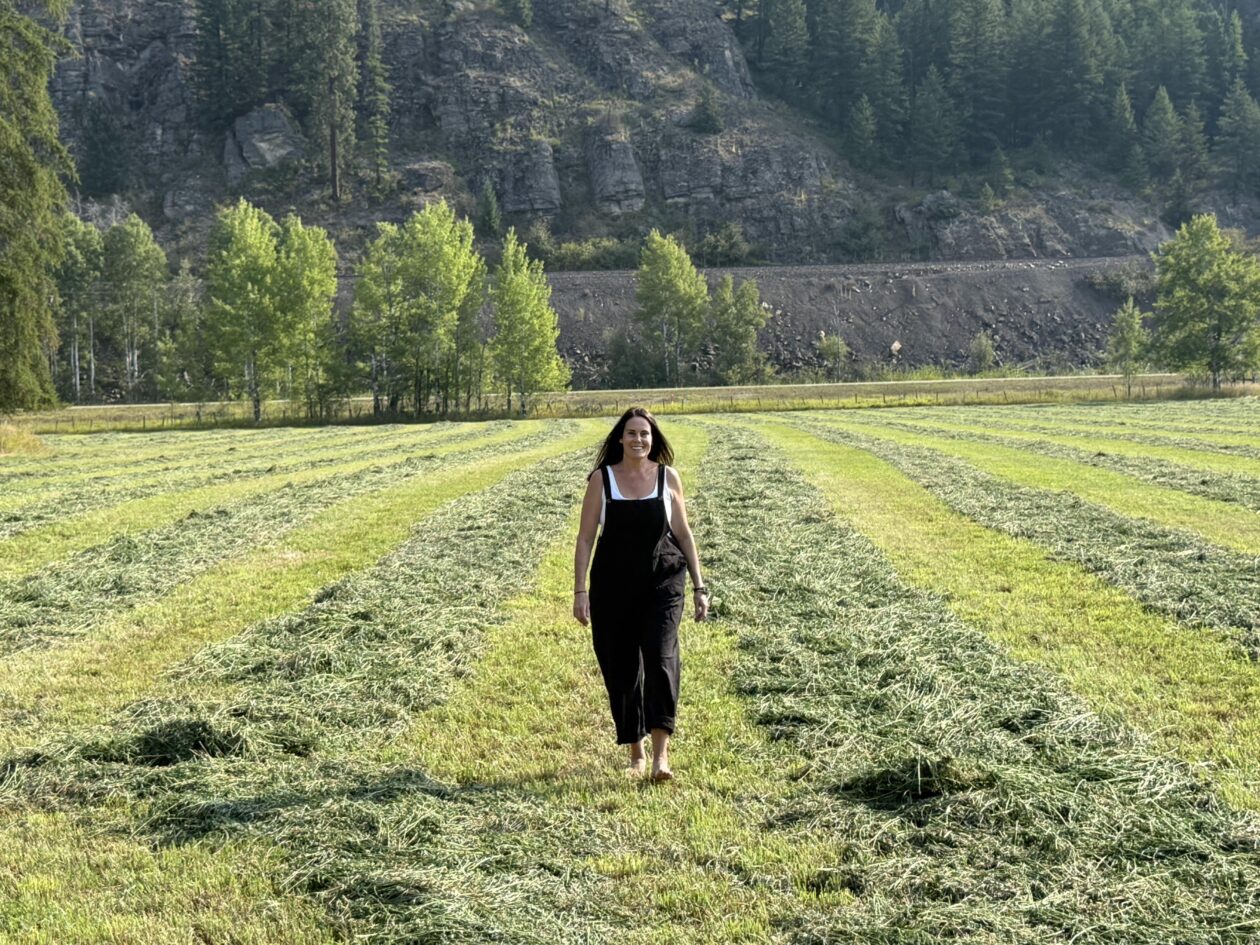
Genevieve Priebe took a business meeting this summer while bottle-feeding baby goats. The image alone shatters any stereotype of a tech founder: no polished pitch deck, no venture capital office, no hoodie-and-sneakers performance. Just a woman in the middle of farm life, holding a wriggling kid in her arms, talking about the future of local food. For Priebe, that moment is simply reality. A few years ago, she was sitting in boardrooms with executives at some of Seattle’s largest companies—Microsoft, T-Mobile, Starbucks, and Boeing—advising them on strategy as a consultant at Accenture. Today she runs Reroot, a bootstrapped Seattle startup that wants to make buying local food as easy and convenient as ordering anything else online. “Best decision I’ve ever made,” she says of the dramatic career change. Reroot is a marketplace where independent farmers, ranchers, bakers, and makers sell directly to customers, with founding partners currently in the Pacific Northwest. In July, the company launched a free companion app, Reroot: Find Local Food, which maps more than 50,000 producers across the United States and parts of Canada. Priebe also built a patent-pending tool called Walk & Talk, which allows a farmer to update an online store by voice while walking the field, even without a cell signal; when they return to coverage, the system reconciles what they said against any sales that came in while they were offline. The mission is ambitious, but for Priebe it is deeply personal. She is a fourth-generation member of a Montana farm family. She grew up in Whitefish, driving her dad’s tractor before she could reach the pedals and counting change at farmers markets where her mother sold flowers. That heritage explains why Reroot feels less like a typical tech platform and more like a homecoming, a way of using her corporate knowledge to save the world she came from.
Priebe’s roots run deep, and so does her understanding of the problem she is obsessed with solving. After twenty years in Seattle consulting, she found herself pulled back to the land when her parents passed away. She and her brother took over the family farm. Being the pragmatic consultant she was, Priebe ran the numbers. She carefully calculated what it would take to make a living growing food, and the result was bleak. “Close to impossible,” she calls it. The statistics are sobering: less than 50 percent of the 1.9 million farms in the United States are profitable. The median farm income is more than a thousand dollars in the red. Fifteen thousand farms go out of business every year. The story is not much better for ranchers, bakers, and other independent food producers. Priebe found herself staring at a paradox: growing food is one of the most important jobs in the world, yet it is nearly impossible to make a living doing it. The system is rigged against small, independent producers. They face thin margins, middlemen, marketing burdens, and a food supply chain that favors massive industrial operations. They often pay to be farmers, not the other way around. Priebe did not want to become a founder. She had built a successful career, she was comfortable, and she knew how hard startups can be. But she could not walk away from the problem. “I didn’t want to be a founder,” she says, “but I couldn’t walk away from the problem.” That reluctant sense of duty is the engine behind Reroot. Unlike founders who are chasing trends or hunting for unicorn exits, Priebe is trying to solve a real, systemic issue that touches every community: the invisibility and economic fragility of the people who feed us. Her twenty years in the corporate world gave her the tools, but her childhood on a Montana farm gave her the reason.
At the heart of Reroot is a deceptively simple observation: local food is all around us, but finding it is hard, and buying it directly from the source is even harder. Why is it easier to buy a mango from Peru than a tomato grown ten miles away? The answer lies in a food system that has become fragmented, industrialized, and opaque. Farmers markets are limited by time and geography. Community-supported agriculture shares require upfront commitment and are not always discoverable. Grocery store shelves are dominated by industrial farms. There is no single place to discover, follow, and buy from local producers. That gap is exactly what Reroot exists to fill. The marketplace connects independent farmers, ranchers, bakers, and makers directly with the people who love what they grow, raise, and make. It handles inventory, fulfillment, analytics, and financial transactions, and it integrates with payment systems like Square and Stripe. For customers, it offers a way to know exactly where their food comes from and to build relationships with the people behind it. For producers, it is a lifeline. Priebe was surprised when she talked to customers to learn just how many small farms are losing money. She expected they were struggling, but she did not expect that most were operating in the red. That discovery sharpened her mission. She also launched the free Reroot: Find Local Food app, which maps more than 50,000 producers across the U.S. and parts of Canada. It transforms the hidden landscape of local food into something searchable, accessible, and intimate. The company is live with founding partners in the Pacific Northwest, and the vision is much larger. Priebe is not building a niche app for foodies; she is building an infrastructure for local food, a discovery layer and a commerce layer all in one. She insists the idea is simple, which is exactly why people assume it already exists. It doesn’t. And that absence is what she is working to correct.
Perhaps the most remarkable part of Reroot is how it is being built. Priebe is a solo entrepreneur, with one employee and a small advisory board. She has no technical co-founder, and she has not written a single line of code. Yet she has built a fully functioning marketplace that processes real financial transactions, sends marketing emails for its customers, manages inventory and fulfillment, and powers a searchable map of tens of thousands of farms. In the past, she says, this would have required a five-person development team, eighteen months, and $1.5 million. Instead, she did it alone in about four months. The difference is artificial intelligence, and Priebe has embraced it dramatically. AI has democratized software creation in a way that allowed her to move at the speed of a much bigger company. She built a patent-pending tool called Walk & Talk, a voice-controlled inventory management system designed for farmers who do not want to sit at a computer. A farmer can walk their field, dictating updates to their online store, and the system will reconcile those notes against sales when they regain cell coverage. It is a beautiful example of using cutting-edge technology to serve ancient work. Priebe’s independence, however, has not come without pressure. She says every advisor and investor she talked to told her to find a technical co-founder, ideally younger and male. She chose to ignore that advice. As a woman in her forties, building a bootstrapped company alone, she consciously rejected the raise-and-burn startup model. “The decision to ignore that advice and bootstrap solo as a woman in my forties was simultaneously the hardest decision I’ve made and the easiest,” she says. She is building for real customers who need what she is making, not for a future exit. So far, it is working.
What makes Priebe’s story human, and not just entrepreneurial, is that she has not lost herself in the grind of building a company. Her coffee order is black with a heavy splash of cream. Her favorite AI tool is her own Walk & Talk, which she describes with the pride of a farmer showing off a new implement. She has been reading Proust’s Swann’s Way for a decade and predicts it may take another decade to finish, but otherwise she devours anything farm-, food-, or cookbook-flavored. Her podcast queue is 75 percent agriculture and food, including Future of Agriculture and The Market Gardener, and the other 25 percent is any book narrated by Ray Porter. Her entrepreneurial idol is not a tech billionaire or a famous founder; it is “anyone who has the moxie to believe in themselves and do things a little bit differently.” She gives advice with the same plainspoken clarity. “Don’t overthink it,” she says. After decades in an environment where every decision required a PowerPoint deck and three rounds of approvals, the best thing about being a founder is the ability to just move. “Build it, ship it, learn, repeat,” she says, and the rhythm of those words sounds like work she knows. This is not the language of a detached technologist. It is the voice of someone who has spent time in the dirt, who knows that seasons do not pause and seeds do not wait. She understands that the people she is building for are not thinking about user acquisition funnels or conversion rates. They are thinking about weather, soil, and survival. That is why Reroot feels different. It is built with respect for the user’s life, not just their wallet.
Priebe’s definition of success is refreshingly un-Wall Street. She says Reroot will have made it when the hardest part of farming is no longer the marketing. When farmers like her parents, grandparents, and great grandparents can actually afford to do the work they love. When she can conveniently replace most of her grocery store spend with local food purchased directly from her favorite producers. That is not just a business goal; it is a vision of restoration. It is about making local food visible, accessible, and economically viable again. It is about making it possible for a fourth-generation farm kid to stay on the land, and for a first-generation farm seeker to find it. Priebe left Montana, spent two decades in Seattle’s corporate world, and returned to the family farm—only to realize that the most important work ahead was building something new. She built Reroot because she could not walk away from a problem that affects all of us. Her story is unlikely: a woman in her forties, a bootstrapped company, fifty thousand farms mapped, baby goats in her arms at a business meeting. Maybe that is exactly what it takes to see the food system clearly and to have the courage to change it. When she looks out at the fields, she sees not just her own history but the possibility of a future where farmers can prosper by doing what they love. In that future, the distance between a farm ten miles away and the dinner table becomes very short indeed. Reroot’s success would mean more than a healthy startup balance sheet. It would mean justice, in a small but essential way, for the people who grow our food. That is a vision worth raising a glass—or a bottle—to.