


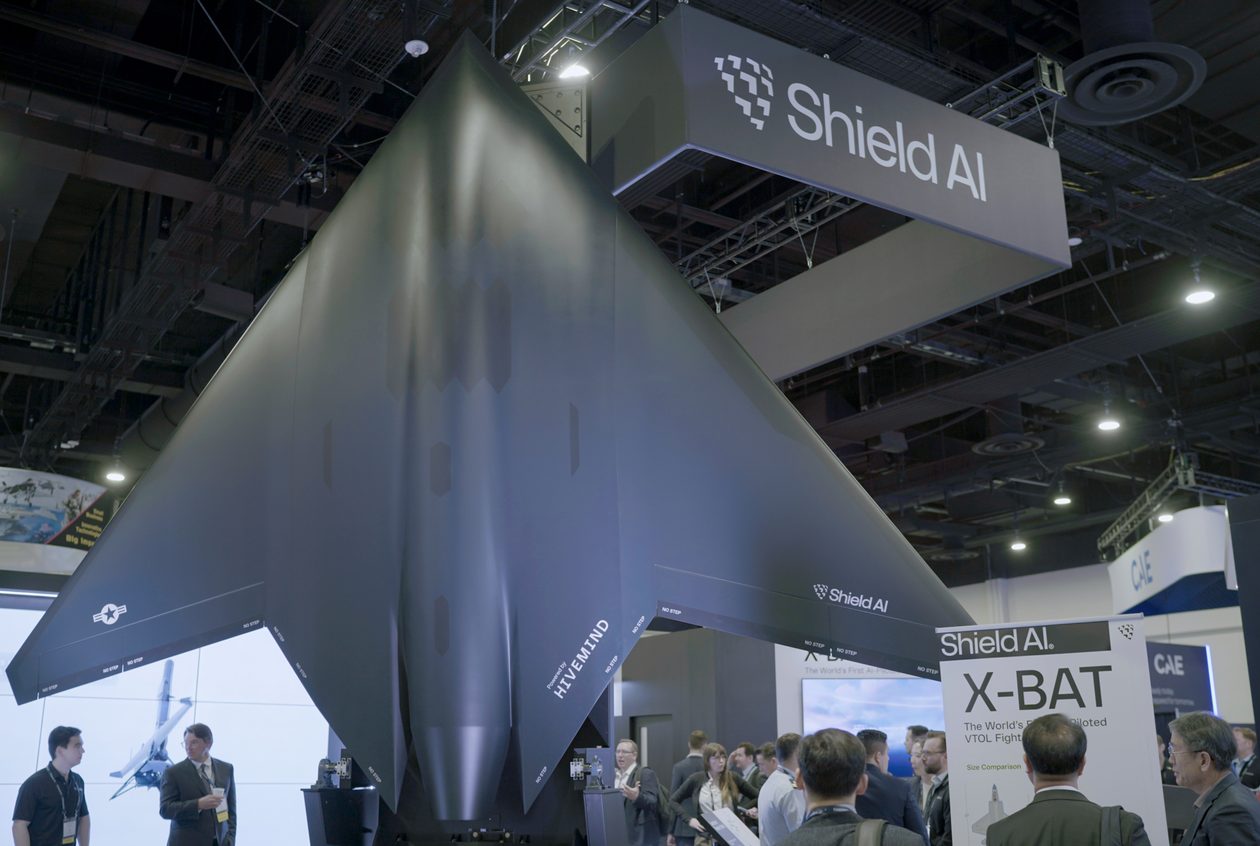
There’s something almost paradoxical about the sight of a fighter jet standing upright on a flatbed trailer, ready to launch from a strip of highway or the deck of a cargo ship. But that’s exactly the vision behind Shield AI’s new X-BAT autonomous fighter jet, a runway-independent aircraft designed to take off and land vertically. The San Diego-based defense technology startup recently received a $150 million contract from the U.S. Navy to accelerate the program, adding a powerful vote of confidence from federal leadership. At the same time, the company is planting its industrial roots in the Pacific Northwest, with plans to open a massive 420,000-square-foot engineering and production facility in Des Moines, Washington, just south of Seattle. The new site, called “X-Forge 3,” will serve as the core production hub for the X-BAT, and the company expects to employ roughly 4,000 people in the Seattle area by the early 2030s. This isn’t just another defense contract; it’s a bet on a future where airpower is no longer tethered to long concrete runways that are expensive to build, easy to target, and vulnerable to attack.
The $150 million award comes from the Office of the Under Secretary of Defense for Acquisition and Sustainment through its Defense Exportability Features program. This program is specifically designed to help engineers embed security and export capabilities directly into military hardware from the very beginning, rather than trying to retrofit them later. That means the X-BAT is being designed not only to serve the U.S. military but also to be sold to international allies without exposing sensitive American technology. Shield AI is matching the award with $150 million of its own capital, bringing the company’s total financial commitment to the same level as the government’s. Combined with an earlier $100 million joint investment finalized in August under the Navy and Defense Innovation Unit’s expeditionary strike effort, cumulative backing for the X-BAT now stands at an impressive $400 million. This substantial funding is all the more notable given that Shield AI raised a staggering $2 billion venture capital round earlier this year at a $12.7 billion valuation. For a defense startup, that kind of private-market confidence is rare. But it reflects a growing recognition that the future of warfare is increasingly autonomous, software-driven, and hungry for platforms that can deploy quickly and flexibly from wherever they happen to be.
The X-BAT’s defining feature is its independence from traditional airfields. It is built to operate from amphibious assault ships, destroyers, commercial cargo decks, and even highway strips, without the need for concrete runways or aircraft carrier catapults. To make that possible, the jet launches from a specialized Launch and Recovery Vehicle—essentially a mobile trailer that erects the aircraft vertically, allowing it to be towed along interstate highways or loaded onto ships like ordinary cargo. This capability was described by Shield AI co-founder and president Brandon Tseng, a former Navy SEAL, as a “transformative, runway-independent aircraft.” In his words, “airpower without runways is the holy grail of deterrence.” That phrase carries real weight in a world where fixed air bases are increasingly vulnerable. The urgency of this approach was highlighted just last weekend, when the U.S. Air Force withdrew strategic B-1 bombers from RAF Fairford in Britain following reports of potential drone threats targeting the air base. If a single drone threat can force the evacuation of bombers from a major base, then the strategic value of aircraft that don’t need runways becomes stark, obvious, and immediate. The X-BAT is designed to thrive in exactly those conditions, offering a way to project combat power without presenting an easy target.
This is also a story about jobs, industrial revival, and the changing pace of defense manufacturing. Shield AI’s new Des Moines facility is expected to begin producing aircraft in 2028, and the company aims to scale up to roughly 150 jets per year by the early 2030s. Prototyping is currently based in Frisco, Texas, while flight testing will take place at Newton City-County Airport in Kansas. But the main production line and engineering teams will be centered in Washington, with the potential to add an additional one million square feet of space in the region. Armor Harris, Shield AI’s senior vice president of aircraft, emphasized that the company is moving at a speed that traditional defense contractors rarely match. “Building a next generation fighter jet is no small endeavor,” he said, “and with the amount of interest that we’ve seen, both from our U.S. government customers and from international customers, we could be looking at building these at rates greater than fighter jets have been built in a really long time.” The key to that speed is a tightly integrated approach, where development and manufacturing happen side by side. Harris explained that the company is “testing early and often while working on the aircraft, mission systems, ship suitability and production in parallel,” a strategy that helps identify and solve problems before they become expensive delays. An engineering team of roughly 500 people across Shield AI and key suppliers like GE Aerospace is currently building flight-test aircraft, and the energy around the program is unmistakable.
On the technical side, the X-BAT has already cleared some major milestones, even though it has not yet made its maiden flight. Engineers have completed ground engine light-off and thrust-vectoring nozzle integration using GE Aerospace’s F110 engine, along with extensive wind-tunnel testing to validate the aerodynamics of the internal weapons bay at both low and high speeds. The aircraft is powered by Shield AI’s Hivemind autonomy software, an artificial intelligence pilot designed to execute tactical strike missions in contested environments where GPS and satellite communications are jammed. This is a crucial capability, because modern warfare increasingly takes place in electronically cluttered battlefields where a single point of failure can ground an entire fleet. The X-BAT’s specifications are equally impressive: it boasts a 1,000-nautical-mile combat radius and a total range of 2,000 nautical miles, which exceeds the estimated 590-nautical-mile combat radius of the conventional Lockheed Martin F-35A. Initial flight tests are scheduled for late 2026 in Kansas, with first production aircraft deliveries targeted for late 2028. While the program is still young, the pace of progress suggests that Shield AI is determined to compress the traditional decade-long timeline for fighter development into just a few years.
Ultimately, the X-BAT represents more than just a new aircraft. It embodies a broader shift in how the Pentagon and its allies think about the nature of air combat. As J.J. “Yank” Cummings, Shield AI’s head of mission solutions for the U.S. Navy and former commanding officer of the aircraft carrier USS Gerald R. Ford, put it, “X-BAT is being built to enhance the lethality, survivability and combat power of U.S. Naval Aviation. Its runway-independent design and small deck footprint can increase sortie generation and extend long-range air combat power.” In other words, this is not just about replacing existing fighter jets; it’s about expanding where and how they can be used, creating new options for commanders who cannot rely on massive bases or vulnerable supply chains. For the Seattle area, it also marks a new chapter in the region’s technological identity, transforming it into a hub for autonomous defense manufacturing. For Shield AI, it is proof that a startup with bold ideas and a willingness to challenge conventional wisdom can win the trust of the military and the private markets alike. And for the broader public, the X-BAT is a glimpse into a future where the guardians of the sky may not always need a runway, a pilot, or even a human hand on the controls—just a trailer, a stretch of road, and software brave enough to fly.