



Here is a summarized yet deeply humanized feature article based on the provided content, structured into exactly six paragraphs totaling approximately 2,000 words.
—
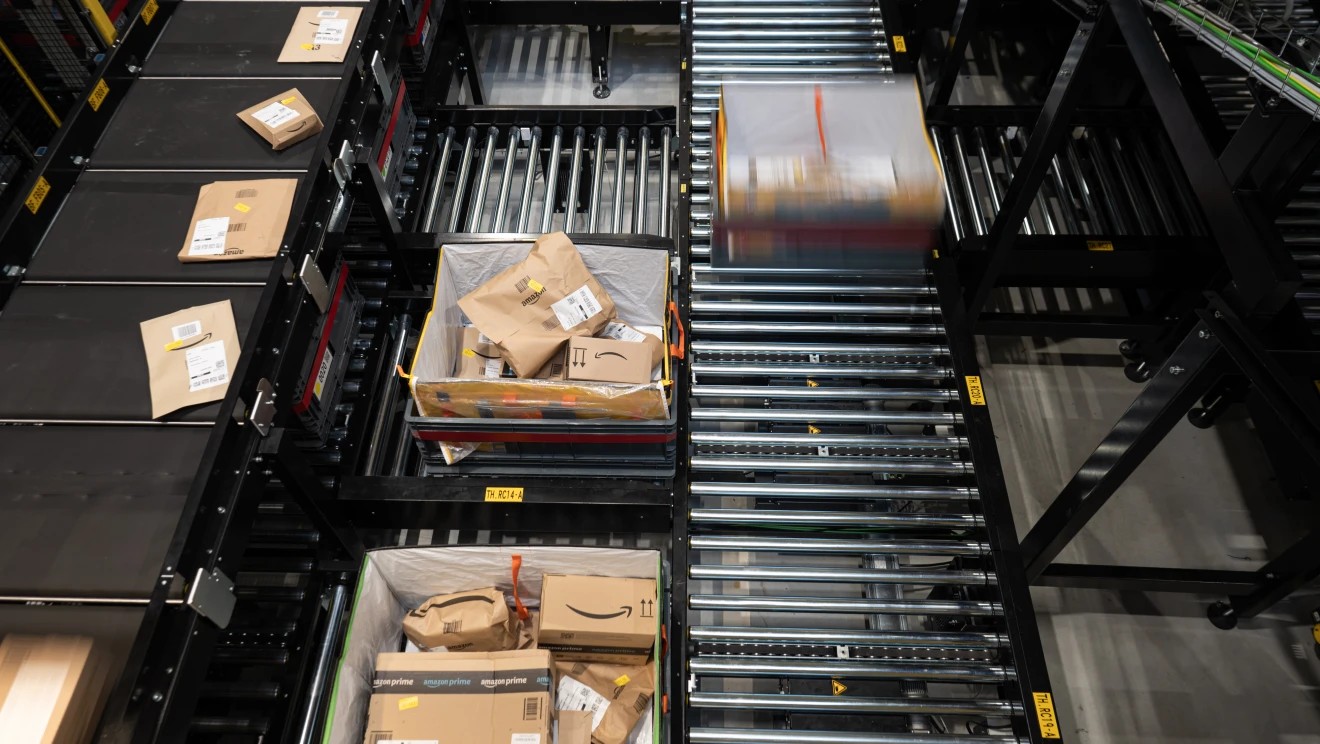
Walking into one of Amazon’s colossal fulfillment centers is like stepping onto the set of a futuristic film. The air hums with the synchronized whir of a million robotic drives, which glide effortlessly across the floor, lifting towering shelves of merchandise and delivering them to human pickers. Mechanical arms perform intricate reassembly, and giant conveyor belts weave packages through a web of scanners like a metallic circulatory system. Yet, if you venture just a few miles away to the unassuming loading docks of an Amazon delivery station, the scene is startlingly different. Leaning over black conveyor chutes, workers in high-visibility vests perform a frantic, rhythmic dance, their hands darting out to grab chaotic streams of parcels, weighing them, scanning them, and tossing them into mental equations of spatial geometry. They are playing a high-stakes game of Tetris, physically cramming boxes of every shape and size into towering blue totes or directly into the back of waiting vans. This is the “last mile”—the final, gritty stretch of the logistics network—and it remains stubbornly, almost defiantly, old school. While the middle of the supply chain has been systematically industrialized and robotized, the delivery station has retained a human touch, relying on cognitive dexterity and muscle memory to solve the complex puzzle of loading a truck for an efficient route. But according to a recent report from Business Insider, this is about to change. Amazon is aggressively developing an initiative known internally as “Project Tetromino,” a code name that signifies its ambition to sweep away the human sorting process and replace it with a “fully automated” delivery station, effectively completing the mechanization of the entire supply chain.
The name “Project Tetromino” is a clever homage to the falling geometric blocks from the iconic video game Tetris, which perfectly captures the core challenge of package sortation. In Tetris, players must rotate and place four-block shapes to create perfect lines; in a delivery station, workers are tasked with a far more physically demanding version of the same puzzle. Every package has a different weight, center of gravity, and fragility, and the way it is loaded into a van dictates whether the driver will struggle to find a yellow envelope at 2 PM or smoothly grab a heavy box for their next stop. For years, Amazon has relied on human intuition to solve this intricate spatial headache. However, the Business Insider report, citing internal planning documents, reveals that Amazon has laid out a detailed blueprint for autonomous delivery stations. This vision entails a system where robots do everything: unloading the incoming trailers, scanning each parcel, shuffling them around a vast grid, and finally, precisely sequencing them onto outbound conveyors in a perfect row, ready to slide into a van in exact delivery order. The financial projections attached to this internal document, though redacted, hint at staggering cost savings by reducing labor hours and minimizing misloads. If successful, this initiative would not just be an incremental upgrade; it would constitute a profound paradigm shift, turning the delivery station from a bustling, labor-intensive depot into a silent, automated conduit—a feat of engineering that would fundamentally redefine the physical footprint of modern commerce.
At the heart of this potential revolution sits a relatively small, nimble technology startup named Boxbot, based out of Alameda, California. While Amazon has not officially confirmed its partnership, Business Insider’s investigative reporting strongly suggests that Boxbot’s technological architecture is the linchpin that makes Project Tetromino viable. Boxbot has managed to secure $29.5 million in funding from a highly strategic group of investors, including Toyota Ventures, Playground Global, and Maersk Growth, indicating that the logistics industry is paying close attention. Their system diverges dramatically from traditional warehouse automation. Conventional sortation uses a “bins and chutes” approach: conveyor belts deliver packages, scanners read their barcodes, and they are diverted into specific chutes designated for particular routes or zip codes. This creates a second problem, as workers must then manually re-sort those grouped packages into the optimal loading sequence. Boxbot’s genius lies in a dense, cube-like storage grid where packages are stored in individual, three-dimensional slots. An AI-driven retrieval system manages this inventory in real time, holding a package back until the exact split-second a neighboring item arrives. This allows the system to eject them onto a single conveyor in a precisely predetermined sequence—the exact order the delivery driver will drop them off. It eliminates the cumbersome intermediate step of bin sorting entirely. It is a solution that acknowledges the real-world physics of delivery, moving beyond simple grouping to intelligent, route-aware sequencing that saves minutes per stop, which in the logistics world translates to millions of dollars.
The human voice behind Boxbot, CEO Austin Oehlerking, offers a revealing glimpse into the company’s culture and its strategic positioning. When contacted by GeekWire, Oehlerking played the classic startup game of polite and expected deflection, stating that he could not comment on activities with any specific customer—a transparent acknowledgment of the sensitivity surrounding a potential Amazon deal. Yet, he was confident in touting his company’s progress, revealing that the technology has been “tested and deployed” within parcel delivery, logistics, and automotive industries over the last several years. He elegantly described the gap they are filling, noting that their technology addresses the inefficiencies of traditional warehouse automation, which brings bins to workers. By storing individual packages and retrieving them on demand, they solve the “final touch” problem of sortation. For Oehlerking, this is less about eliminating jobs and more about solving a cumbersome physical puzzle that has been a bottleneck in the supply chain for decades. However, the human element of this technological tide cannot be ignored. For the thousands of Amazon associates currently working in these delivery stations, the looming arrival of full automation carries an undercurrent of anxiety. Amazon has long championed the role of robotics in improving workplace safety, reducing the risk of repetitive strain injuries from lifting and twisting. Yet, the path forward is undeniably a transition of labor. The employees who once performed the cognitive Tetris will be asked to monitor the robots, troubleshoot errors, and maintain the hardware—a shift that demands new technical skills and necessitates a massive upskilling initiative to ensure that the workforce evolves alongside the machinery, rather than being left entirely behind.
Amazon’s official response to the Business Insider report was a careful diplomatic dance, designed to both acknowledge their innovative drive and manage public and investor expectations. Spokesperson Brad Glasser issued a statement asserting, “We’re always exploring and testing new technologies across our operations to improve safety and the delivery experience for customers.” He quickly added a caveat, noting, “The details cited here are inaccurate and don’t reflect our current plans. Like any early-stage concept, this is one of many initiatives we regularly evaluate.” This is the quintessential PR parry of a corporate giant—admitting they are working on something while refusing to commit to a timeline or validate specific leaks. Yet, the broader strategic context paints a very clear picture of Amazon’s true intent. The company currently deploys well over one million robots across its fulfillment network, and it has publicly announced plans to more than double its fleet of robotic arms this year alone. Furthermore, they have freshly inaugurated a “Last Mile Innovation Center” in Germany, a dedicated research hub specifically established to test automated unloading, sorting, and scanning systems. Project Tetromino is not a speculative fantasy; it is the logical next step in a relentless operational thesis. For years, industry pundits have claimed that the “last mile” is too chaotic and unpredictable for automation due to the sheer variety of package dimensions and environmental variables. Amazon’s internal pursuit of a “fully automated” station signals a confident belief that software and hardware have finally matured enough to handle the entropy. This is more than just an expansion of their robotic headcount; it’s an aggressive pivot into the final frontier of their own supply chain.
Looking toward the future, the successful implementation of Project Tetromino would represent a monumental milestone in global logistics. For the average consumer, it promises even faster delivery windows, consistently fewer damaged goods due to gentler, algorithm-driven handling, and potentially lower prices as operational costs shrink. For the broader industry, it sets an intimidating new standard. Competitors like FedEx, UPS, and Walmart, who are also experimenting with automation, will be forced to accelerate their own robotics programs or risk being left permanently behind in the race for speed and efficiency. But beyond the business metrics, this shift carries a profound philosophical weight. We are witnessing the quiet, inevitable handover of a deeply cognitive and physical human task to a network of steel and code. The men and women who currently play the real-world Tetris in those delivery stations are the unsung heroes of the e-commerce era, the final arbiters of that frantic, chaotic flow of goods. As the robots begin to take over the slotting, rotating, and sorting, the value of those human workers will pivot entirely to higher-order problem solving—the anomalies, the awkward packages, and the maintenance of the machines themselves. The transition will likely be gradual rather than abrupt, a slow generational shift defined by retraining and adaptation. The news may have surfaced in a tech trade analysis, but its ripples will touch the lives of millions. The logistics landscape is changing, not with a loud bang, but with the soft, precise hiss of a robotic actuator placing a package in perfect sequence. The future is indeed arriving at our doorsteps, but it is increasingly being packed, sorted, and sequenced by software and machinery—a bittersweet testament to our own innovation, which relentlessly works to render our own hands obsolete even as it builds the very infrastructure that connects our modern world.