


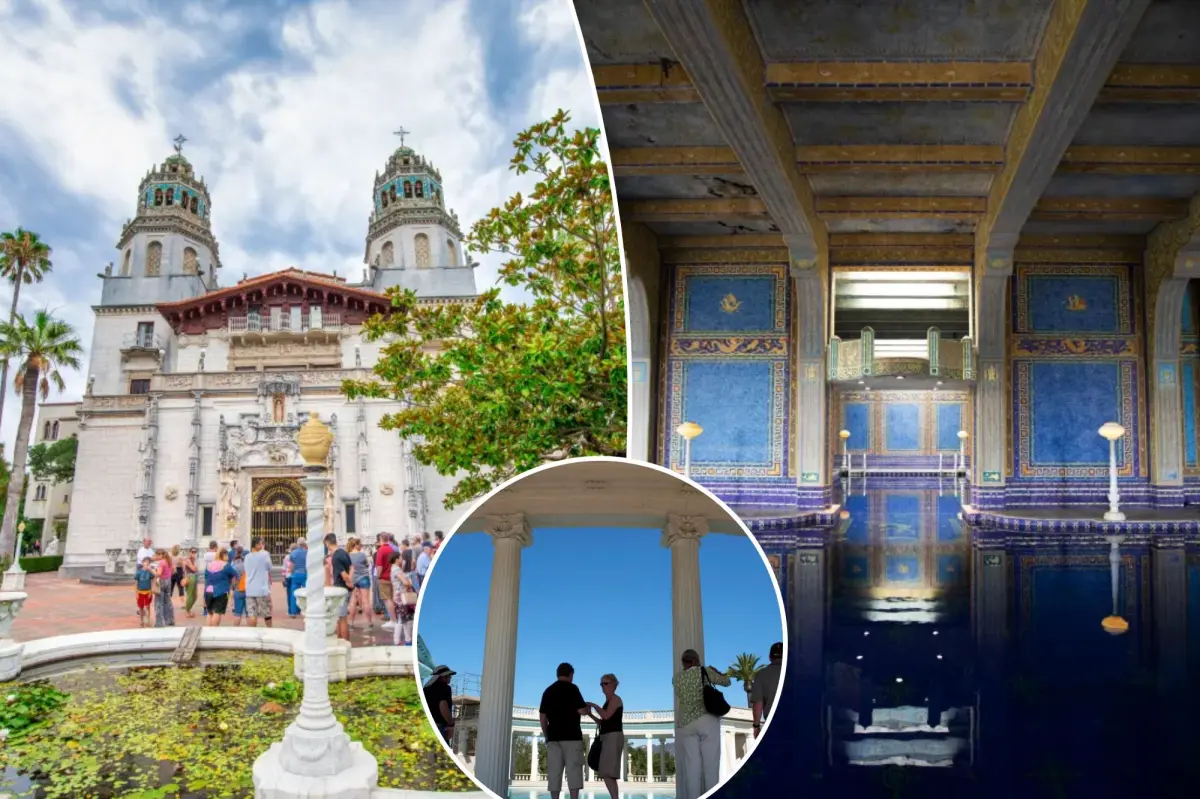
There is something almost impossibly romantic about Hearst Castle, especially on those foggy Central California mornings when it appears above the Pacific like a golden mirage. Perched on a hill in San Simeon, with the endless blue of the ocean on one side and rolling ranchland on the other, the estate was designed to dazzle. It still does. But behind the beauty, a quiet question has taken hold: Are the walls closing in on one of California’s most beloved landmarks? The castle, once a major cash cow in the state’s park system, has seen visitor numbers shrink dramatically in recent years. Tourists are increasingly skipping the $35 ticket to the lavish estate, choosing instead to drive through the popular coastal route that runs right past its door. The reasons are as varied as the landscapes around it—stormy weather, road closures, high gas prices, and shifting travel habits. Yet each explanation feels incomplete on its own. The result is a place that still looks magnificent but no longer hums with the same energy. It is as if a grand old mansion has become a stranger to its own front door, waiting for the world to remember the way back.
To understand what Hearst Castle means, you have to picture its extraordinary history. The Mediterranean Revival estate was built between 1919 and 1947 by publishing tycoon William Randolph Hearst, who spared no expense in creating a fantasy world above the California coast. He enlisted architect Julia Morgan, a pioneering woman in a field dominated by men, to bring his vision to life. Together, they created a compound of lavish rooms, shimmering pools, fragrant gardens, and terraces overlooking the sea. It was not just a home; it was a statement, a monument to ambition and taste. For decades, the castle drew enormous crowds, with annual attendance reaching 700,000 to 800,000 visitors in its best years. Its picturesque grounds became part of American pop culture, serving as the backdrop for films like 1960’s “Spartacus” and Lady Gaga’s 2014 music video for “G.U.Y.” People came from all over the world to walk the same halls where Hearst entertained Hollywood stars, politicians, and artists. But that golden age of tourism has faded. According to California State Parks officials, the castle’s last “normal” year was 2019, just before the pandemic turned everything upside down. When COVID-19 swept through the state, the attraction shut down in 2020 like so many others. What should have been a temporary pause stretched into a long silence. The castle did not reopen to the public until spring 2022, delayed not only by the pandemic but by necessary road repairs that made access difficult. For two full years, the castle sat empty, its fountains still, its pools reflecting only the sky.
Since reopening, attendance has struggled to recover. The numbers tell a sobering story. During the 2024 busy season, 178,181 people visited the castle, according to SFGATE. The following year, that number fell to 162,758. Traffic increased slightly this year to 168,133 visitors—an encouraging tick upward but still a far cry from the 274,025 people who came in 2019. The gap between past and present is wide, and officials are trying to understand exactly why. They point to a tangle of factors, each one adding to the weight. One of the biggest is Highway 1, the iconic coastal road that winds through some of California’s most breathtaking scenery and provides direct access to the castle. A 90-mile stretch of Highway 1 near Big Sur was shut down for an extended period after landslides, severing one of the main routes for travelers coming from the north. The road also closed again in August and September of this year due to the Plaskett Fire, adding more disruption to a region already struggling with lost tourism. Dan Falat, district superintendent for California State Parks’ San Luis Obispo Coast District, put it plainly: “There are a number of impacts that can relate to overall attendance. Highway 1 comes into play. Overall tourism comes into play. We were closed for over two years, and yes, things have changed… Changes with international travelers. Domestic travel patterns are different. Gas prices. It’s hard to put all factors into one reason.” His remarks capture the frustration of trying to solve a puzzle with no single missing piece. The pandemic, road repairs, climate-fueled fires, and the broader economics of travel have all conspired to keep visitors away.
The decline at Hearst Castle has rippled far beyond the estate’s gilded gates, landing hard on the small community of San Simeon. For generations, the castle was the area’s economic heartbeat, a reliable magnet that filled hotels, restaurants, and shops with a steady stream of tourists. When the castle sneezes, the town catches a cold—and lately, it has been a long illness. Luis Gonzalez, who has lived in San Simeon since 1989 and works in hotel management, described the current tourism slump as the worst he has ever seen. “The worst years in San Simeon since I lived here is after COVID,” Gonzalez said. “COVID, then after COVID, the castle was closed because they had to do repairs to the road for a year. After they opened everything, we’re doing good. COVID to 2025, it was bad, a lot of business closed, there’s no business. It was hard.” His words carry the quiet weariness of someone who has watched neighbors struggle, watched familiar storefronts shutter, and wondered whether the crowds would ever come back. The castle may be a historic monument, but for the people who live and work in its shadow, it is also a livelihood. Hotel bookings have been erratic, off-season months have become even quieter, and the sense of uncertainty has made it difficult for local businesses to plan for the future. There is a human cost to the empty parking spots and unused tour slots, one that cannot be measured in attendance figures alone. The castle was never just a building; it was the reason this tiny coastal community existed, and without its steady pull, the region feels the emptiness in deeply personal ways.
State Parks, however, is not ready to surrender. There is a stubborn belief that Hearst Castle’s story is far from over, and new efforts are underway to restore its place on the California travel map. Officials have introduced fresh tours designed to spark renewed interest, including one that focuses on Julia Morgan, the brilliant architect who shaped the estate’s every beautiful detail. It is a fitting tribute, not only to a visionary woman but to the idea that the castle is more than a relic of one man’s wealth—it is a work of art, a collaboration between two creative minds. By highlighting Morgan’s role, these tours invite visitors to see the castle through new eyes, to appreciate the craftsmanship, the engineering, the elegant solutions to difficult design problems. There is also hope that the castle’s sheer splendor will eventually win travelers back. Its Neptune Pool, with its Greco-Roman statues and white colonnades, still glows in the afternoon sun. The Assembly Room still feels like a stage set for grand conversations. The gardens still smell of cypress and salt air. For anyone who has ever wandered through its rooms, the memory of the place has a way of lingering. The challenge is convincing a new generation of travelers, many of whom are managing tighter budgets and different priorities, that the journey is worth it. It may require thinking beyond the old playbook: embracing social media, creating immersive experiences, offering virtual tours, or partnering with nearby attractions to build broader itineraries. The road to recovery will not be easy, but the foundation is still strong.
In the end, Hearst Castle’s struggle is emblematic of a larger story unfolding across California and the country. Beloved institutions that once relied on reputation and tradition are now being forced to adapt to a post-pandemic world where travel habits have shifted dramatically. International visitors have not returned in the same numbers, domestic tourists are making shorter trips, and every expensive outing must compete with the convenience of staying home. The walls may not be closing in, exactly, but they are certainly being tested. Yet there is something lasting about a place built with such intention, a castle that survived economic depressions, world wars, changing tastes, and even the passing of its creator. It has overcome challenges before, and it can do so again, but only if people are willing to fight for it. The road will reopen, the fires will fade, and eventually the sound of tour buses may fill the air once more. What Hearst Castle needs now is not just a miracle but a community of believers—travelers who understand that some experiences are worth the detour. This is not simply a tourist attraction; it is a window into a moment in California’s history, a reminder that human beings can dream on an extraordinary scale. Whether the crowds return in 2025 or in the years beyond, the castle will remain there, perched above the Pacific, waiting patiently. Its walls have stood for nearly a century, and they are not about to crumble. The question is whether the rest of us will find our way back to the door.