


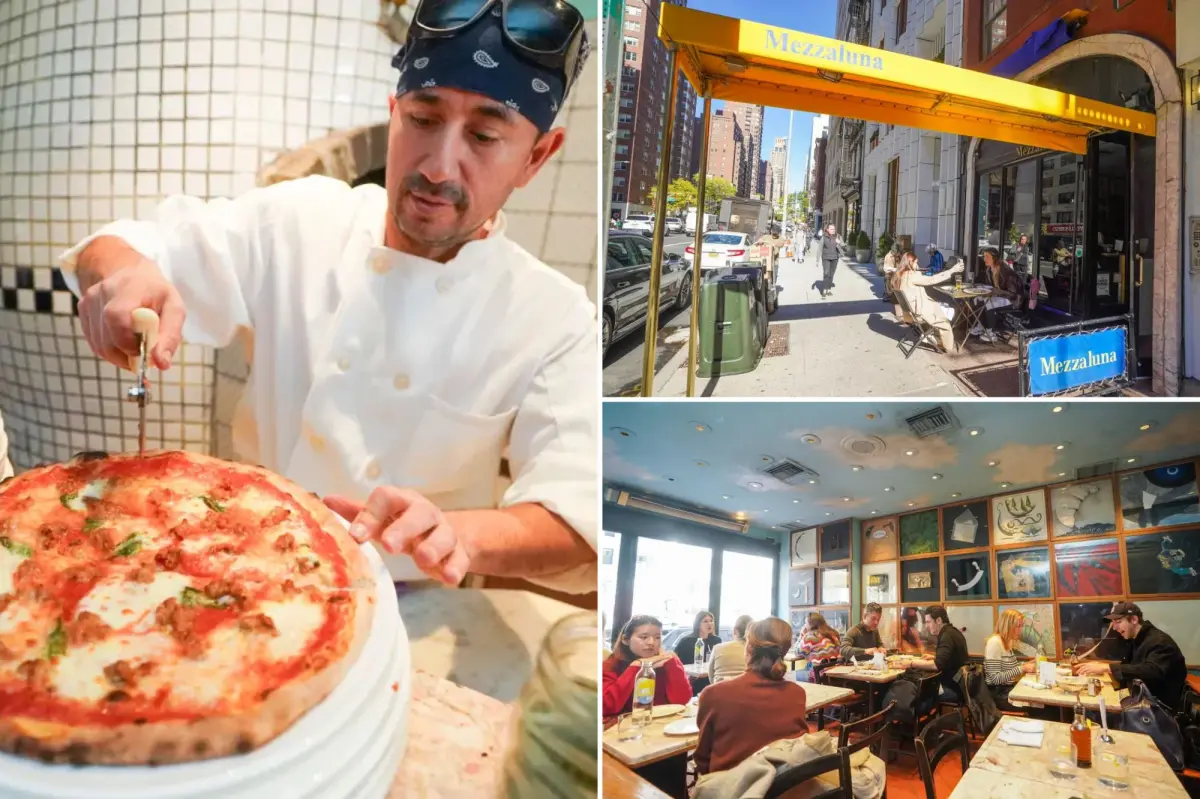
There is a particular kind of grief that settles over a neighborhood when a place it has always taken for granted suddenly isn’t there anymore. That grief is now palpable on the Upper East Side, where Mezzaluna—the beloved, impossibly tiny Italian trattoria on Third Avenue—is closing its doors for good. For months, regulars allowed themselves to hope. There were rumors, denials, a Change.org petition signed by more than 2,100 people, and even a miraculous six-month reprieve after founder Aldo Bozzi, moved by the sight of lines wrapping around 75th Street and customers waiting three hours for a table, asked his landlord for an extension. But this time it is real. The restaurant will serve its last meal on Sunday, November 1, and at 8 p.m., after 42 years, it will turn out its lights, lock its painted door, and leave behind a corner of the city that will feel suddenly empty. In these final days, the scene has been part wake, part love letter: regulars stopping by not just for one last plate of pasta, but to buy the plates themselves, to thank the staff, to soak in a place that has felt more like a living room than a restaurant. The owners made the difficult choice not to sign another 10-year lease, knowing the kitchen—famously tiny, dwarfed by the wood-fired oven—would need extensive renovations that would close the restaurant for months and drain its resources. It is, by any measure, another loss for the old Upper East Side, where longtime neighborhood haunts are increasingly giving way to luxury condos, glossy chain coffee shops, and a streetscape that residents who grew up here barely recognize. “It’s so depressing. I was there yesterday,” said Genny Eide, 33, who grew up on the Upper East Side and has eaten at Mezzaluna since childhood. “They were selling plates. I bought one.” When she asked the staff if it was really the end, they told her it was “real this time.” For Eide, who now brings her own children to the restaurant, life without Mezzaluna is hard to imagine. “My mom orders the Pollanca every day, no corn, no tomatoes,” she said of the restaurant’s signature salad. “She says she doesn’t know where she’s gonna eat anymore.”
To understand why a salad could inspire such devotion, you have to go back to 1984, when Aldo Bozzi opened Mezzaluna at 1295 Third Avenue. New York certainly had no shortage of Italian restaurants, but Mezzaluna was different from day one. Bozzi imported artisanal pasta from Gragnano, near Naples, and olive oil from his family’s Tuscan estate, where 800 olive trees still grow. Friends and colleagues told him Americans would never taste the difference. “I said absolutely not. They recognize quality. They understand when it’s good,” Bozzi recalled. He was right. The little restaurant soon became a force, helping to ignite a revolution in how New Yorkers thought about Italian food, and much of that original vision remained intact over four decades: the terracotta floors, the wood-fired pizza oven, the dozens of framed Italian artworks on the walls, the unpretentious warmth that made every diner feel like a regular. When the end finally came into view, Bozzi, now 86, faced the decision with a heavy heart. The restaurant had originally been scheduled to close in March, but the neighborhood’s reaction—what Bozzi called “a tsunami”—convinced him to keep going a little longer. Ultimately, staying at 1295 Third Avenue would have meant signing another 10-year lease and undertaking extensive, expensive renovations, including overhauling that famously small kitchen. The project would have shuttered Mezzaluna for months, piling up costs with no revenue coming in. “I’m not a young chicken any longer,” he joked. “I’m 86. I wish I was 76. I would have more energy.” Even now, he refuses to think of the closing as a final farewell. It is the kind of grace note you might expect from a man who spent 42 years feeding a neighborhood and watching generations grow up at his tables.
Over the decades, Mezzaluna became something far rarer than a reliably good restaurant: it became a second home. It was almost comically tiny, packed at any moment of the day, with tables so close together that you could eavesdrop on your parents’ friends or strike up a conversation with the table beside you. It served wine but no hard liquor, and that seemed to suit its character—a place for lingering, for easy conversation, for the kind of unhurried afternoon that feels like a luxury now. It was, at various times, the unofficial after-school meeting ground for private school students, a neighborhood grandmother’s favorite spot for a birthday dinner, and a place where teenagers could feel grown-up while still being home by eight. It was a melting pot of generations, a social destination without the pretension that often defines Upper East Side dining rooms, where securing a table can sometimes feel like a social experiment. And the food was consistently good, with generous portions and prices that didn’t require a second mortgage. That combination—atmosphere, authenticity, affordability, and a kind of benevolent chaos—was not easy to replicate. Alexa Eshagian, 32, who grew up in the neighborhood, described Mezzaluna as a thread woven through her entire life. “For as long as I can remember, Mezzaluna has been part of our everyday lives,” she said. “From sitting there in a high chair, to after school with friends, weekends with family, countless lunches that never required deciding where to go.” Even after moving to Miami, she said, it remained her first stop whenever she returned to New York. “It’s rare for a restaurant to become such a meaningful part of a family’s history,” she added, “and even harder to imagine the neighborhood without it.” That sentiment echoes across the Upper East Side, where residents who have mourned other lost institutions now find themselves grieving a place that felt less like a business than a shared living room.
I understand that grief personally. Growing up across the street from Mezzaluna, I ate there more than at any other restaurant in my life—even after delivery apps made virtually every cuisine available at my doorstep. Proximity helped, sure. But it was the kind of place you could eat four days in a row without questioning your sanity. In 2008, I could spend an entire weekend afternoon on that corner, watching rotating casts of neighborhood characters fill and empty the tables and the tiny sidewalk. There was hardly a better place to run into everyone you knew without actually making plans. The food was the anchor, but the real dish was the scene: the laughter, the gossip, the clatter of plates, the grandmothers in their best coats, the kids still in school uniforms, the waiters who had been there for years and knew exactly what you wanted before you ordered. Erica Moser, a longtime patron and Manhattan native, captured the feeling when she told The Post: “Mezzaluna was freedom. Unlimited iced tea, lunching with girlfriends before we knew lunching was a verb, and we were old enough to watch Sex and the City. We were able to be social and independent while being home before 8:00 p.m.” There is something especially poignant about that kind of memory—a place that gave young people their first taste of adulthood while keeping them safe, familiar, and near home. For Eide, it meant her mother’s daily Pollanca order, a ritual so fixed that the staff probably knew the words “no corn, no tomatoes” before she said them. For others, it meant marking milestones, mourning losses, celebrating report cards, or simply escaping the loneliness of the city for an hour. It is impossible to quantify what such a place contributes to the emotional geography of a neighborhood, but everyone who ever sat down at one of those cramped tables knows it is enormous.
The loss of Mezzaluna is not just a nostalgic ache; it is also a sign of how much the Upper East Side has changed. In recent years, the neighborhood has said goodbye to family-owned institutions like Donohue’s and Neary’s—places where menus rarely changed, where the staff were as central to the identity as the food, and where regulars were treated like family. Mezzaluna was perhaps the last of its kind on that stretch of Third Avenue, and its departure is yet another blow to real neighborhood restaurants. The surrounding blocks are now filled with new developments, luxury condos, and chain coffee shops; Blank Street alone has three locations in just a few surrounding square blocks. At one point, a rumor circulated that Chipotle might take over the decades-old establishment’s space, which felt to many like a cruel punchline. The economics of small restaurants have never been easy, and between rising costs and a city that seems to have less room for old-fashioned neighborhood places, survival has become harder. But Mezzaluna’s particular value was never about maximizing revenue; it was about cultivating a sense of belonging. “Some Mezzaluna staff have been there for over 40 years,” Roberto Manfe, the restaurant’s general manager, told The Post. That kind of longevity is almost unheard of in the restaurant world, and it explains why the closing feels so heavy. It isn’t just a building that is closing; it’s a web of relationships, a living archive of neighborhood history. The staff know the children who have become parents, the couples who have become grandparents, the orders that have not changed in decades. When those relationships are scattered, a part of the city’s soul goes with them. The Upper East Side has always prided itself on stability and tradition, but even here, the ground shifts underfoot. What was once a neighborhood of family restaurants and corner bars is slowly becoming a landscape of generic chains and luxury towers. Mezzaluna’s closing is not the first such loss, and it won’t be the last, but it may be the one that finally makes people stop and ask what else is being lost.
And yet, even in farewell, there is a glimmer of hope. Bozzi now lives full-time in Southampton, but he has not ruled out another incarnation of Mezzaluna. He and his daughter have talked about finding a new space, ideally on a corner with outdoor seating, where the same warm spirit could take root again. There are no imminent plans, but Bozzi seems to understand that the restaurant’s legacy is not bound to a specific address. For 42 years, he did something remarkable: he built a place that felt both timeless and alive, where the pasta was transported from Italy, the olive oil came from his family’s Tuscan estate, and the spirit was entirely New York. He started a revolution in Italian dining, but more importantly, he created a home for a neighborhood. As the final customers squeeze in for one last meal, as the plates are sold and the chairs are packed, there will be tears, laughter, and stories told and retold. The sign may come down, but the memories won’t. “Let’s not say goodbye,” Bozzi said. “Let’s say arrivederci. That’s a big difference. We can see each other maybe soon. Who knows?” That is the right note to end on—not with closure, but with possibility. For the Upper East Side, Mezzaluna was never just a restaurant. It was a backdrop for growing up, a place to be alone without being lonely, a table where the city felt smaller and warmer, a tradition that made a neighborhood feel like a community. Even if its doors close on November 1, its presence will linger in the people who ate there, loved there, and said “same thing as always” to a waiter who already knew. The city will keep changing, but for those who lived it, Mezzaluna will remain a place you can return to, in memory, any time you need to feel at home.