





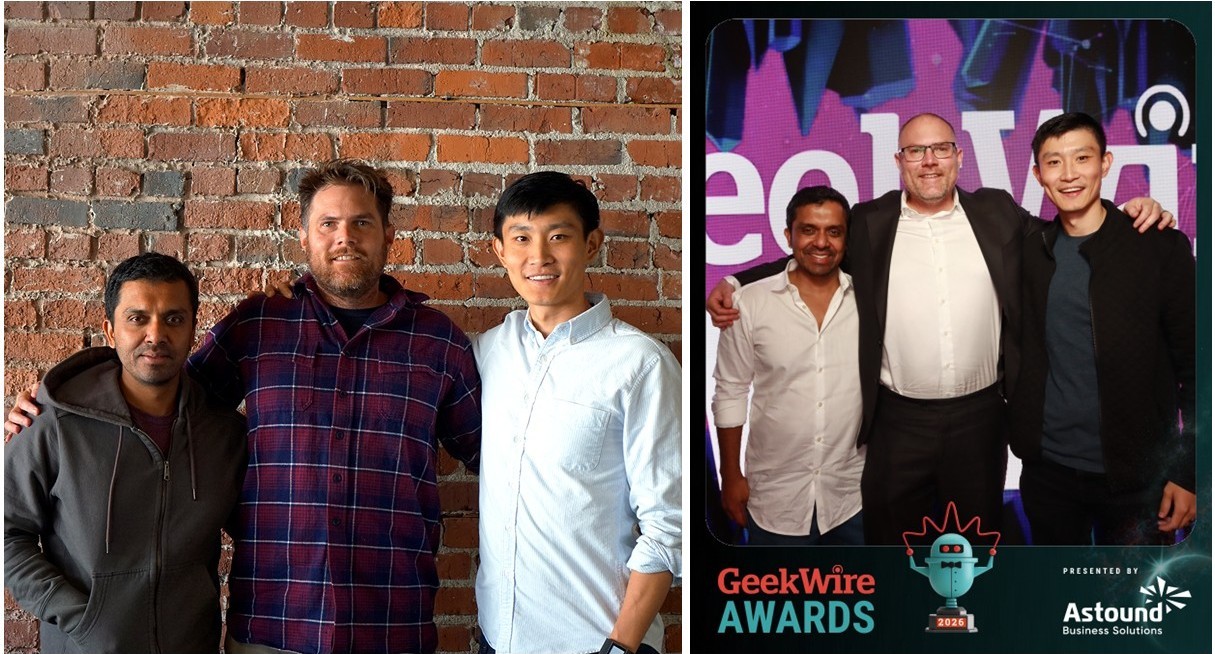
In the chaotic journey of building a startup, few sights are as deeply gratifying as a group of battle-tested co-founders reuniting to celebrate their survival and success. At the recent GeekWire Awards in Seattle, Tony Huang, Prasad Mahendra, and Tyler Conant stepped into a photo booth to recreate an image taken during their earliest days as scrappy entrepreneurs. The passing of time was visible, but so too was a profound sense of shared relief and triumph. These three founders, who originally honed their skills as colleagues at Axon, have guided Possible Finance through what CEO Tony Huang describes as a vivid “tale of three chapters.” It is a narrative archetype familiar to the startup ecosystem, featuring a spectacular rocket launch, a grueling survival test that brought the company to the edge of ruin, and ultimately, a resilient comeback story. Today, as the fintech firm experiences a dramatic renaissance, this chapter feels less like a corporate pivot and much more like a warm family reunion, marked by returning pathfinders, massive milestones, and a renewed sense of purpose.
To truly appreciate the scale of their current triumph, one must understand the deeply human mission that drives Possible Finance. The company was founded in 2017 to disrupt the notoriously predatory safe-havens of the payday lending industry. For millions of lower-income families living paycheck to paycheck, an unexpected car repair or medical bill can trigger a financial catastrophe. Traditional payday lenders prey on this vulnerability, offer loans that must be repaid in a single, high-interest lump sum on the borrower’s very next payday, and systematically hide these transactions from credit bureaus. This insidious design ensures that struggling consumers are trapped in an endless loop of high-interest debt with absolutely no mechanism to build their credit scores or escape poverty. Possible Finance completely rewrites this oppressive dynamic by offering micro-loans of up to $500 through an elegant, mobile-first app, completely bypassing the traditional FICO credit check system. Instead of relying on flawed, outdated credit scores, Possible harnesses advanced machine learning algortihms to analyze a user’s real-world bank transaction history, accurately assessing risk based on cash flow rather than historical failures. Crucially, the company permits borrowers to repay these debts in manageable, smaller installments over time and actively reports these successful repayments to major credit agencies, paving a real pathway out of poverty and helping everyday citizens build the credit scores they need to secure financial freedom.
However, even the most noble mission is not immune to the harsh realities of macroeconomic shifts and founder fallibility. Following its launch, Possible exploded out of the gate, riding a wave of astronomical growth that saw its revenue run rate surge to $44 million by the close of 2020. Then, the pandemic struck, throwing the global economy into chaos and exposing critical structural vulnerabilities within the startup’s operational blueprint. For two consecutive years, revenue stagnated at a stubborn $46 million, and the founders faced the agonizing, heartbreaking reality of laying off more than a third of their beloved workforce. Huang reflects on this period with extreme humility, acknowledging that as first-time founders, they had over-indexed heavily on flashy technology while ignoring the unglamorous, foundational pillars of risk containment and regulatory compliance. The company was trying to outrun basic economics with clever code, a mismatch that became fatal once the low-interest-rate venture capital era ended and took with it the easy funding that had previously masked operational deficiencies. While competitors folded or retreated into obscurity as capital dried up, Possible’s leadership chose to sober up and execute painful but necessary corrections, taking the time to fundamentally restructure their credit underwriting models and bringing in external financial experts to stabilize their fragile ship.
The salvation of the company lay in their willingness to restructure their executive ranks with seasoned professionals who could bridge the gap between financial discipline and innovative software design. This cultural and operational transformation is visible in the caliber of leaders they have recently recruited to steer the ship. Among the notable additions is Meghan Frazer, a lawyer-turned-human-resources leader who took over as chief people officer to nurture the company’s human capital. To navigate the complex regulatory waters, Possible secured Craig Anderson, former general counsel at Revolut, whose deep compliance expertise from stints at Klarna and Sezzle provided the startup with institutional safety. On the consumer-experience side, they brought on Jon David as chief product officer, a creative force who previously managed legendary gaming franchises like Plants vs. Zombies at Electronic Arts and served as CEO of Taunt. In perhaps the most telling sign of the company’s magnetic culture, Bobby McCarty, a former vice president of operations who had departed in 2021, chose to return as chief of staff. This leadership reconstruction was beautifully crowned by the return of co-founder Prasad Mahendra, who had left the company two years prior to test his mettle at another startup, but felt the irresistible pull of Possible’s new chapter, returning to spearhead the company’s ambitious artificial intelligence initiatives.
As the company’s executive brain trust came back together, the leadership team realized they also needed to rethink the physical space and physical connection of their workforce. During the height of the global pandemic, Possible had embraced a fully distributed, remote-first model, hiring exceptional talent across numerous countries and earning praise from its venture capitalists for possessing one of the best remote cultures in the industry. Yet, despite the external praise, Huang and his leadership team felt a growing friction behind the scenes, noting that remote operations required a heavy, stifling layer of administrative process just to keep teams mathematically aligned. This constant back-and-forth slowed down communication, diluted creative interactions, and stripped away the spontaneous magic of in-person collaboration. In a bold counter-cultural move, the company systematically pivoted back to a hybrid model, establishing a policy where employees work side-by-side in their Seattle offices three days a week, a transition so vital that key figures like CTO Tyler Conant and long-time CFO Harsha Srinivas actively relocated back to the Pacific Northwest to lead by example. To keep their remaining distributed employees engaged and connected, the company instituted “Possipalooza,” a vibrant, semi-annual physical gathering in Seattle where the entire international crew can bond, build trust, and align their shared vision under one roof.
This methodical return to operational maturity, balanced financial discipline, and deep physical connection has yielded jaw-dropping business results. Possible Finance’s revenue soared to $58 million in 2023, climbed to $79 million in 2024, and ultimately achieved an astonishing annualized revenue run rate of $125 million, crossing the $130 million mark shortly thereafter. More importantly, the startup recorded the very first annual profit in its entire history, an achievement that cements its transition from a speculative venture to a highly sustainable, robust financial institution. Backed by $55 million in equity funding from early champions like Axon CEO Rick Smith and Unlock Venture Partners, alongside institutional giants like Union Square Ventures, Canvas Ventures, and Euclidean Capital, the startup has earned prestigious nationwide acclaim. Now comfortably sitting at No. 93 on the GeekWire 200 list of top Pacific Northwest startups, and recognized as the sole Seattle-area representative on the highly coveted Forbes Fintech 50 list, Possible is pointing its newly stabilized ship toward the future. By investing heavily in proprietary artificial intelligence and machine learning models under Mahendra’s returning leadership, the team is set on democratizing financial services even further, demonstrating that with the right people, intellectual humility, and a relentless focus on the consumer, a startup can survive its worst storms to build something truly lasting.