





Here is a humanized and expanded summary of the content, crafted into six paragraphs.
—
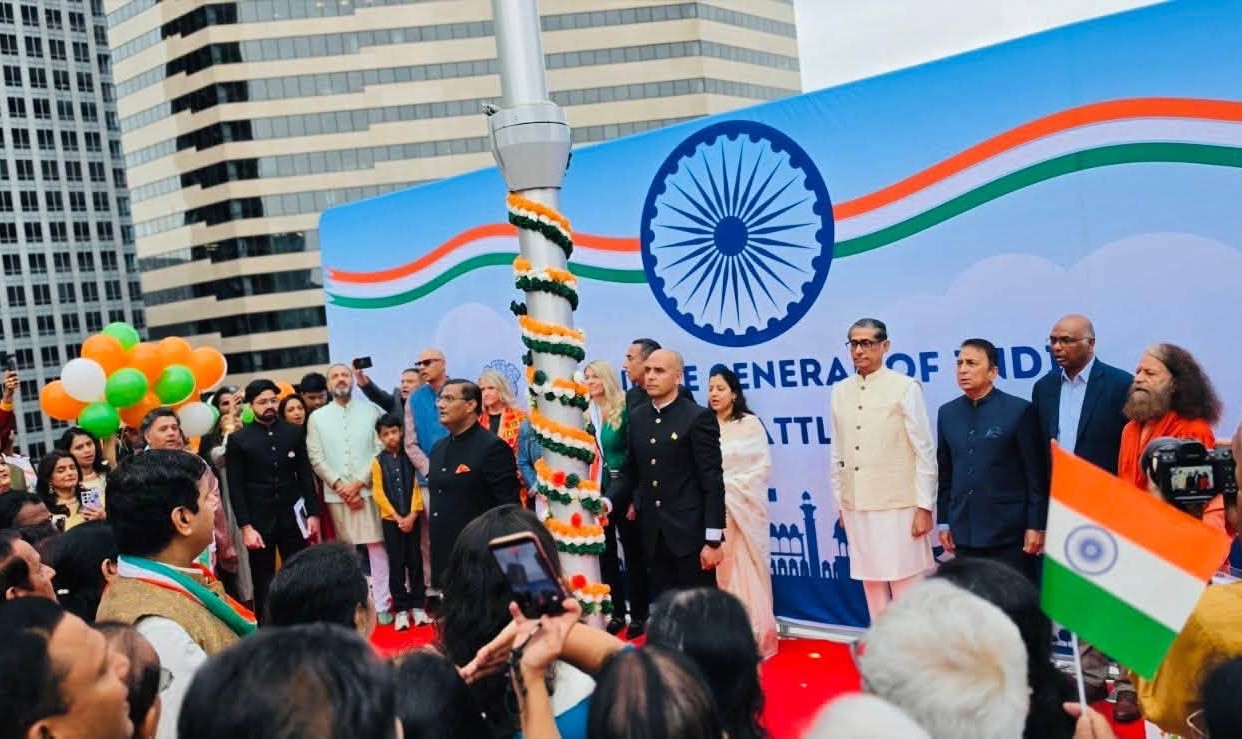
The morning sun cast a hopeful glow over downtown Seattle as a long, winding line of people snaked around the block, all waiting to enter a celebration at the Indian Consulate. This was the scene on August 15th, as the Indian American community gathered to mark India’s 80th Independence Day. For Consul General Prakash Gupta, the host, the sheer number of attendees – from tech CEOs to community members – was a testament to the community’s vitality. But beyond the flags and the speeches, the real story was not simply a celebration of a nation’s freedom from the past; it was the powerful, visible expression of a diasporic community’s immense success and growing influence in the Pacific Northwest, a story of mutual growth and partnership that is reshaping the region.
The most telling sign of this transformation was not the festivities themselves, but the constellation of political leaders who came to pay homage. Governor Bob Ferguson had declared August 15th as “India Day” across Washington State, while the mayors of Seattle, Bellevue, Kent, and SeaTac each signed their own proclamations. The King County Council, representing 39 cities, added its collective voice, and the region’s congressional representatives sent official messages. In person, state senators and a host of city council members from Redmond to Bothell to DuPont stood shoulder-to-shoulder with the Indian American community. This widespread political resonance was not a casual gesture; it was a acknowledgment that the Indian American community has become a central and deeply intersecting thread in the region’s civic, economic, and social landscape.
The driving force behind this goodwill is a key demographic shift that has made the community impossible to ignore. With 5.2 million Indian Americans constituting about 1.6% of the U.S. population, the numbers in the Pacific Northwest are particularly compelling, with over 100,000 in King County alone and roughly 200,000 statewide. In cities like Redmond and Kent, Indian Americans form a significant portion of the tax base, the school population, and the core of the local business network. This is the foundation of their new influence. They are not just residents but stakeholders, contributing to the vitality of their municipalities and the region’s broader prosperity. This economic embeddedness translated into political presence when their children enter the classrooms, their businesses create jobs, and their civic engagement strengthens the social fabric.
This momentum is a testament to a journey that has been building for decades but has risen to a new altitude. The same talent that once filled engineering teams and entry-level tech roles is now steering the region’s most prominent corporate and cultural institutions. Satya Nadella has steered Microsoft since 2014, Anand Eswaran has led the helm at Veeva, and Srini Gopalan has organised T-Mobile since 2025. This paradigm shift has generated a wave of success beyond typical corporate leadership into venture capital, through investors like the late S. “Soma” Somasegar, and into cultural ventures like the Seattle Orcas cricket franchise. This new wave of ascension is a natural evolution, moving from individual immigrant to a powerful, collective force that shapes national trends and public narratives.
The civic presence that emanates from this success is the natural next step for a community that now sees itself not just as sojourners but as builders and shapers of their adopted home. This is why we are seeing a record number of Indian-origin candidates being elected to local councils. The community, once focused on drilling into the tech sector, is now branching out, and this is where its true influence is making its final mark. The author’s own story mirrors this larger narrative: arriving in the U.S. two decades ago as an engineer, he built a career at tech giants and then successfully transitioned into a broader role, culminating in an elected position on the City Council of Medina, Washington. His journey is a microcosm of a greater shift—the Indian American community’s story moving past mere individual accomplishments to a collective, dynamic force that scales its impact across the main pillars of society.
In the 80 years since India’s independence, the narrative of its diaspora in Washington has evolved into a testament of resilience and mutual respect. It is a story that now shapes the leadership of our state’s most important companies, influences the culture through initiatives, and helps decide the direction of our cities. The governor’s proclamation and the well-known presence of local leaders are not just political posturing; they are a recognition that this partnership is a direct investment in a shared future of entrepreneurship and vibrant economic growth. The celebration of India’s Independence Day in the Pacific Northwest is no longer a mere holiday for that community; it is a regional event, symbolizing the power of diversity to strengthen the fabric of the region. The bond is not just celebrated; it is nurtured and proudly strengthened.