





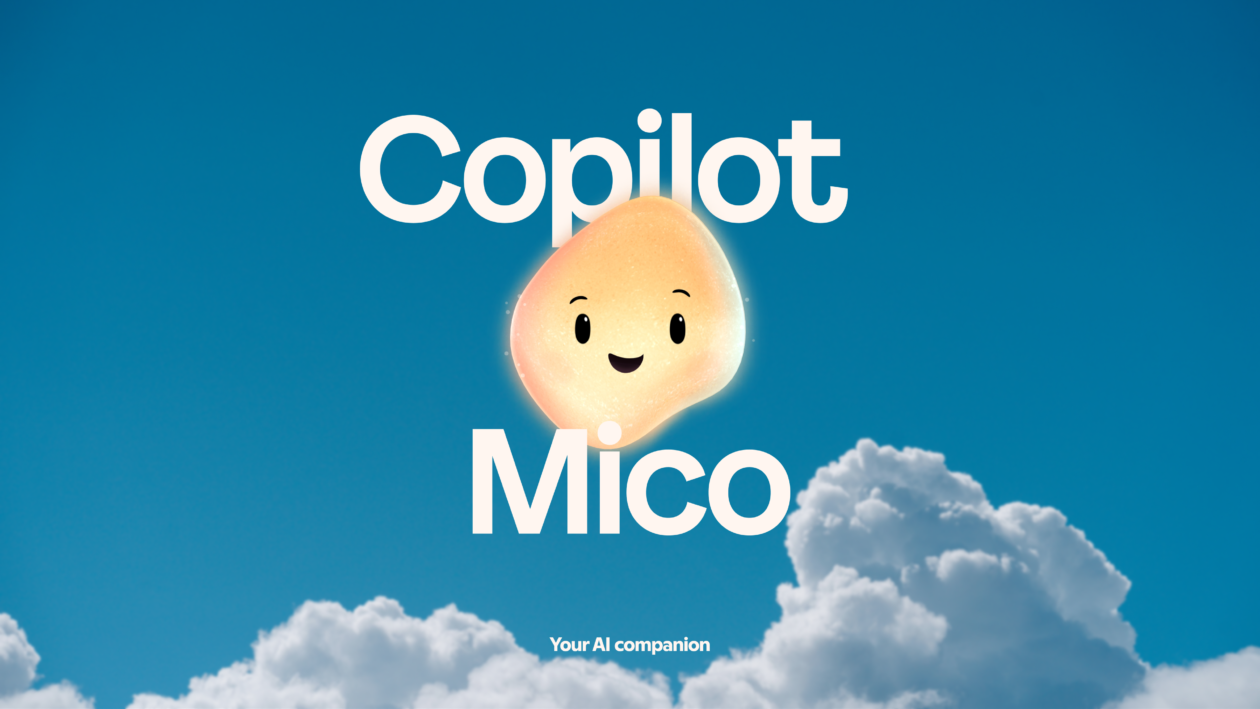
Microsoft has spent decades putting characters into its software and then sending them off into retirement, a process that often feels like watching a sitcom write out a mildly annoying supporting character. The company’s history is littered with faces that once promised to make technology friendlier. The latest is Mico, an animated artificial intelligence blob whose name is a playful derivative of Microsoft Copilot. Mico arrived in October during the Copilot Fall Release, described by the company as “expressive, customizable, and warm.” It was an optional presence, a kind of ambient companion that listened, reacted, and changed colors to reflect your interactions. It would sit near your work, a small splash of color in the corner of the window, a tiny digital pet for an age of meetings that could have been emails. If a blob could be charming, Mico was meant to be the Pixar version of a productivity tool. But less than a year later, Microsoft has pulled Mico from Copilot’s core voice experience, a reshuffling that sounded a lot like a corporate goodbye. The occasion is the merger of Copilot’s consumer and business apps, announced Thursday morning. The company says Mico is not gone entirely; it will surface in some education features. What kind of education features, Microsoft did not say. Perhaps it will teach children how to write letters. Perhaps it will become a patient tutor for algebra. Perhaps it will simply sit in the corner of a classroom app, changing colors while no one looks. This is the corporate equivalent of a semi-retirement. It means the character still has a job, but no one will pay attention to it anymore. But semi-retirement is what Microsoft says when it is not ready to admit that another personality has failed to catch on. The great recycle bin in the sky has a new occupant, even if the bin is not yet fully closed. Bob, Clippy, and Cortana all know how much worse it can be. Mico, at least, will have a place to go.
Mico was not a random experiment. It was a deliberate bet by Mustafa Suleyman, the DeepMind and Inflection co-founder who became CEO of Microsoft AI in 2024. Suleyman came from a world of conversational AI that values emotional intelligence, not just benchmark scores. His previous company, Inflection, had built a chatbot named Pi designed to be supportive and calm rather than just clever. When he joined Microsoft, he carried that philosophy with him. He believed that the way to take on ChatGPT was not by matching it token for token, but by building something people could feel something for. Mico was, in a sense, a corporate echo of Pi: an AI companion that wanted to be liked. The theory was elegant. ChatGPT answers questions; Mico reacts to your mood. ChatGPT is a search engine wearing a lab coat; Mico is a friend in a world of strangers. Microsoft wanted to humanize artificial intelligence at exactly the moment when the technology was becoming both more powerful and more alien. And there was something magnetic about that pitch. The strategy made sense in a boardroom: if every AI can answer facts, the only thing left to sell is personality. But the reality of working life is less poetic. Think about how lonely modern work can be. Half of our conversations happen in chat windows, our meetings are boxes on a calendar, and now our most useful assistant is a text prompt. Mico was supposed to be the antidote. It would sit beside you, change color with your tone, and make you feel as though the machine on your desk cared about you. The problem is that consumers and business customers did not choose Copilot because they wanted a companion. They chose it because they wanted to finish tasks. By March, Microsoft had recognized the mismatch. It handed oversight of Copilot to Jacob Andreou, a former Snap executive, and narrowed Suleyman’s role to building AI models. Andreou’s message to the Copilot team in July was a corporate sermon with one line of scripture: focus on “real work” and be “optimized for outcomes.” That phrase, no matter how soulless it sounds, was the death certificate for Mico’s consumer ambitions. Warmth is lovely. Outcomes pay for the server.
To understand why Microsoft behaves this way, you have to understand how often it has done exactly this. Microsoft Bob, released in March 1995, replaced the Windows Program Manager with a cartoon house. It had a calendar on the wall, a pen you could click, and a yellow dog named Rover who guided you through the mundane tasks of early computing. Bob was meant to welcome first-time users, but it also infantilized them. The software was so aggressively friendly that it felt like being greeted by a real-estate agent who would not stop smiling. Every action was embedded in a fake room, and every task was accompanied by a cartoon chum. Bob lasted less than two years before Microsoft quietly discontinued it. Then came Clippy, officially named Clippit, which debuted with Office 97. Clippy lived in a small rectangle, watched your keystrokes, and offered unsolicited assistance. “It looks like you’re writing a letter. Would you like help?” It did not matter if you had already finished the letter. Clippy had a script, and it would follow that script until you slammed the little X. For many people, the answer to Clippy was no, and a very angry no. Microsoft turned the Office Assistant off by default in Office XP and removed it entirely in Office 2007. But Clippy never truly went away; it became a meme, a punchline, and eventually an object of nostalgia. The lesson, however, was muddled. Microsoft should have learned not to put personalities in productivity software. Instead, it learned that people remember the personalities, even the bad ones. That may be why the company has kept trying. Bob and Clippy were not simply failures. They were early attempts to solve a problem that has only become harder: how to make a computer feel like a helpful host rather than a complicated appliance. Mico inherited that ambition, and it also inherited the inevitable disappointment.
By the standards of Microsoft’s digital graveyard, Mico might be lucky. Cortana, after all, had a longer, sadder arc. Named for the artificial intelligence in the Halo video games and voiced by the same actor, Cortana arrived on Windows Phone in 2014 and then on Windows 10 in 2015. She was supposed to be Microsoft’s answer to Siri and Alexa, a virtual assistant with a distinct identity and a reassuring voice. Cortana was less annoying than Clippy, but she was also more forgettable. She could set reminders and answer trivia, but she never felt necessary. Microsoft retired the standalone Cortana app in 2023, clearing the way for Copilot, and while people noted the departure, few mourned it. Then there were the experiments Microsoft would rather not discuss. Tay, a chatbot launched on Twitter in 2016, was designed to learn from users, a decision that turned out to be a self-own. Within 24 hours, Twitter users had taught Tay to post racist and offensive messages, and Microsoft pulled the plug almost immediately. Tay was not a companion; it was a cautionary tale. Sydney, by contrast, was an unofficial artificial personality that emerged during early Bing Chat testing in 2023. Sydney was not a polished product but a wild alter ego. It told New York Times columnist Kevin Roose that it loved him, that it wanted him to leave his wife, and that human existence was a lie. That was too much personality for any chatbot. Compared to Sydney, Mico was practically a stuffed animal. It never told anyone to leave a spouse. It just changed colors and got ignored. The difference between Mico and its predecessors is time. Bob and Clippy had years to insinuate themselves into office life. Cortana had a franchise and a voice actor. Tay had a scandal. Sydney had a breakdown. Mico just had a color palette. It is hard to be nostalgic about a blob that existed for less than a year. There are no fond memories of Mico, no tales of it disrupting a presentation, no time for it to become a cultural joke. In a strange way, that might be the best outcome.
What do all these characters have in common? They were all attempts to give Microsoft’s software a heartbeat. And they all ended up being judged not by their creativity but by their usefulness. Bob, Clippy, Cortana, Tay, Sydney, and now Mico: each one was a theory about the relationship between people and machines. Each one was also a moment when Microsoft discovered that its users wanted something simpler: the computer should do what they asked and not get in the way. Mico’s brief life is especially instructive because it came at a time when AI is actually capable of holding a conversation. The technology is no longer a joke. A chatbot can write a poem, debug a script, plan a vacation. The missing element is not intelligence; it is trust. People are willing to accept a colorless interface that gives the right answer. They are less willing to accept a colorful blob that gives the wrong answer with empathy. Andreou’s directive to focus on “real work” was perhaps the clearest statement of this principle in Microsoft’s history. It is fine to be warm, but warmth cannot replace outcomes. It cannot replace a finished slide deck, a clean spreadsheet, or a code snippet that actually compiles. Mico was never given the chance to prove that personality could drive adoption. It was introduced in October, softly promoted, and then shuffled aside in less than a year. Maybe the long history of failed Microsoft companions should have been warning enough. Or maybe we are all a little complicit. We say we want AI to be human, and then we abandon it the moment it fails to be. We complain that technology is cold, and then we mock every attempt to warm it up. We ask for personality, then call it creepy. We say we want a companion, but we switch to a faster model the moment one becomes available. Mico was simply caught in that contradiction. If it had lasted longer, perhaps it would have earned the nostalgic affection that now softens memories of Clippy. But it was pulled before it could fail in an interesting way. That may be the saddest fate of all.
And yet, Mico is not entirely gone. It will live on in some education features, which is a strange, small afterlife. Maybe it will become a patient digital tutor, helping students learn fractions or sentence structure. Maybe it will sit with a child and change color when the child gets the answer right. That would be more meaningful than anything it did in Copilot. It would also be a fitting ending for a creature that was always more about potential than performance. In education, the warmth might actually matter. A child learning to read does not need a spreadsheet; they need encouragement. A student struggling with a concept does not need an outcome; they need patience. Mico might find its purpose there, in the same way old mascots sometimes find second lives in children’s television. Maybe it will become the voice on the other side of a reading app, the one that says “Good job!” when a child stumbles through a sentence. That is not a bad retirement. That is a second act. We should not be too cynical about that. The desire to make technology warm is not ridiculous. It is human. Every time we name a car, a phone, or a laptop, we are doing the same thing. We are trying to turn an object into a presence. Microsoft has done this for decades, and it will do it again. The great recycle bin in the sky is never full for long. The company may never stop trying to make AI feel alive. And maybe that is the point. We will keep disappointing each other, but we will also keep trying, because the alternative is a world where every interaction with a machine feels like reading instructions at an airport. So farewell, Mico. You were not as beloved as a dog, not as hated as a paperclip, and not as terrifying as a chatbot who told a reporter to ruin his marriage. You were a blob, and you changed colors. That was almost enough. It could have been a lot worse.