





When Stanford University recently released its highly anticipated 2026 AI Index—widely acclaimed as the global technology sector’s most rigorous, objective, and exhaustive annual physical examination—it offered an incredibly detailed, four-hundred-page portrait of a world in the midst of an unprecedented digital epoch. This monumental data-driven research effort, which carefully monitors everything from raw computational benchmarks and venture capital trends to job market disruptions, environmental burdens, public opinions, and geopolitical friction points, has established an unmatched standard for tracking the real-world trajectories of machine intelligence. While the vast majority of the index’s twelve headline takeaways do nothing more than confirm the trends we have long suspected—such as exponential jumps in raw performance, a tidal wave of corporate funding, and the rapid closing of the geopolitical gap between Eastern and Western developers—one specific dataset caught the industry completely off guard. It was a statistical finding that challenged our deepest assumptions about technological waves, revealing a profound and deeply human paradox: the country currently leading the global frontier of artificial intelligence development is not the country leading its actual daily integration and adoption. By diving deep into this striking division, the index shines a bright light on a growing chasm between those who build the future and those who are willing to live in it, exposing how the United States has successfully engineered a technological masterpiece that its own populace is remarkably hesitant to use. This central tension highlights that while the supply side of the artificial intelligence boom is progressing at a breakneck, almost terrifying pace, the demand side is running headfirst into a complex web of cultural anxiety, regulatory skepticism, and domestic hesitation that is reshaping the global playing field.
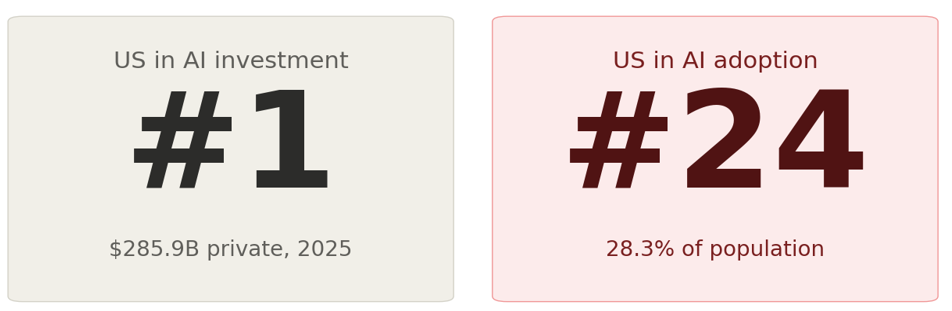
This unexpected trend becomes starkly apparent when analyzing the index’s global adoption metrics, which meticulously track the portion of a nation’s citizenry actively utilizing generative artificial intelligence tools across more than two dozen major economies in the latter half of 2025. The global leaders occupying the top of this list are far from the usual suspects, with the United Arab Emirates claiming the absolute gold medal with an astonishing 64% adoption rate, followed intensely by Singapore at 61%, while European powerhouses like Norway, Ireland, and France proudly secure the remaining top spots. On a macroeconomic level, there is a clear, statistically vibrant correlation between high gross domestic product per capita and the rapid societal deployment of these advanced software utilities; logically, wealthier nations possess the robust computational infrastructure, high-speed connectivity, and modern knowledge-worker economies that are perfectly primed to capitalize on cognitive-automation programs. Yet, this highly intuitive economic model breaks down spectacularly when applied directly to the United States of America. Rather than standing shoulder-to-shoulder with other wealthy, tech-forward nations at the summit of the hierarchy, the United States languishes in a highly disappointing 24th place, recording a meager 28.3% adoption rate that places it just barely ahead of the Czech Republic. When visually depicted on Stanford’s comparative GDP-to-adoption scatterplot, the American superpower sits a staggering thirteen points below the regression trend line, representing the largest negative adoption-to-wealth gap of any highly developed country on Earth. What makes this domestic deficit so incredibly baffling is that it cannot be excused by physical, regulatory, or economic obstacles; American citizens have instantaneous, unrestricted, and overwhelmingly free access to the world’s most capable foundation models on the exact same days they are launched, meaning this widespread underutilization is not a matter of systemic exclusion, but rather a collective, deliberate hesitation.
The irony of this adoption gap becomes even more glaring when we contrast it against the sheer, overwhelming magnitude of American investment and intellectual supremacy on the production side of the equation. In 2025, private capital pouring into artificial intelligence developments within the United States reached an extraordinary, record-shattering $285.9 billion—a massive fiscal commitment that represents more than twenty-three times the private investment of China and comfortably eclipses the total investments of the rest of the civilized world combined. Even with highly concerning administrative obstacles, such as an 89% plunge in elite international AI research talent migrating to the country over the last eight years, the United States continues to host a vastly superior volume of pioneering engineers and researchers than any rival state. However, this relentless drive to engineer raw computational power is generating a parallel track of deep, systemic anxieties that are beginning to worry policy makers, beginning with the staggering physical resources these virtual intellects demand. Instantiating, training, and running queries on these massive foundation models requires a jaw-dropping amount of raw electrical power; training a single state-of-the-art model such as Grok 4 released an estimated 72,816 tons of carbon dioxide into our fragile atmosphere, an environmental toll equivalent to operating 17,000 fuel-burning passenger cars for an entire year. With the global network of dedicated data centers now drawing a cumulative 29.6 gigawatts of electrical capacity—roughly equivalent to the entire electrical infrastructure of New York State humming at peak summer capacity—the sheer carbon and resource-guzzling footprint of this industry is forcing many citizens to wonder if the ecological consequences of this technological race outweigh its benefits.
These physical and environmental anxieties are compounding a host of alarming geopolitical, economic, and institutional warning signs that the Stanford Index details with sobering clarity. Geopolitically, the long-held assumption of permanent Western dominance has been thoroughly shattered, as the performance gap between top-tier American and Chinese AI models has dramatically narrowed to a paper-thin 2.7 percentage points, with Beijing asserting dominant leadership in raw scientific publication volume, industrial patent filings, and the deployment of physical factory-floor robotics. Back home, this intense competition is translating into severe labor-market friction, particularly visible in the devastating “entry-level squeeze” where the employment of young software developers aged 22 to 25 has plummeted by nearly 20% from its 2022 peak, leaving a generation of newly minted tech graduates standardly locked out of the workforce. To make matters worse, this volatile labor climate is unfolding alongside an unprecedented collapse in corporate transparency, with the Foundation Model Transparency Index documenting a steep drop in average developer accountability scores from 58 down to a secretive 40 in a single year, proving that as these systems become more commercialized and integrated, the companies building them are choosing to lock away crucial details regarding training datasets and algorithmic biases. Meanwhile, a profound institutional lag is occurring within our educational systems; while an impressive four out of five high school and college students now routinely utilize generative tools to manage their schoolwork, half of all middle and secondary schools across the country possess no official usage policies, and a microscopic 6% of educators report having clear guidelines from their administrations, creating an unregulated Wild West in classrooms.
Yet, despite the undeniable shadow of these societal challenges, the Stanford report also offers highly illuminating rays of hope, presenting a stunning catalog of technical milestones and concrete human advantages that highlight the sheer promise of computational evolution. Historically, frontier artificial intelligence models have achieved and often surpassed human-level capabilities on complex, highly specialized milestones, including doctoral-level scientific challenges, advanced competitive mathematics, and complex multi-layered environments, while the successful threat-detection and defense rate of autonomous digital agents navigating critical cyber-security frameworks rocketed from a vulnerable 15% in 2024 to an incredible 93% in 2025. This rapid intellectual ascent is backed by a global economic commitment of corporate capital that topped $581.7 billion in 2025—a massive 130% year-on-year surge that has seen generative applications capture almost half of all venture-capital resources. Beyond commercial application, these cognitive engines are directly fueling a magnificent renaissance across the natural, life, and physical sciences, with AI-driven scientific papers increasing by over a quarter as researchers successfully built the world’s first end-to-end, machine-learning-powered meteorological forecasting pipeline alongside groundbreaking foundational models tailored to decode the vast mysteries of astronomy. Most profoundly, in the vital arena of clinical healthcare, the widespread integration of advanced clinical-note generation software has successfully slashed the administrative writing time required of weary practitioners by an incredible 83% across multiple major hospital networks, a life-saving development that directly shifts hundreds of hours away from tedious screen-time and returns them to close, compassionate, face-to-face patient interactions.
Ultimately, the true significance of the Stanford 2026 AI Index lies not in its raw statistics, but in the profound human story it reveals about our complex, deeply anxious relationship with the tools we create, highlighting a severe “diffusion gap” that suggests technological leadership does not automatically translate into societal acceptance. While the report itself refrains from definitively diagnosing why the United States suffers from such a massive adoption deficit, the adjacent cultural metrics tell a vivid story of a society grappling with a profound crisis of institutional and psychological trust. In stark contrast to the citizens of the United Arab Emirates or Singapore, who overwhelmingly view modern machine learning as a collaborative, highly empowering, and patriotic vehicle for economic progression, only 33% of working-class Americans expect these technologies to improve their daily job experiences, and an incredibly low 31% trust their state and national governments to safely and effectively regulate its development. This pervasive American skepticism is deep-seated, fueled by a justifiable fear of corporate-driven labor displacement, a systemic weariness toward opaque monopolistic tech firms, and a historic lack of reliable federal regulatory oversight. This situation represents an incredibly ironic, poignant tragedy of modern innovation: the very culture that dreamed up, financed, and birthed the modern era of synthetic intelligence has retreated furthest from its practical utility, paralyzed by the fear that their own creations will render them obsolete. As the global digital race accelerates, this historic mismatch serves as a crucial warning to developers and policymakers alike, emphasizing that raw technical supremacy is entirely meaningless if a society fails to cultivate the foundational trust, economic safety nets, and shared human optimism necessary to actually welcome these tools into their daily domestic lives.