





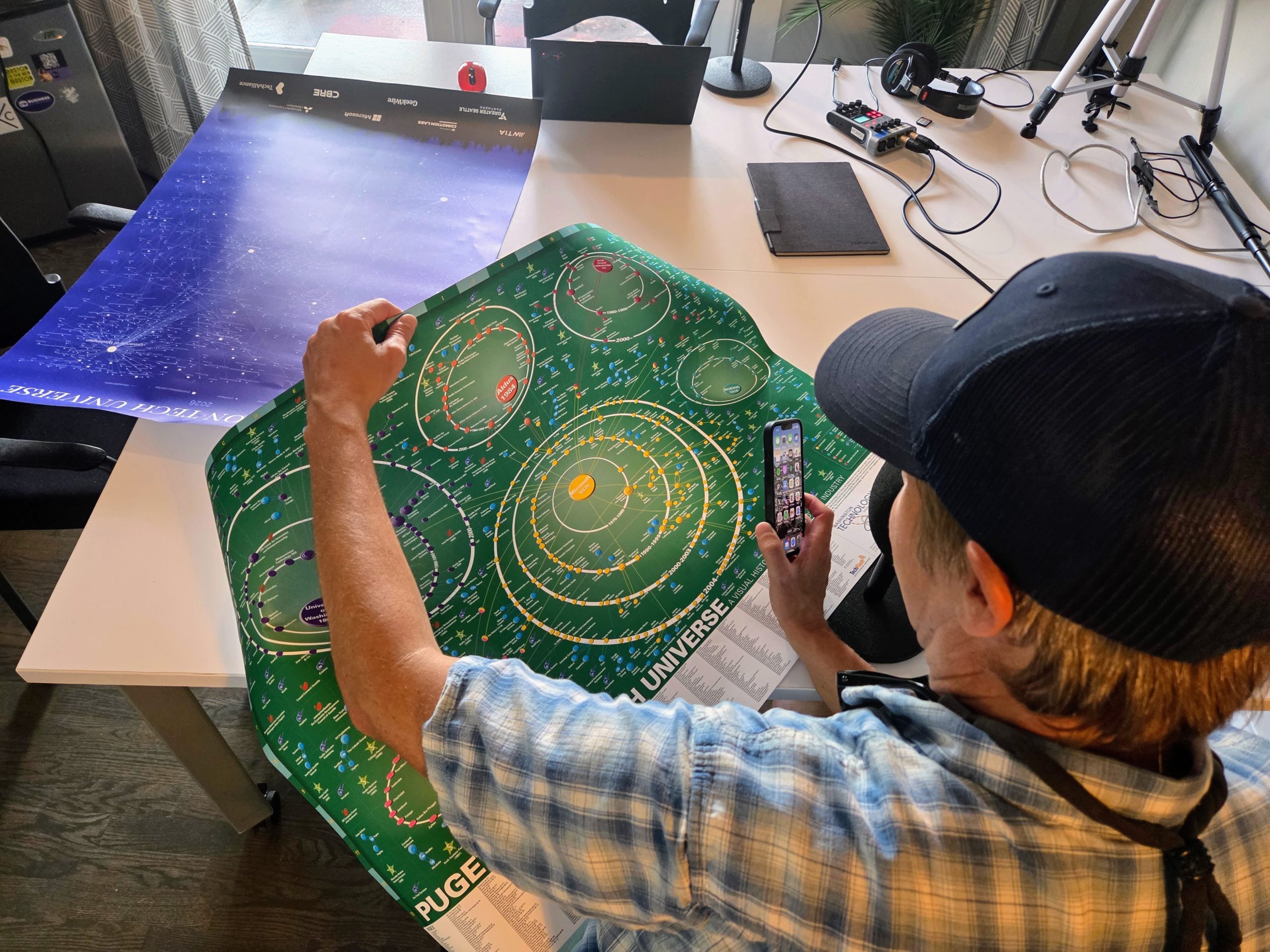
In the quiet, ambient warmth of the GeekWire recording studio, hosts John Cook and Todd Bishop found themselves physically and intellectually suspended between two vastly different eras of human ingenuity, staring down at giant, beautifully illustrated paper cartographies of regional ambition. Spread across the large studio table were two distinct iterations of the Washington Tech Universe map—one originating from the optimistic, pre-smartphone dawn of 2009, and the other representing the sprawling, hyper-connected, and highly complex reality of 2026. This physical juxtaposition of paper charts served as the perfect visual and emotional centerpiece for an episode dedicated to tracing the invisible, winding threads that connect yesterday’s boldest dreams to today’s commercial realities. There is a deeply human instinct behind mapping our achievements; these physical posters, meticulously designed and updated by the Washington Technology Industry Association (WTIA), are far more than mere corporate directories, marketing tools, or graphic design projects. Instead, they act as living, breathing family trees that track the migration of engineering talent, the transfer of intellectual property, and the radioactive fallout of high-stakes venture capital. As Cook gently traced his fingers along the faded lines and forgotten logos of the 2009 original, it became clear how much of our modern global infrastructure was coded, tested, and imagined right here in the rain-slicked corridors of the Pacific Northwest. The contrast between these two documents highlights a profound geographic and cultural transition: a region once primarily defined by desktop software licensing and commercial aviation has morphed into a global command center for cloud computing, artificial intelligence, and orbital engineering. To look at these maps side-by-side is to realize that the massive corporate empires dominating our lives today did not emerge from a vacuum; they were built directly upon the foundations, and sometimes the spectacular bankruptcies, of the eccentric pioneers who came before them, proving that the story of technology is never just about silicon and code, but rather a deeply collaborative, messy, and intensely human drama unfolding over decades of shared effort.
This striking evolution from local software development to global space-based infrastructure was brought into sharp, contemporary focus by the week’s headline-grabbing financial milestone: SpaceX’s historic first earnings call as a newly minted public company. For many years, the aerospace giant operated behind the closed doors of private venture capital, shielded from the relentless scrutiny of Wall Street, but its recent transition to the public markets has pulled back the curtain on a commercial enterprise of unprecedented scale and ambition. During the highly anticipated call, Elon Musk laid out a breathtaking vision for global connectivity, boldly claiming that Starlink—SpaceX’s rapidly expanding satellite internet constellation—is on track to deliver the vast majority of all global internet traffic within the next decade. What makes this staggering cosmic vision intensely local to the Pacific Northwest is its manufacturing and engineering heartbeat located in Redmond, Washington. It is here, just miles away from Microsoft’s sprawling corporate campus and Nintendo’s American headquarters, that thousands of highly skilled technicians and aerospace engineers are quietly mass-producing the very hardware currently orbiting miles above our heads. This Redmond facility has silently catalyzed a dramatic shift in the local technology labor market, blending traditional software development with high-stakes aerospace engineering. For the average consumer, internet access is often taken for granted as an invisible utility that simply exists in the air, but the public financial disclosures of SpaceX serve as a stark reminder of the immense human labor, physical capital, and manufacturing prowess required to sustain this orbital net. The transition of SpaceX to a public entity means that regular investors now have a direct financial stake in this orbital frontier, forever tying the retirement portfolios of everyday citizens to the machinery crafted in Washington state, further cementing the region’s status as the undisputed capital of the modern space economy. This public transparency allows us to appreciate the human faces behind the machinery—the factory workers, the quality control specialists, and the logistics teams who turn raw silicon and aluminum into a constellation capable of bridging the digital divide for rural school children and remote communities around the globe.
Never one to mince words or shy away from a public confrontation, Musk used the earnings call to size up his local neighbors and competitors, specifically targeting the cloud-computing empires of Microsoft and Amazon. In a characteristically provocative remark that sent ripples through the tech community, Musk dismissed the complexity of building terrestrial data centers—the very backbone of the modern internet and the source of trillions of dollars in market valuation for Redmond-based Microsoft and Seattle-based Amazon—as a trivial engineering problem when compared to the monumental challenge of creating fully reusable orbital rocket systems. This rhetorical hand-grenade highlights the growing ideological and physical rivalry between the ground-based cloud giants and the space-based innovators. While Microsoft’s Azure and Amazon’s Web Services (AWS) have spent the last two decades constructing massive, energy-hungry concrete fortresses of servers across the globe to house humanity’s data, SpaceX is betting that the ultimate high ground lies in the stars. Yet, this rivalry is far more cooperative and nuanced than Musk’s bravado suggests, as these orbital networks still rely heavily on terrestrial cloud infrastructure to route, process, and secure the massive torrents of data beamed down from space. Furthermore, Amazon is actively preparing its own counteroffensive with Project Kuiper, a competing satellite internet constellation that aims to challenge Starlink’s dominance and is being designed by engineers based in the Seattle area. This friction between ground and sky represents a fascinating philosophical debate about the future of human infrastructure: is our digital destiny anchored to the physical soil and deep-sea cables of our planet, or will it be liberated by a network of autonomous, reusable machines dancing in the cold vacuum of space? The engineers working on both sides of this divide in the Seattle area find themselves at the center of this conceptual war, proving that even the most abstract technological rivalries are fought on the ground by real people writing code, arguing in meeting rooms, and turning wrenches.
Shifting their attention back to the physical artifacts laid out in the studio, Cook and Bishop dived deep into the nostalgic rabbit hole of the 2009 Washington Tech Universe map, uncovering several historical gems that reveal the surprising, non-linear ancestry of today’s digital landscape. Among the most fascinating discoveries was an unlikely corporate connection between the aerospace monolith Boeing and Classmates.com, an early social networking pioneer founded in 1995. Long before Facebook became a ubiquitous global utility, a political battleground, and a multi-billion-dollar empire, Classmates.com was helping millions of early web users navigate the novelty of digital nostalgia by reconnecting them with long-lost high school friends and military colleagues. The 2009 map illustrated how Boeing, a company traditionally associated with heavy metal, commercial aviation, and defense contracting, served as an unexpected incubator and financial backer for these early consumer internet endeavors, highlighting how deeply intertwined the region’s industrial and digital DNA has always been. This historical connection reminds us of a bygone era when the boundaries of the technology sector were still fluid and undefined, when traditional industrial titans were eagerly experimenting with the wild, lawless frontier of the early World Wide Web to see what might stick. Exploring these old connections brings back a profound sense of wonder about the trial-and-error nature of innovation, where corporate family trees reveal that ideas which seem completely disconnected today were once part of the same experimental portfolio. It humanizes the monolithic tech industry by showing that our current social platforms did not simply spring forth fully formed from Silicon Valley; rather, they were prefigured by quirky, localized projects funded by aerospace executives and mid-career engineers who were simply trying to figure out how this new medium could bring people closer together. This reveals a beautiful, cyclical human truth: even in the early days of the web, when bandwidth was slow and the interface was clunky, our primary instinct as human beings was to use this new technology to reach backward in time, seeking out the comforting faces of our youth through digital directories.
Perhaps the most poetic and instructive connection unearthed from the faded lines of the 2009 map was the ghost of Teledesic, a legendary but ultimately ill-fated venture from the mid-1990s that serves as the direct spiritual ancestor to today’s Starlink. Conceived by visionary wireless pioneer Craig McCaw and backed by massive personal investments from Microsoft co-founder Bill Gates and industrialist cellphone pioneers, Teledesic set out with the incredibly ambitious goal of launching a constellation of hundreds of low-Earth orbit satellites to beam high-speed, broadband internet to every forgotten corner of the globe. At the height of the dot-com bubble, the project was enthusiastically hailed as the “Internet in the Sky,” capturing the imagination of a generation of futurists who believed that terrestrial copper and fiber-optic cables would soon be rendered obsolete by orbital arrays. However, the physical and economic realities of the late 1990s were simply not mature enough to sustain such a colossal undertaking; launch costs were astronomically high, satellite manufacturing remained a slow and artisanal craft, and the venture eventually collapsed under the weight of its own premature ambitions, leaving behind a dramatic cautionary tale of technological overreach. Today, as Starlink successfully routes live internet traffic to millions of users worldwide from its Redmond-built constellation, the parallel to Teledesic looms large, illustrating a comforting truth about human progress: visionary ideas rarely fail because they are conceptually flawed, but rather because the physical ecosystem hasn’t yet caught up to the dreamers. The architectural blueprint laid out by Craig McCaw and Bill Gates decades ago is finally being executed in the very same region by a new generation of engineers, proving that true innovation is a continuous, multi-generational relay race where the baton of progress is passed through decades of public failure and quiet perseverance. This cyclical nature of tech shows that no failure is truly final; rather, each failed project leaves behind a blueprint, a set of lessons, and a cohort of experienced professionals who go on to build the next successful iteration, showing how failure is a necessary stepping stone toward humanity’s greatest achievements.
To round out this rich exploration of tech history and future horizons, the episode marked the triumphant return of the GeekWire Trivia Challenge, offering listeners a playful, intellectually stimulating puzzle focused on the early origins of search giant Google. This segment, expertly edited and produced by Curt Milton, injected a lighthearted, communal energy into the show, reminding the audience that for all the talk of multi-billion-dollar IPOs, satellite constellations, and global corporate rivalries, the tech community is ultimately built on a shared sense of curiosity, playfulness, and intellectual sport. The trivia question served as a perfect bridge between the macro-narratives of global dominance and the micro-moments of individual human curiosity that spark great inventions, prompting listeners to reflect on how a simple academic research project at Stanford eventually transformed into the cognitive utility of modern human life. As the podcast episode drew to a close, the visual of John Cook and Todd Bishop standing over those two tech universe maps remained a powerful image of reflection. It underscored the truth that while the names, logos, and specific corporate entities on the map will inevitably change, shift, and fade over the next seventeen years, the underlying human spirit of exploration—whether it is connecting old high school classmates, building massive cloud networks on earth, or launching rockets into the heavens—remains the true, unchanging constant of the Washington technology ecosystem. It is this human drive, fueled by a relentless desire to solve the impossible and map the unknown, that will continue to write the next chapters of our shared tech universe, ensuring that the maps of tomorrow will be even more breathtaking than the ones we hold in our hands today. As listeners tune in from their cars, offices, or laboratory benches, they are reminded that they are not just observers of this tech universe, but active participants in its ongoing creation. Whether writing a line of code or designing a satellite bracket, each individual is adding a coordinate to the next map, proving that the future is not something that simply happens to us, but something we actively build, draft, and color together as a community.