




Imagine you own a small café. The coffee machine hisses, regulars settle into their usual chairs, and a carefully chosen playlist drifts through the room. You picked those songs because they make people feel comfortable, maybe a little nostalgic, maybe a little more willing to order another coffee. You probably never think about who owns the rights to those songs. Then one morning a letter arrives—from ASCAP or BMI—demanding proof that you have a commercial music license. If you don’t, you could owe thousands of dollars, and the fines can range from $750 to $150,000 for a single song. This is the murky, high-stakes reality that thousands of small business owners face whenever they stream background music. John Boyle wants to make that fear disappear. Boyle, who lives in Kirkland, Washington, spent years working in the background-music industry, most recently as vice president of digital marketing and e-commerce at Mood Media, the company once known as Muzak. Last September, he left the corporate world. He could have hired a team, but the hiring market was tight and the old way felt slow. Instead, he decided to test a question that sounds like science fiction: how far can one founder get by building a business with AI? The answer is Music for Business Finder, a free platform that acts like an “Expedia for business music.” It lets owners compare legal streaming options, calculate compliance requirements, and find their way out of the licensing fog. Boyle built it essentially alone, with a team of bots. And he hopes it proves something big about the future of startups.
Boyle’s path to this experiment was not a typical startup story. Before striking out on his own, he worked for Expedia and GoDaddy, leading digital marketing and e-commerce efforts. At Mood Media, he got an inside look at how music licensing works—and how easily small business owners get lost in it. Commercial music is a sprawling business. Big players provide legal background music to stores, restaurants, and offices; performance rights organizations collect fees for songwriters; and small businesses are caught in between, often with no guide. Boyle saw that pain firsthand. When he left last September, he didn’t want to raise money or wait for a product team to organize around him. He had watched how slow a large company could be: a good idea would sit at the bottom of a queue for months while engineers were pulled in other directions. “If that was something I pitched at a big company and I needed engineers to do it, it would probably sit at the bottom of the queue for months, and I built it in a day,” he says. That single-day build was the start of Music for Business Finder. He calls himself a one-man-plus-AI band. The phrase sounds playful, but it describes a serious experiment in how work will get done. Boyle’s technical skills, combined with a suite of AI assistants, allowed him to design, code, launch, and market a product that would once have required a small team. For him, the platform is not just a business. It’s a test of what one person can do with the right tools—and a reminder that the barrier to starting something has fallen dramatically.
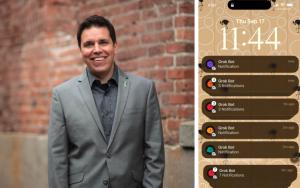
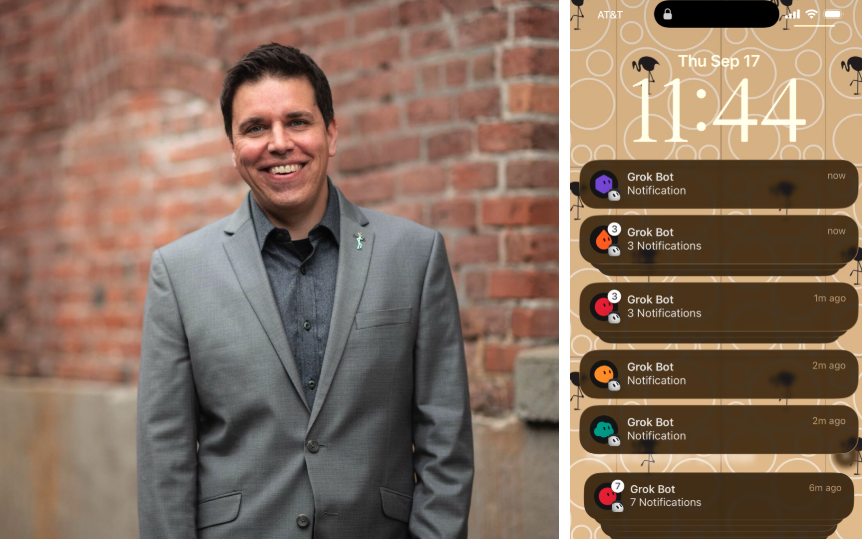
Under the hood, Music for Business Finder is an AI-heavy operation. Boyle used a combination of models, including Gemini and Claude, plus autonomous agents, to build various parts of the platform. These tools handled the front-end development, the backend architecture, the graphic design, the SEO, and even automated email marketing. What would have required a four-person team was cracked by machines and one coordinator. He also configured an autonomous analytics bot on a platform called Grokbot, running on a dedicated cloud computer around the clock. That bot watches anonymous user sessions, spots friction points in the user experience, and recommends improvements. It is, essentially, a product manager that never sleeps. Boyle describes the arrangement with a kind of calm wonder: “The barrier to create something or start something or try something is so low now. It’s going to be probably one person with a team of bots, and that person coordinates it all through that system.” That coordination is key. The AI doesn’t replace the judgment he acquired through years in the industry; it extends it. He decides what matters, and the bots handle the exhausting execution. The result is a free, polished service that launched in January and has been quietly helping small business owners navigate one of the least friendly corners of the business world. For a former corporate executive, running a company this way may seem unusual. But the proof is in the product: the platform looks like it was built by a startup with a comfortable payroll, not by a founder working from home with a stack of AI tools and a phone full of bot notifications.
The heart of the site is its music licensing checker. A restaurant owner, for example, can answer a few questions about how they use music: whether they play background tracks, host live music, or run karaoke nights. They enter details about their venue, their current music setup, and the number of locations they operate. In seconds, the tool produces a customized compliance checklist, including direct links to commercial streaming platforms and performance rights organizations like ASCAP and BMI. It translates legal jargon into practical next steps. The site also includes a dedicated section with real-world enforcement cases and lawsuits against bars, restaurants, and shops across the country. That section makes the consequences concrete: one business sued, another fined, a local venue learning a hard lesson about public performance rights. Boyle doesn’t use these stories to scare people. He uses them to educate and to show that the path to compliance is actually simple once you know it. The platform’s utility has not gone unnoticed. Since launching in January, traffic has grown 308 percent. Commercial music providers have noticed, too. The site has partnerships with Soundtrack Your Brand, Jukeboxy, and SoundMachine, and Boyle monetizes through affiliate and partner relationships. But he maintains an unbiased catalog of all major background music providers, because his credibility depends on giving small business owners the truth, not just the partners who pay him. The balance is delicate. He wants the platform to be free, useful, and trustworthy—and still pay for itself. Early signs suggest it can. More importantly, the growth shows that small business owners are hungry for plain-English answers about licensing. They don’t need to know every legal precedent; they need someone to point them in the right direction.
For Boyle, Music for Business Finder is also a laboratory for the future of work. He still manages partner deals and strategy, the human side of the business that requires relationships, negotiation, and long-term vision. But his AI bots remain on the clock 24/7, monitoring site performance, watching for breakdowns, and tweaking the user experience. It’s a collaboration, not a replacement. Boyle believes the frameworks he has built with these AI agents are a blueprint for how larger organizations will operate in the near future. The idea challenges assumptions about how companies are built. For decades, launching a serious product meant hiring engineers, designers, marketers, and operations people. Boyle shows what can happen when one person with deep domain expertise orchestrates a team of digital assistants. He isn’t saying human collaboration disappears; he is saying that the cost and friction of starting something are falling so fast that staying in a big company may no longer be the only way to get big things done. The same tools that let a solo founder build an “Expedia for business music” could help a small non-profit build fundraising software, or help a retired nurse create a patient-education app. The pattern is the same: human knowledge plus an army of well-directed AI agents. Boyle’s work is a proof-of-concept, but it’s also a prompt. When the barrier to trying something is low, the number of people who will try something goes up. That might mean more startups, more experiments, more creative solutions to niche problems like music licensing. And it might mean that the next big company begins not in a startup incubator or an executive’s side project, but as one person sitting at a kitchen table, teaching a bot how to build.
In the end, Boyle is quick to bring the story back to what he actually set out to do. “The goal was to test how far I could take this on my own,” he says. “It’s been a blast running it, but more than anything, it proves what’s possible when you pair human domain expertise with a team of bots.” The words are soft-spoken, but the experiment is loud. Music for Business Finder may be a small platform in a niche industry, but it stands at the crossroads of two enormous forces: the anxiety of everyday entrepreneurs and the arrival of practical, accessible AI. For a café owner who has been too afraid to play music because of licensing threats, the platform offers something more valuable than legal nomenclature—it offers confidence. For a former executive who left a comfortable job, it offers a new kind of career: one where a person can be a company, with all the support they need flowing through a phone screen. Boyle’s startup is not about making every business owner a developer, nor about replacing human workers with machines. It is about clearing the path between a good idea and a real product. That barrier has dropped dramatically in just a few years, and Boyle’s story shows what can happen when someone walks through that opening. The music licensing checker might be the first act. But the principle—that one person, a strong sense of mission, and a team of bots can make a genuine difference—might be the lasting melody. For small business owners, and for everyone who has ever wanted to build something alone, that is music to their ears.