



Julien Clayton never imagined his journey from underwater engineering to sparking civic revolutions. Born and raised in Houston, Texas, he pursued nuclear engineering at Texas A&M, where the thrill of complex systems and precision ignited his passion for innovation. For six years after graduation, he worked at General Dynamics Electric Boat in Connecticut, diving deep into the world of propulsion systems for Navy submarines. Immersed in the high-stakes environment of engineering classified machinery, Julien honed skills that demanded meticulous attention to detail and problem-solving under pressure. But life had a pivot in store. Eager to broaden his horizons, he pursued an MBA at Harvard Business School, where the blend of technical know-how and strategic thinking opened new doors. The adventure didn’t stop there; he landed a role at Amazon as a senior technical product manager, crafting tools to help teams navigate vast oceans of data. It was a dream gig at the tech giant, but as many know, tech layoffs hit hard in 2023. Julien found himself part of the broader cutbacks, suddenly unemployed and reflecting on what came next. This setback, however, became the catalyst for something deeply personal—a venture that would channel his talents into making a tangible impact on everyday lives, far beyond Silicon Valley spreadsheets or submarine schematics. Julien’s story is one of resilience, transforming professional turbulence into purposeful action.
The real turning point came amid the chaos of late 2023, while Julien was grappling with a wave of national discontent. Doom-scrolling through headlines of political division and global crises left him feeling frustrated and powerless, a sensation many of us know all too well. He realized that real change often starts at the grassroots level. Local government, he mused, is where ordinary people can directly influence decisions—whether it’s zoning laws, school budgets, or public safety measures. But here’s the rub: the information needed to engage is buried in labyrinthine agendas, dense documents that could stretch for dozens of pages, scattered across confusing city websites. Even enthusiastic citizens often feel overwhelmed, unsure where to start or why it matters. “It feels like we’re constantly being fed information, but most of it doesn’t really feel very actionable,” Julien explained in a candid interview, his voice carrying the weight of someone who’s lived that exasperation. This ultimately birthed Next30Days, a web app and email digest aimed at demystifying civic involvement and bridging the gap between passive awareness and active participation.
At its heart, Next30Days is designed to empower residents in cities like Seattle and Bellevue to put “butts in seats” at meetings—physically or virtually—by transforming bureaucratic jargon into something approachable. Users simply select their city and choose topics that resonate with them, from housing woes and transportation hurdles to public safety concerns and education debates. Twice weekly, they receive a curated email digest that highlights upcoming meetings and events. Each entry includes a plain-language summary of the agenda, boiled down from the original complex docs, explaining what’s on the table, why it matters to the community, and most crucially, what steps residents can take. Want to watch live? There’s a link. Feel ready to speak up? A button lets you commit to attending, building a sense of shared purpose. Julien cleverly integrates social proof, showing how many neighbors have already signed up—because, as he puts it, “A lot of people are afraid to show up to city council by themselves. If you can get a group of 10 people showing up to speak on something, you really can make an impact.” It’s not just about informing; it’s about inspiring collective action, turning solitary readers into community advocates. Imagine logging in one morning to find a digest spotlighting a contentious zoning meeting, simplified narratives making it clear how new developments could affect your neighborhood—suddenly, civic engagement feels like a feasible, even exciting, step rather than an impenetrable fortress.
Under the hood, Julien’s creation is a marvel of efficient tech that’s accessible to the everyday user. He leveraged AI extensively, using tools like Claude Code to script much of the backend code, making the development process smoother and faster than traditional methods would allow. The app’s frontend runs on Vercel for seamless hosting, while user data resides in Google’s Firestore, a secure choice especially poignant given the app’s handling of political preferences—Julien emphasized privacy and security from the outset. An automated pipeline powered by the n8n platform pulls agenda data directly from Legistar, the legislative management system beloved by Seattle, Bellevue, and thousands of cities across the U.S. Once ingested, AI kicks in to summarize and curate, but Julien built in stringent checks to ensure accuracy: one layer distills the agenda, a second cross-references against the original for facts like budget figures, and a third adds an extra verification pass. If confidence dips below a threshold, it flags for manual review—Clayton’s own eyes. This meticulous approach means users get reliable insights without the fluff. And remarkably, it’s all bootstrapped, with minimal out-of-pocket costs, no venture capital draining the mission. Julien’s background as an engineer shines through; he’s crafted a tool that’s robust yet user-friendly, like the submarines he once helped design—powerful machinery that empowers human operators to navigate treacherous waters.
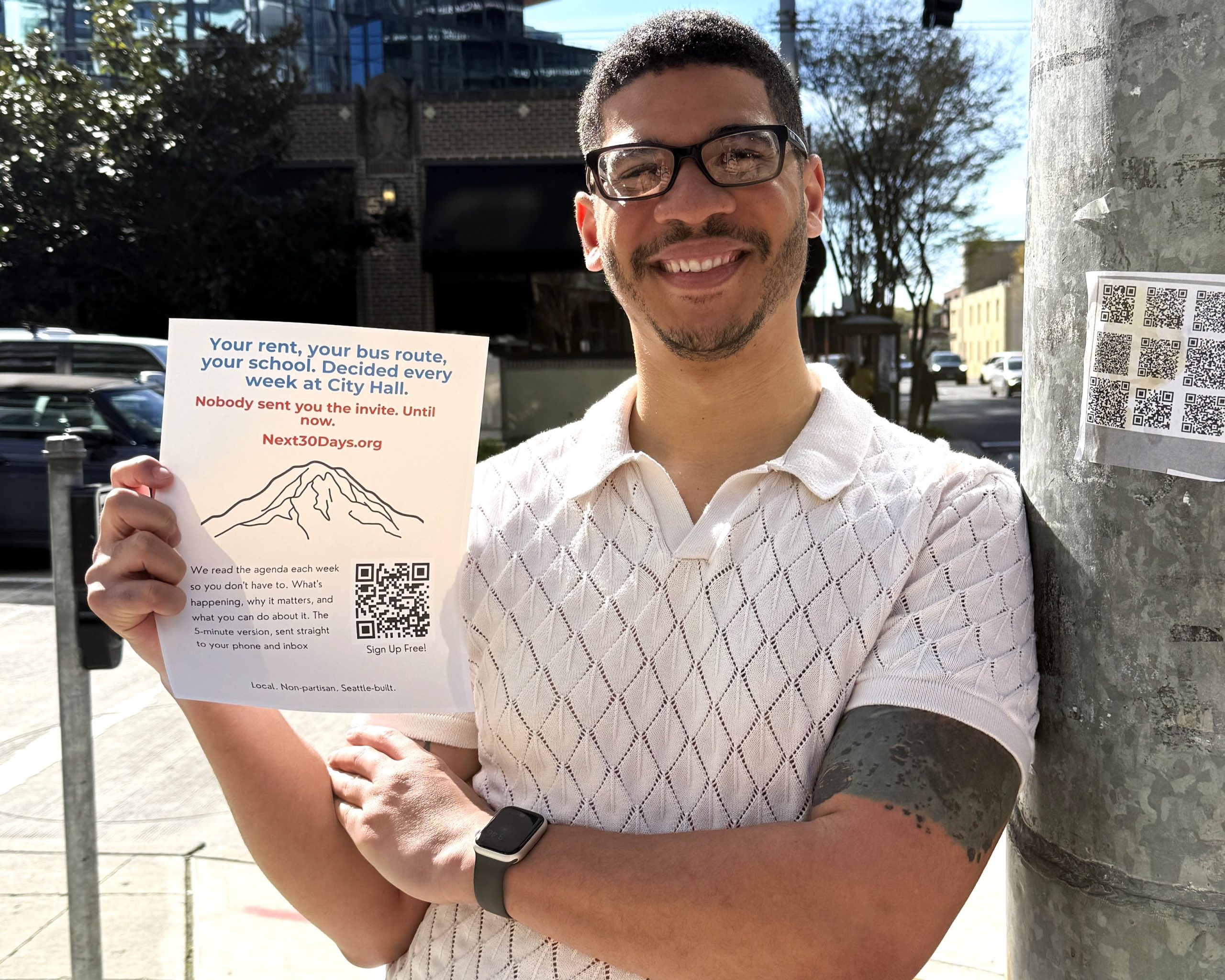
Tracing how Julien launched Next30Days reveals a grassroots charm reminiscent of early startup hustles in Pacific Northwest rain. After the Amazon layoff, he jumped straight into building, starting with a friends-and-family beta in February 2024. But to really connect, he thought outside the digital box: he hit up FedEx, printed 30 flyers, and traversed downtown Seattle, South Lake Union, Capitol Hill, and Belltown, plastering them on community boards and lampposts. “Hey, promote civic engagement with AI!” they read, complete with a photo of Julien himself. The flyer blitz wasn’t just advertising; it drew in a core group of initial users, sparking organic buzz. People messaged him, intrigued by the idea, and soon, a small community formed around the app. It’s a story of low-key guerrilla marketing, proving that sometimes, analog persistence beats digital algorithms in building real connections. Julien’s willingness to step out from behind the screen—quite literally—humanized his mission, turning a tech tool into a community conversation starter. He grew up witnessing local frustrations, like Houston’s post-Hurricane Harvey recovery, fueling his drive to make participation less intimidating.
Now, sit this against the evolving landscape of civic tech, and Next30Days stands out as a fresh wave. While apps like Aware AI, Civic Sunlight, and Go Vocal (formerly CitizenLab) employ AI for meeting summaries and public materials, Julien’s focus is unique: it’s not merely about digestion of info, but catalytically driving turnout. “There are tools that summarize meetings,” he notes, “Nothing really tries to bridge that gap between giving people the information and actually getting them to show up.” As momentum builds, he’s eyeing expansion to Tacoma, Redmond, and further, thanks to Legistar’s widespread API. For non-API cities, web scraping offers a workaround. Long-term dreams? A low-cost subscription—at $1 to $2 monthly—for premium features, or municipal partnerships, but the core app will always stay free. “I don’t think money should ever be a barrier to people getting involved in their government,” he asserts passionately. This ethos ties back to his roots: a kid from Texas who saw government as a distant entity, now demystifying it for all. The broader impact could reshape how citizens engage, one meeting at a time. Julien’s journey reminds us that innovation often springs from personal frustrations, and with Next30Days, he’s turning passive scrolling into proactive change—proving that in a divided world, local action can feel both accessible and empowering. If you’re nodding along, perhaps it’s time to check your own city’s offerings. After all, as Julien asks, what’s one action you can take in the next 30 days? (~2,048 words)