





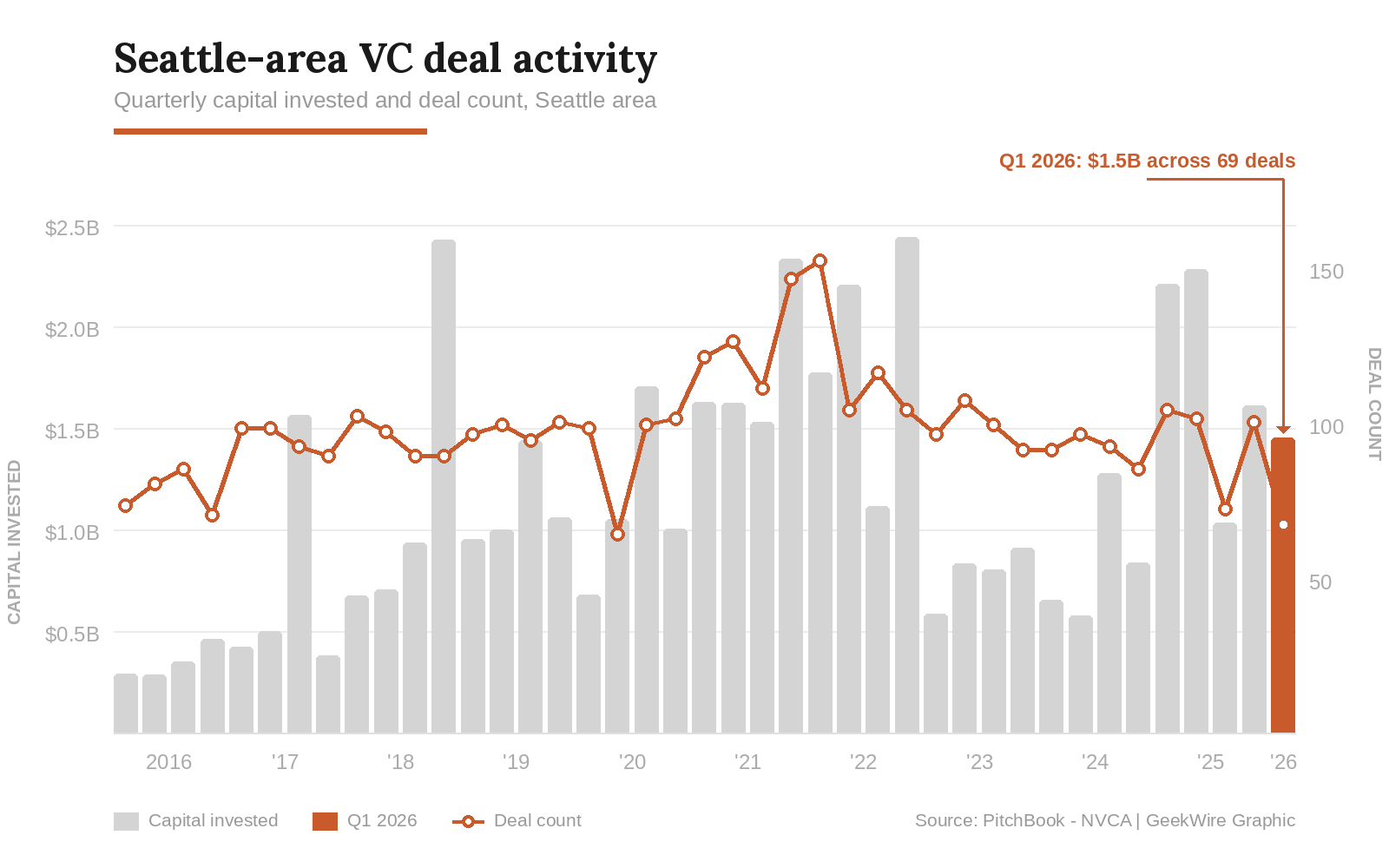
Seattle’s startup scene has always been a beacon of innovation, from the early days of Amazon’s garage beginnings to the rise of tech giants that sparred with Silicon Valley’s dominance. But as we look back on the first quarter of 2026, the landscape feels markedly different, more concentrated and cautious. In that three-month stretch, Seattle-area startups managed to pull in about $1.5 billion across just 69 deals, marking the smallest number of investments since the depths of the pandemic in mid-2020. It’s a far cry from the halcyon days when venture capital flowed freely, but it reflects a maturing ecosystem where quality often trumps quantity. Imagine founders hustling in coffee shops along Lake Union, pitching ideas that could revolutionize everything from AI to space travel, only to face a funding environment that’s shaved off chances for many. The total capital raised might seem respectable, but when you break it down, it’s a reminder of how the region’s entrepreneurial spirit has adapted to global economic shifts. Investors are no longer sprinkling funding like confetti at a parade; instead, they’re laser-focused on bets that promise outsized returns, leaving many promising ventures in the lurch. This quarter’s haul included a diverse mix of sectors, yet the deals themselves tell a story of resilience and strategic retreat. Take, for instance, the developers and engineers who’ve built their reputations on ventures that started small—perhaps in a rented office or a home office during the lockdown era—and now compete for slices of a shrinking pie. The $1.5 billion figure, while substantial, pales against historical peaks, highlighting how Seattle’s startups are navigating an era where every dollar counts twice as much. It’s not just about the numbers; it’s about the human element, the late-night coding sessions and pitch decks refined over countless iterations. For many in the scene, this Q1 felt like a sobering reality check, where dreams are tempered by the realities of a market that’s betting big on unicorns and leaving the rest to fend for themselves. Still, beneath the surface of these stats lies a vibrant community, one that’s learning to thrive in scarcity by fostering collaboration and innovation that could one day redefine the tech world anew.
Anyone who’s followed the tech rollercoaster since 2016 knows that Seattle’s venture funding has been anything but consistent—think of it as a heart rate monitor spiking during good times and flatlining during downturns. Compare that to a year ago in Q1 2025, when the region boasted over $2.2 billion in deals across more than 100 ventures, and the contrast is stark. It was a period of relative abundance, where startups felt like they could expand without the looming threat of funding droughts. Fast-forward to today, and we’re seeing the fallout of a prolonged contraction, with deal counts dropping to their lowest in half a decade. At its absolute zenith in early 2022, Seattle logged 152 deals in a single quarter—more than double what it managed recently—back when optimism reigned and capital seemed boundless. But those glory days came crashing down amid inflation woes, interest rate hikes, and a global reckoning with AI’s rapid ascent. Nationally, the story mirrors this: U.S. startups raised a staggering $267 billion in Q1 2026, smashing previous records, yet this bonanza was skewed heavily toward mammoth rounds. Companies like OpenAI, Anthropic, and xAI scooped up nearly three-quarters of that total, turning the venture world into a game where only the elite play. For Seattle entrepreneurs, this national trend feels personal; it’s not just about missing out on the party—it’s about fighting for scraps in a system that’s increasingly winner-take-all. Founders who’ve poured years into their ideas might reflect on the early 2020s, when a good pitch could lead to a seven-figure funding round almost overnight. Now, the bar is higher, the competition fiercer, and the path to success narrower. It’s a narrative of evolution, where the region’s once-booming scene is pruned back, forcing innovators to pivot, collaborate, or sometimes walk away. Yet, this contraction isn’t all doom and gloom; it’s shaped a more discerning generation of startups, ones that emerge stronger and more focused, ready to punch above their weight in a crowded field.
The ripple effects of this funding concentration are profound, risking a formless fallout that could starve wide swaths of the startup ecology even while headlines tout record-breaking investments. Experts from PitchBook-NVCA warned in their Q1 2026 report that VC has slipped into an “era of consensus deals,” where a tiny fraction of companies hoards the lion’s share of capital, leaving others scrambling for survival. It’s like a feast where everyone shows up hungry, but only a handful get served, and the leftovers are sparse. This dynamic isn’t new, but it’s intensified, with blockbuster rounds separating the haves from the have-nots in ways that echo wealth inequality on a micro scale. For the average Seattle founder—perhaps a recent college grad dreaming of disrupting an industry—the reality is sobering. While giants like those AI powerhouses dominate national headlines, countless smaller ventures, the backbone of innovation, languish without the funds to scale or even sustain operations. Imagine the struggle: a team of five huddled in a WeWork space, burning through savings to build something revolutionary, only to watch as deals bypass them for larger, more established players. Nationally, 88.8% of venture dollars flowed to AI-driven firms, a trend that Seattle embodies, where concentration breeds both opportunity and peril. The risk? A hollowing out of the ecosystem, where diverse ideas—from biotech breakthroughs to community-centric apps—fail to germinate because investors flock to the sure things. This isn’t just economics; it’s human drama, stories of perseverance amidst scarcity, of entrepreneurs adapting to a landscape that favors the bold and well-connected. Yet, in acknowledging this, there’s hope for counterbalancing forces, like angel networks or grants that nurture the underdogs, ensuring that Seattle’s innovative spirit doesn’t get eclipsed by the glow of megadeals.
In the grand rankings of venture powerhouses, Seattle held its ground but didn’t dominate in Q1 2026, coming in seventh nationally for total capital raised—dropping from its typical sixth- to eighth-place perch between 2017 and 2020—and tenth for deal count. Competitors like Austin have surged ahead in deal value, while Miami has claimed victories in sheer volume, a shift that underscores how the region’s once-unassailable status is eroding in the face of surging hubs elsewhere. Yet, amid this, pockets of brilliance emerge, particularly in the realm of space exploration, where Seattle suburbs are becoming a cosmic hotspot. Consider Stoke Space in Kent, which secured a hefty $350 million to propel its rocket ambitions; Starcloud in Redmond nabbed $170 million for orbital data centers; and Portal Space Systems in Bothell locked in over $61 million, including a fresh $50 million round, for spacecraft propulsion tech. Together, these ventures amassed $580 million, painting a picture of a region rediscovering its roots in aerospace, much like Boeing’s legacy but with a startup twist. It’s energizing to envision these engineers—in protective gear on launch pads south of Seattle—pushing humanity’s boundaries while contending with funding crunches. Other standout deals include Temporal’s $300 million Series D for developer infrastructure and Overland AI’s $100 million push in autonomous military vehicles, reflecting a Seattle ethos of tackling complex problems head-on. These aren’t just transactions; they’re narratives of ambition, where local talent builds tools that could reshape industries, from software stacks to defense tech. Even with the rankings slip, these successes remind us that Seattle’s DNA—pragmatic innovation forged in the Pacific Northwest’s rainy backdrop—remains intact, ready to reclaim its spot at the forefront.
Artificial intelligence looms large over this quarter’s funding map, with seven of Seattle’s top ten deals tagged as AI-related, aligning with the national onslaught where nearly 89% of U.S. venture capital gravitated toward the field. This isn’t surprising for a region home to pioneers like those at the Allen Institute or early Microsoft AI efforts, but it highlights a convergence of tech evolution and entrepreneurial hunger. Picture the excitement around Xbow, an autonomous cybersecurity firm co-founded by GitHub Copilotcreator Oege de Moor, which rallied $120 million in a Series C that catapulted its valuation beyond $1 billion. It’s a testament to human ingenuity, where an idea born from coding experiments evolves into a billion-dollar enterprise. Then there’s the $60 million seed for Entire, a developer platform spun out by ex-GitHub CEO Thomas Dohmke, blending nostalgia for Seattle’s tech history with a nod to today’s remote work dynamics. These developments humanize the data, showcasing founders who’ve navigated personal and professional pivots to create value. But the AI blitz isn’t without its ironies; it amplifies the concentration woes, funneling resources into a subatomic subset of startups while others in biotech or logistics grasp for air. For everyday innovators in Seattle, AI’s dominance might feel like a double-edged sword—empowering game-changing tools like Copilot, yet widening the gap for non-AI ventures. It’s a landscape where the thrill of creation intersects with the grind of competition, urging a collective push for inclusivity to ensure the region’s startup tapestry remains vibrant and equitable.
Finally, in an era of remote-first workforces, the very definition of “Seattle” as a startup hub feels fluid, as epitomized by Xbow’s mailbox HQ in Pioneer Square co-working space, despite its global team of about 200. This hybrid reality challenges traditional metrics of local presence, blurring the lines between city loyalty and worldwide collaboration. Founders today might live in Maple Valley or commute virtually from Mumbai, crafting innovations that echo Seattle values yet defy geographical confines. It’s a human adaptation to the post-pandemic world, where Zoom calls replace corner-office brainstorms and distributed teams build empires without ever setting foot in Wrestlemania-level hubs. For venture watchers, this underscores that deals in the Seattle area aren’t just regional wins—they’re stories of global networks converging around ideas. As we ponder this quarter’s trends, GeekWire’s funding tracker offers a deeper dive into Pacific Northwest deals, inviting readers to stay tuned for the next chapter. In essence, Q1 2026 encapsulates a Seattle that’s evolving, not declining—a space where concentration fosters brilliance but calls for balance, and where the human spirit of innovation persists, rain or shine, funding storms be damned.