





The vast, sun-baked landscape of South Texas, situated approximately one hundred miles southeast of San Antonio, is a region characterized by its rolling prairies, hard-working communities, and a climate that can swing from punishing drought to catastrophic deluge in the blink of an eye. In towns like Beeville, life generally moves at a measured, peaceful pace, with residents well-accustomed to the quiet rhythms of rural life. However, on a recent, deceptively ordinary Saturday, the skies opened with a sudden, violent intensity that caught the entire region off guard. This area of Texas is notorious for its low-water crossings—economical road designs that allow seasonal creek beds to flow over paved roads during heavy rains rather than routing them over costly bridges. In dry weather, these crossings look perfectly safe, harmless dips in the asphalt that drivers navigate daily without a second thought. Yet, when rapid storm systems stall over the parched clay of South Texas, the dry earth cannot absorb the volume of water quickly enough, turning these crossings into instant, violent funnels for fast-moving runoff. On this particular afternoon, the rain fell with such velocity and volume that it immediately overwhelmed the local waterways, transforming the peaceful terrain into a hazardous maze of rising waters. Before emergency crews had a moment to place warning barricades, the flash flood had already claimed the crossing. The transition was so instantaneous that a passing vehicle reached the dip in the road just as a torrent of brown, churning water swept across the asphalt, rendering escape nearly impossible. This sudden convergence of a routine drive and a natural disaster set the stage for a heart-stopping, life-or-death struggle, demonstrating how quickly the familiar comforts of our daily lives can be completely erased by the raw, unyielding power of a flash flood.
To fully understand the harrowing nature of this event, one must imagine the deceptive simplicity of the moments leading up to the crisis from the driver’s perspective. It was a typical Saturday, perhaps filled with mundane chores, a trip to the store, or a visit to nearby relatives, with the comforting presence of a tiny, innocent baby secured safely in the backseat of the vehicle. As the rain intensified, transforming from a heavy drizzle into a blinding, deafening sheet of water that hammered relentless rhythms against the roof, the driver’s world shrank to the view through the sweeping arcs of the windshield wipers, creating a sense of isolation from the outside world. It is incredibly easy to criticize a driver’s decisions in hindsight, but human psychology is naturally wired to assume that familiar routes remain safe, leading many to underestimate the depth and velocity of water crossing a roadway. Just as the vehicle approached the low-water crossing, a local fire chief who happened to be nearby realized the imminent danger and stood in the pouring rain, frantically waving his arms in a desperate attempt to flag down the vehicle and halt its progress. Unfortunately, trapped behind a fogging windshield, amidst the roaring static of the downpour and the distracting stress of bad weather, the driver did not see the warning in time. The car rolled forward into the water, and in an instant, the terrifying physics of buoyancy took over. Within minutes, the water level rose up to the top of the wheels, stripping the tires of their traction and leaving the heavy vehicle at the mercy of the current. The sickening sensation of losing control—feeling a multi-ton machine begin to float, spin, and drift helplessly toward the surging depths of a flooded creek—must have been a paralyzing nightmare, as the driver realized they had become trapped in a floating metal cage with their most precious cargo.
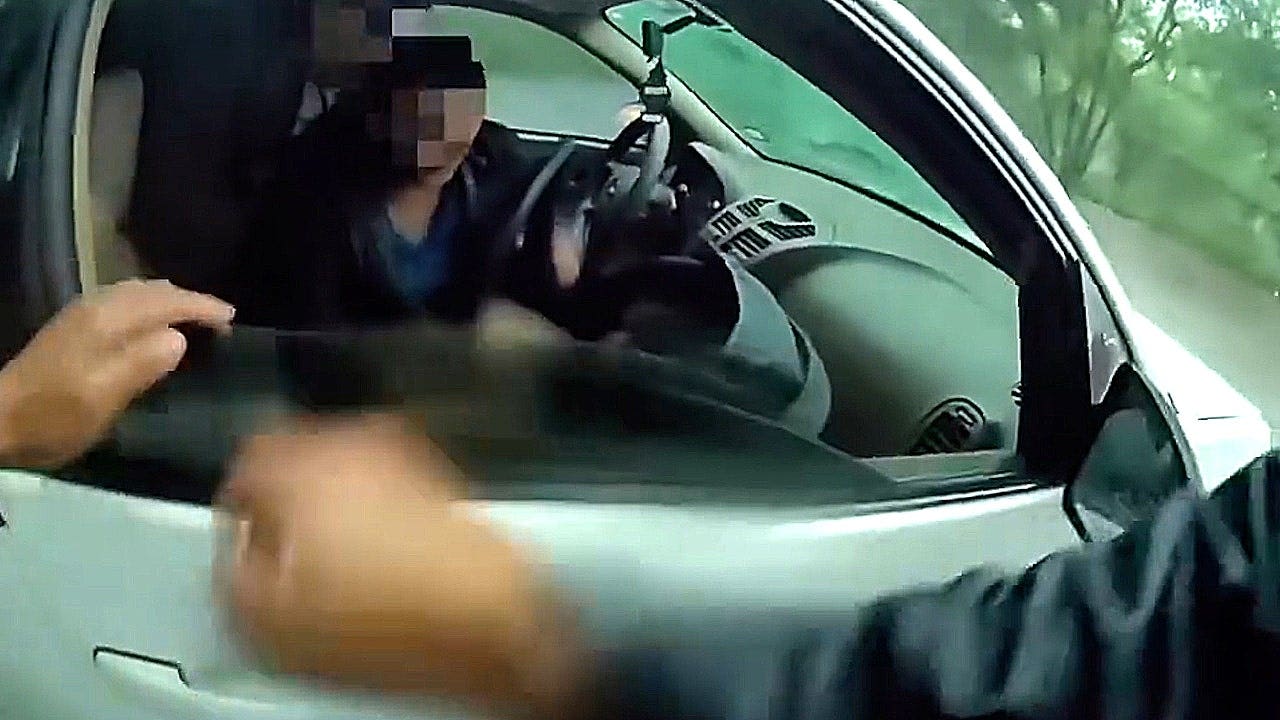
The sheer terror of this escalating crisis and the extraordinary courage of the response were captured in vivid, raw detail by the body-worn camera of an arriving police officer, providing a chillingly human perspective on what it means to face a life-or-death emergency. The footage opens with a scene of utter chaos: the wind howling through the trees, the grey sky releasing a punishing downpour, and the brown, muddy water of the flooded creek swirling violently around the stranded vehicle, slowly pushing it toward the deeper, more dangerous currents of the creek bed. As the responding officers and firefighters arrived on the scene, still trying to evaluate the fast-moving water and establish a safe rescue line, the tense atmosphere was suddenly pierced by a sound that would strike terror into the heart of any human being. Rising above the deafening roar of the elements was the frantic, desperate scream of the driver, crying out to the nearby first responders that a baby was trapped inside the water-logged car. In that singular, heart-stopping moment, all calculated protocols and cautious evaluations instantly evaporated, replaced by pure, instinctive human heroism. Without a single moment of hesitation or a thought for his own personal safety, the responding police officer lunged forward into a dead run, charging headlong into the treacherous, fast-moving floodwaters. The camera bounced and jarred violently as he fought against the immense lateral pressure of the current, which threatened to sweep his legs out from under him with every step. Pushing through the waist-deep torrent with pure adrenaline fueling his muscles, he reached the passenger door of the drifting vehicle, determined to reach the innocent child before the dark, rushing waters of the creek could wash the vehicle completely away into the dark depths.
What followed was a breathtaking demonstration of tenderness, skill, and absolute selflessness amidst the violent hostility of the storm, showcasing the very best of human nature in a moment of supreme vulnerability. Forcing the car door open against the heavy pressure of the rushing water, the officer reached into the dark, damp cabin and firmly grasped the baby’s car seat carrier, elevating the fragile infant above the rising water levels inside the vehicle. Clutching the carrier tightly to his chest like a shield, protecting the sleeping child from the freezing spray, he began the grueling struggle back to safety, stepping carefully through the slippery, invisible hazards of the submerged roadway while the current tugged relentlessly at his uniform. As he emerged onto the relative safety of the wet embankment, carrying the precious bundle, the collective focus of the rescue team shifted to protecting this tiny life from the elements. Another first responder ran forward without hesitation, quickly stripping off his own heavy, protective jacket and gently draping it over the infant’s carrier, creating a warm, dry sanctuary to shield the newborn from the cold, stinging rain. The visual of this simple, profound gesture—a rugged rescuer gently wrapping a wet, shivering baby in an oversized jacket—offers a powerful testament to the deep instinct of protection that binds us together as human beings. Simultaneously, other members of the rescue crew worked quickly to assist the terrified driver out of the vehicle, guiding them through the current to dry land. Miraculously, despite the horrifying speed with which the water rose and the immense danger of the situation, both the baby and the driver were rescued without a single physical injury, turning what could have easily been an unspeakable tragedy into a triumph of human spirit and quick thinking.
While this specific rescue ended with tears of relief and warm blankets, it occurred against a backdrop of severe, widespread weather across the state of Texas that served as a grim reminder of how dangerous these natural events truly are. During this exact period of intense storm systems, flash flooding across various Texas river basins had tragically claimed several lives, leaving emergency crews elsewhere racing against time in a desperate search for other missing individuals. This sobering reality underscores the absolute unpredictability of flash floods, which can turn a familiar, peaceful neighborhood street into a deadly trap in under five minutes. When we are encased in the comfortable, dry interiors of our modern vehicles, we often suffer from a psychological illusion of safety, believing that our heavy SUVs and trucks can easily conquer a few inches of moving water. In reality, the physical laws of nature are completely indifferent to our schedules and our confidence; it takes only twelve inches of rushing water to sweep a small car off the road, and just two feet of water can easily carry away a heavy truck or SUV, turning a vehicle into an uncontrollable boat. For the first responders of Beeville, this rescue was not just another day on the job; it was a profound emotional experience that highlights the immense psychological weight these men and women carry every time they put on their badges and uniforms. To hear the scream of a parent fearing for their child’s life, and to feel the cold, heavy pull of a flooding creek, is an experience that stays with a person forever, reminding us all of the fragile thread upon which human life hangs and the immense gratitude we owe to those willing to risk everything to keep that thread from snapping.
In the aftermath of this miraculous escape, the Beeville Police Department made the conscious decision to share the dramatic body camera footage not as a piece of casual entertainment, but as a solemn, deeply human warning designed to save lives during future storms. They used the video to emphasize the urgent, life-saving doctrine of “Turn Around, Don’t Drown,” reminding the public that what looks like a shallow, negotiable pool of water can rapidly transform into a washing machine of currents capable of sweeping away any vehicle. Their public statement was filled with a sense of urgency, pleading with drivers to respect physical barricades and reminding them that bypassing these warning signs is not only an act of extreme, life-threatening recklessness but also a serious criminal offense. In our modern, fast-paced society, we are often consumed by the pressure of our daily schedules, convinced that missing an appointment, delaying a delivery, or taking a long detour is an unacceptable inconvenience. Yet, transport yourself back to that flooded crossing in Beeville, where a baby’s life hung in the balance of a single, desperate rescue, and the perspective shifts instantly: no errand, no shortcut, and no destination is ever worth risking your life or the irreplaceable safety of your family. As the waters receded and the community of Beeville returned to its quiet routine, the image of that small infant safely wrapped in a first responder’s jacket remained as a beautiful, enduring reminder of our shared responsibility to look out for one another. Let this dramatic rescue serve as a lasting lesson of caution, an invitation to slow down, and a powerful tribute to the everyday heroes who stand ready to plunge into the dark, rushing waters of adversity to bring us safely back to shore, proving that humanity’s greatest strength is its love and care for the vulnerable.