






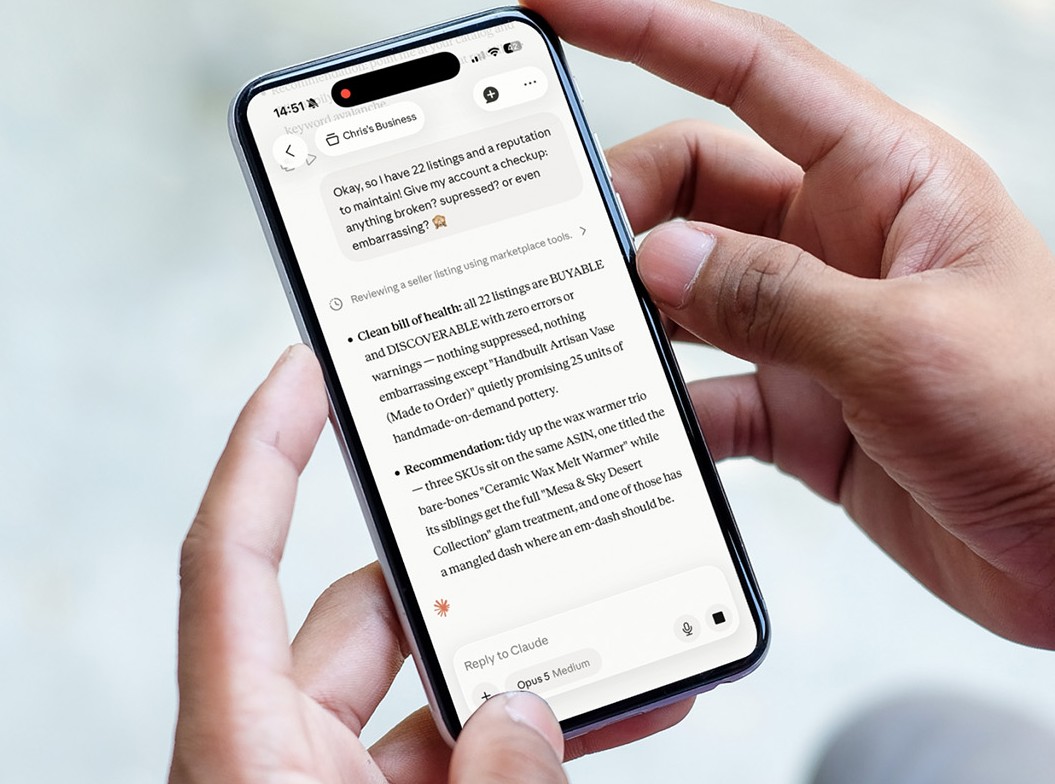
Imagine you run a small online business selling, say, artisan coffee equipment, and your day is spent juggling inventory, pricing, customer questions, and advertising campaigns. To manage all that inside Amazon’s seller portal, you’d normally have to log into Seller Central, click through a maze of menus, run reports, and manually make changes. Amazon’s new idea is to make that drudgery disappear. At its annual Accelerate conference in Seattle this week, the company unveiled a suite of AI tools designed to let independent sellers run their Amazon operations from the AI assistants they already use—Anthropic’s Claude or Amazon’s own Quick assistant. The centerpiece is a plugin that connects a seller’s Amazon account to those assistants, allowing them to check inventory levels, adjust prices, update listings, and review performance metrics without ever opening Seller Central. Think about what that means in practice: instead of opening a desktop portal to check whether a product is about to go out of stock, a seller can simply ask Claude or Quick, “What’s my inventory level?” and then approve a suggested reorder. Mary Beth Westmoreland, Amazon’s vice president of Worldwide Selling Partner Experience, put it plainly: “Our vision was that they would never have to log into Seller Central. We would just bring it to them where they work.” This is a meaningful shift. For years, Seller Central has been the command center for independent merchants, but Amazon now recognizes that sellers have moved their daily workflows into other tools, often powered by AI. The company says about 90% of sellers already use some form of outside AI in parts of their operations. The new plugin essentially formalizes that reality, turning Claude or Quick into a front door for Amazon selling. It also signals a broader ambition: Amazon wants to be more than a store and logistics network. It wants to be an AI-enabled partner in how sellers run their businesses, even when the interface isn’t Amazon’s own.
The stakes behind this announcement are enormous, and they go far beyond convenience. Independent sellers account for more than 60% of units sold on Amazon worldwide. The fees they pay—referral fees, fulfillment fees, storage charges, and a long list of other expenses—generated $46.8 billion in Amazon’s second quarter, which was actually more revenue than Amazon’s cloud computing business, AWS, brought in during the same period. Advertising, another major cost for sellers, is also a huge part of Amazon’s earnings. The sponsored listings that sellers buy to promote their products brought in $19.8 billion in the quarter, up 26% from a year earlier. That money is central to Amazon’s business model, but it has also made the company a target. The Federal Trade Commission’s antitrust case against Amazon, now set for trial in March 2027 in federal court in Seattle, accuses Amazon of overcharging sellers and punishing them for offering lower prices on other platforms. Amazon denies the allegations and says the lawsuit is “wrong on the facts and the law.” The FTC, in its original complaint, argued that advertising has become “virtually necessary for sellers to do business,” and that Amazon’s combined fees swallow close to half of many sellers’ revenue. Sellers themselves are a tough, pragmatic crowd. They are not easily seduced by flashy announcements. At last year’s Accelerate, the loudest ovation went not to an AI feature but to a housekeeping fix: Amazon ended commingling, the practice of mixing identical inventory from different sellers in its warehouses. That change gave sellers more control over their own products and less fear of being blamed for issues caused by someone else’s goods. The moment was a reminder that what sellers want most from Amazon is fairness and transparency, not just clever technology.
For all the broader drama, Amazon has kept the first integration deliberately simple. Connecting a seller account to Claude takes about 60 seconds and requires no coding. The plugin pulls a seller’s product listings, inventory levels, sales analytics, and performance metrics into the assistant. From there, a seller can type natural-language questions like “Which of my products are running low?” or “What would happen if I raised prices by 5%?” Because the connection runs both ways, the assistant can also take action—updating a listing, adjusting a price, or changing inventory settings—in much the same way that Seller Assistant, Amazon’s built-in AI, does inside Seller Central. That sounds convenient, but it also raises concerns about trust and control. Amazon says sellers choose which types of data the plugin can access, and must approve every action before it is carried out. The company also says it does not see the other business data stored in a seller’s Claude or Quick environment. Imagine giving a new employee access to your store: you’d want them to see what they need, but not everything, and you’d certainly want to sign off on any major change. That’s the model Amazon is trying to create. The plugin is being offered in beta in Amazon’s U.S. stores, with international expansion to follow. Westmoreland stressed that this is only the beginning, adding, “We’ve built this in a way that should be modular enough for us to continue to publish plugins.” In other words, Amazon is not committing to a single AI assistant as the future interface for e-commerce. It is building a connector layer that can be extended to other platforms over time. That is a sensible hedge in a fast-moving market, but it also sets up a new kind of relationship between Amazon and the AI industry. Amazon is simultaneously a platform, a customer, an investor, and a gatekeeper, and the plugin is a test of how those roles fit together.
The timing of the announcement is no accident. Days after Amazon blocked Meta’s Muse, a new AI agent designed to shop on behalf of consumers, it is opening the door to AI agents on the seller side. That may seem contradictory, but there is a clear logic. For Amazon, the seller tools are a business-to-business service: merchants choose to use Claude or Quick, and Amazon can set explicit boundaries about data and actions. Consumer shopping agents, by contrast, could interfere with the browsing, advertising, and recommendation experience that makes Amazon’s retail business work. Amazon wants to control how automation touches its customers even as it embraces automation among its sellers. There is also a financial relationship at work. Amazon is one of Anthropic’s largest investors, and Claude models already power Seller Assistant, the AI technology built into Seller Central that answers sellers’ questions and, with their approval, updates listings and prices. The new Claude plugin is therefore less of a wild experiment than a logical extension of an existing partnership. It is also a way for Amazon to make its seller tools part of the broader AI ecosystem, rather than a siloed feature trapped inside Seller Central. For sellers, this means they no longer have to choose between their preferred assistant and their Amazon business. They can live in Claude and still run their store. But it also means Amazon is setting the rules for how AI agents participate in its marketplace. Amazon’s public stance is that outside agents must identify themselves and follow the rules of the sites they use. That applies to consumer agents like Muse, but it also creates a framework for seller agents. By making the rules explicit, Amazon can ensure that any AI assistant operating on its marketplace is traceable and accountable. It is a way of maintaining order while still inviting innovation.
Beyond the Claude plugin, Amazon is making its own Seller Assistant smarter and more proactive. The upgraded version now remembers a seller’s pricing patterns, inventory cycles, and growth goals from one session to the next. So a seller returning with a question like “Should I lower prices for the holiday season?” doesn’t have to re-explain their entire strategy; the assistant already knows the context. Amazon is also introducing background automations that monitor a seller’s business continuously, watching inventory levels, sales trends, and account health, and can act on those observations with the seller’s prior approval. This is the difference between asking a colleague for a report and having a colleague who quietly watches the store, notices you are about to run out of a best-seller, and prepares a reorder for you to approve. Then there is the new canvas feature in Seller Assistant. It is a visual workspace generated on the fly from a seller’s live data. Instead of looking at static spreadsheets, sellers can ask questions like “Compare my current pricing with last quarter” or “Diagnose why my ad campaign underperformed,” and the canvas will draw a visual response. It redraws as the seller asks follow-up questions, making the whole experience feel more like a conversation than an analytics dashboard. Amazon is also giving every primary selling account holder worldwide a free 12-month subscription to Amazon Quick Plus, available through Dec. 31, 2026, with two additional co-workers covered at no cost. That is a concrete incentive for sellers to try the new tools. It might look like a promotional perk, but it is also a strategic move: the more comfortable sellers become with managing their businesses through AI, the more integral Amazon’s AI ecosystem becomes to their daily routines. Despite all the advances, Amazon’s approach remains measured. The company is not claiming that AI will solve every problem a seller faces; it is trying to reduce the friction that has made Seller Central feel like an obligation rather than a tool.
All of this lands at a moment of leadership change in Amazon’s seller organization. Amit Agarwal, a 27-year Amazon veteran who launched the company’s India marketplace, took over selling partner services in February. Dharmesh Mehta, who previously ran the group, moved into a new role as technical advisor to CEO Andy Jassy. Changes like this often signal a shift in priorities, and Agarwal’s background building a marketplace from scratch in a complex, fast-growing region suggests a more entrepreneurial approach to the seller platform. The larger context remains the FTC lawsuit and the constant scrutiny over how Amazon treats the merchants who make its marketplace so vast. No AI plugin can resolve that legal and political tension. What the AI push can do is shift the conversation toward empowerment and efficiency. There is a genuine appeal to the vision: a small seller with a handful of products can now have an AI assistant that monitors their store as carefully as any corporate team, suggesting price moves, spotting problems early, and even helping with growth strategy. At the same time, Amazon controls the underlying data and marketplace, and it is setting the rules for how AI agents can participate. That gives Amazon a powerful position in the next phase of e-commerce, but it also invites new questions. Will the tools work equally well for a tiny seller in Tennessee and a major brand in Germany? What happens to the data generated by these conversations? Amazon says sellers have control, and it has promised not to see information in their assistants. But trust, especially among sellers, is earned slowly. The loudest applause at last year’s conference went to a simple change that gave sellers more control over their inventory. This year’s AI announcements are more spectacular, but they will only matter if they make sellers’ lives genuinely better. The recognition that sellers work in a multi-tool world is a good first step. In the end, Amazon has to show up where its sellers are—not merely wait for them to log in to Seller Central. If that happens, the future of selling on Amazon may feel less like wrestling with a portal and more like having a knowledgeable partner.